


The growing interest in the UAE’s natural world has been highlighted by the global success story of a book about the subject.
A Natural History of the Emirates, published formally by Springer Nature in 2024, documents the UAE's wildlife, ecosystems and habitats – from heat-tolerant corals in the Arabian Gulf to wildlife in mountain wadis – and the challenges they face.
Data supplied by the publisher shows the free-to-access online book had at least 507,000 downloads as of Thursday – and not just in the UAE, but as far afield as China and Nigeria. This number is far above comparable Springer publications. For example, in 2025, the book had 207,541 downloads, with other works at 3,792.
The book, which is also available in hardback, has 146 citations, meaning it is being used to inform research about the UAE and its environment.

“I expected to see 25,000 to 30,000 downloads,” John Burt, the book’s editor and professor of biology at New York University Abu Dhabi, told The National.
“I did not expect anything even remotely along the lines of the success that we've had,” he added, paying tribute to the more than 20 other authors involved. “We all put in a considerable amount of work to pull this together and it's nice to see that reflected.”
The book explores how the UAE is more than cities and rolling desert. It dives into the heat-tolerant corals of the Gulf, the thriving marine life near the country’s shores and how the mountains and wadis sustain plant and animal species.
It also offers suggestions about how to sustain and preserve the UAE’s natural environment in the face of climate change and an increase in the development and population of the country. Its ideas to bolster the environment include strengthening environmental policies and encouraging the use of nature-based solutions.
UAE's wildlife conservation efforts - in pictures
-
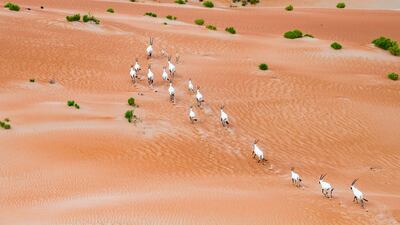
The largest population of Arabian oryx now lives in protected areas in the UAE after previously being listed as extinct in the wild. All photos: Environment Agency - Abu Dhabi -
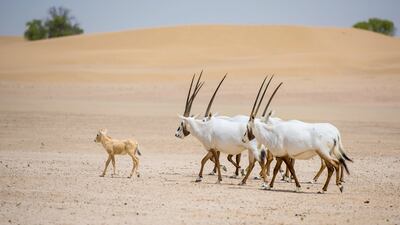
Arabian oryx were reclassified as vulnerable by the International Union for the Conservation of Nature in December 2023 -
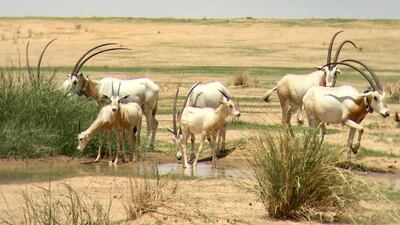
Environment Agency - Abu Dhabi has also spearheaded a repopulation programme for scimitar-horned oryx -
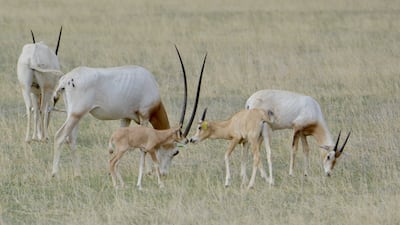
Scimitar-horned oryx calves with their mothers in Chad -
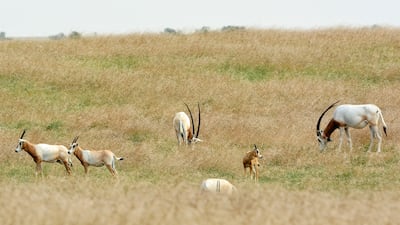
The Sahelian plains of Chad are now home to more than 600 scimitar-horned oryx -

The agency released six Dama gazelles into a wildlife reserve in Chad in May 2024 -
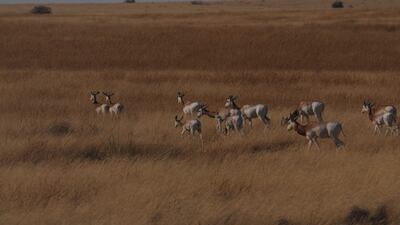
The Dama gazelle is classified as critically endangered -
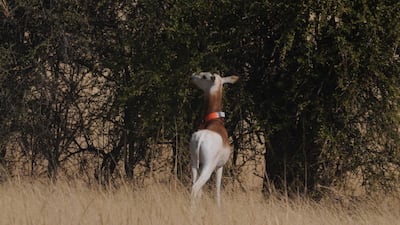
Three of the gazelles are equipped with satellite tracking devices, so the team can monitor the animals’ progress in the reserve -

The agency has also helped repopulate the addax antelope in Chad -
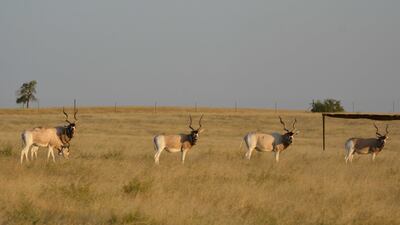
The addax, also known as the white antelope, is native to the Sahara -

The addax is classified as critically endangered


“We are already living in quite a marginal environment,” said Prof Burt. “And with the amount of urban development that's happening, plus the pressures from climate change, there's a risk that we push some of these organisms and ecosystems over the edge. What we're hoping with that final chapter is not to talk about what's going wrong, but rather to talk about the amazing natural assets we have and why we should protect them.”
With more than 450 colour images, the 24-chapter book is reaching a broad audience, he said, including chief executives and astronauts. Plans for an Arabic edition are also advancing.
“That's where I think we're really going to get the buy-in from the people who really count here, which are the decision makers in the UAE government," Prof Burt added. He said the book had “100 per cent" raised awareness. “I would like to see it have more impact at the policy level.”
It is also hoped that the book could be used in schools to educate youngsters about the wonders of the UAE’s natural world. “What I'm really hopeful for is, once we get this translated into Arabic, we can convert what is in this book into material that's useful for someone who's in kindergarten, all the way to grade 12."
Looking ahead, Prof Burt said every day brought new insights into the natural world. An updated second edition could be useful in the future, particularly because some environments – such as the UAE’s sabkhas, or salt flats – remain prime areas for research.
“The environment is changing and we're learning more,” he said. “Watch this space.”

