


Heavy fog spread across much of the UAE on Wednesday morning, as a red alert was issued for Abu Dhabi for the second day in a row.
Poor visibility on roads across the country followed a warning from the National Centre of Meteorology of dense fog, starting from around midnight until 10am on Wednesday.
Visibility was down to a few metres in some areas of the capital, including low-lying Yas Island. The streets were eerily quiet as some commuters put off their drive into work and waited for the fog to clear.

Abu Dhabi Police were positioned at the side of the main motorway between Dubai and the capital, waving at heavy goods vehicles to pull over and wait for conditions to clear. The speed limit was reduced to 80kph on that road and several others.
Abu Dhabi Airport's live flight status board appeared to show little, if no, disruption as of about 8am.
The forecast for the week ahead suggested fog could persist in coastal areas and islands.
-
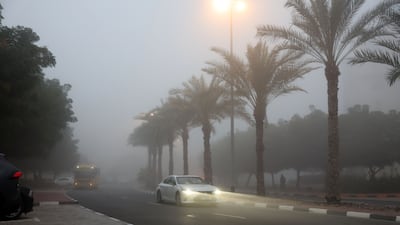
Fog across parts of the UAE led to a red alert being issued. All photos: Chris Whiteoak / The National -

Visibility was reduced to a few metres in some areas -

Off to school as fog blankets Dubai -

Off to school as fog blankets Dubai -
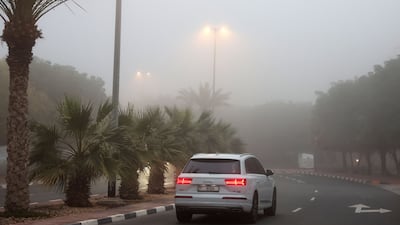
Morning fog in Dubai


Precautions
Authorities warned motorists against using hazard lights while driving, stressing the practice is dangerous and punishable under UAE traffic law. Experts cautioned that fog-related crashes often result in deadly pile-ups.
Brig Jumaa bin Suwaidan, director of traffic at Dubai Police, said the force had more police patrols on Sheikh Mohamed bin Zayed, Emirates, Sheikh Zayed, Al Khail and the Dubai to Al Ain roads.
Brig bin Suwaidan said the force barred lorries from the roads temporarily and asked truck drivers to stop in designated parking areas. “There is a difference in speed between the trucks and light vehicles, which raises the possibility of accidents in poor visibility.”

Driving safely in fog
Thomas Edelmann, managing director of Road Safety UAE, said people drive too fast in the UAE when it is foggy. The organisation recommends that drivers slow down in poor visibility and Mr Edelmann said drivers should allow longer for their journey.
"Maybe they're going too fast because their initial planning is not good. It's all about being extra careful, about the time considerations," he said.
"When we know it will take longer, normally we have to start earlier, we have to plan our trip better, maybe we try to stay off the roads altogether or we wait until the forecast is [for the fog to have] disappeared or we ask our boss if we can work from home. People have a tendency to run late and they try to catch up on lost time on the roads, and this is especially dangerous in foggy conditions."
He said that when visibility is good, the safe time to maintain from the vehicle in front is two seconds, but when it is poor, drivers should leave at least five seconds.
"Of course, it goes without saying, no [use of] hazard lights. Hazard lights are only for stationary vehicles, not for vehicles that are moving," Mr Edelmann said.
In bad weather Road Safety UAE recommends drivers use low-beam headlights and front and rear fog lights.
If visibility is almost zero, the organisation advises drivers should park on the side of the road and put their hazard lights on, or wait at a petrol station or rest area.
Is fog more common than it used to be?
Research at Khalifa University in Abu Dhabi indicates that periods of fog lasting for several days in the UAE have become more common, although the severity may be decreasing.
As previously reported, the scientists believe fog is more regular partly because a warmer atmosphere holds more water vapour.
“Long-term studies show that since the 1980s, fog events have been happening more frequently and are lasting longer,” said Dr Diana Francis, an assistant professor and head of the Environmental and Geophysical Sciences (Engeos) Laboratory at Khalifa University in Abu Dhabi.
“In our research we identified that this is linked to climate change, which is making the lower atmosphere warmer and more humid.”
This extra moisture, along with weather patterns that bring calm winds and stable conditions, means that fog forms more easily and persists for longer, Dr Francis said.
”Moist air flowing inland from the Arabian Gulf and strong night-time cooling over desert land also play a key role,” she added.
Research has also found, however, that increased urbanisation means less dust is whipped up into the air, so fog is sometimes not as dense.

