

Calls have been made for stronger protection for turtles after a study found that the creatures are under some of their greatest pressures in UAE waters.
Fishing, shipping and oil and gas infrastructure could all affect turtles in the Gulf, analysis by a team of international scientists indicates.
Only a fraction of the animals’ Gulf habitats are covered by marine protected areas, according to the research, and even in these, there may be much human activity.

The Environment Agency Abu Dhabi has said that it has measures in place to protect sea turtles over and above those offered by protected areas.
In the study, researchers looked at the green sea turtle and the critically endangered hawksbill sea turtle.
They determined how much pressure the turtles were under by developing a cumulative exposure index (CEI) based on factors such as the extent of fishing and shipping. The highest CEI values in the Gulf were in UAE waters.
The study’s first author, Dr Forough Goudarzi, of Shahid Beheshti University in Tehran, said that “improvements in protection are absolutely necessary” in the Gulf.
“Our study showed that most foraging areas are affected simultaneously by several activities such as intense fishing, dense shipping traffic, and proximity to oil and gas infrastructure,” she said.
“The cumulative exposure index revealed that only a few foraging sites can really be considered low-risk. This was surprising because it shows that even areas that were thought to be relatively undisturbed are in fact under considerable anthropogenic [human] pressure.”
She added that the UAE’s high CEI results reflected “its position as one of the most industry and commercially active” places in the Gulf.
“There are very high levels of shipping, fishing and coastal development concentrated in relatively shallow waters that also serve as key foraging areas for sea turtles,” she said.
How can the situation improve?
Dr Goudarzi said that to protect turtles in UAE waters, the focus should be on mitigating or reducing the ecological effects of economic activities, rather than simply restricting them.
Practical measures that could include, she suggested, rerouting shipping lanes away from the most sensitive areas.
Seasonal restrictions on fishing in busy turtle zones, or limiting the use of harmful fishing gear, may also help.
Better monitoring and enforcement of existing MPA regulations, and strengthening environmental assessments for new coastal and offshore projects are other measures, Dr Goudarzi said.
She said that the study indicated that while Marine Protected Areas were essential, in the Gulf, they did not on their own provide sufficient protection.
“The extent and intensity of human activities, such as fishing, shipping and oil extraction, make it clear that we need to improve both the size and management performance of these protected zones,” she said.
Better co-operation is needed between Gulf nations to control activities that threaten turtles, Dr Goudarzi said, especially as foraging grounds may be intersected by two or three national exclusive economic zones.
The UAE, she said, appears to act responsibly in marine conservation. However, with about 11 per cent of its waters under protection, it is “far” from the goal of a major biodiversity framework that 30 per cent of land and sea should be under protection by 2030.
The new study, written by four scientists in Iran and Greece, has been released in Social Sciences Research Network as a pre-print, meaning that it has not been peer reviewed.
With a population that is decreasing, the hawksbill sea turtle is classified by the International Union for Conservation of Nature as critically endangered.
How much progress has been made?
After decades of conservation measures, the green sea turtle, by contrast, was recently classified by the IUCN as being of least concern, a three-category improvement on its previous designation as endangered. Its numbers have increased 8 per cent since the 1970s, the Turtle Foundation has reported.
However, Dr Goudarzi said that this did not mean that they were out of danger in regions such as the Gulf, because high levels of human activity, including climate change as well as oil spills, shipping and fishing, meant that there could be localised threats that did not show up in global assessments.
“Even with a global status of ‘least concern’, local populations may still be declining or facing unsustainable pressure,” she said.
Environment Agency Abu Dhabi said that it runs “one of the region’s most comprehensive sea turtle conservation programmes”.
It undertakes regular population monitoring, aerially surveying more than 8,000 square kilometres. The most recent survey, in 2024, estimated that there were about 7,949 sea turtles in UAE waters.
“Sea turtles have been monitored in Abu Dhabi since 1999, including nesting activity, hatching success, and foraging habitats. This long-term data allows the agency to track trends and respond to changes over time,” the organisation said.
MPAs and other conservation zones cover important nesting beaches and feeding areas, according to the agency.
“Marine Protected Areas remain one of the most effective tools for marine conservation, but they are not a stand-alone solution,” it said.
-
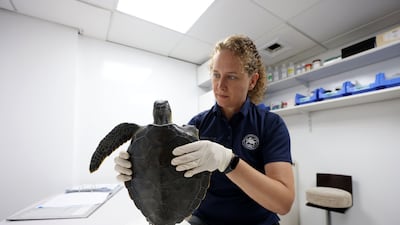
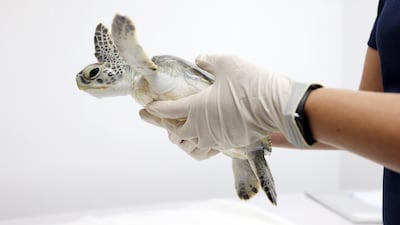
Barbara Lang Lenton, director of the aquarium and turtle rehabilitation project at Burj Al Arab Turtle Rehabilitation Centre, examines a turtle that lost two flippers and ingested plastic. All photos: Chris Whiteoak / The National -

Ms Lenton measures a piece of plastic ingested by a turtle -
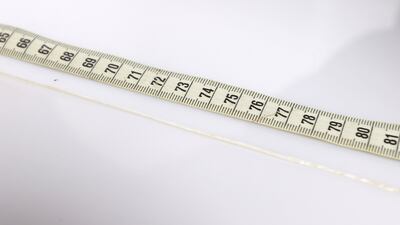
One of the pieces of plastic ingested by a rescued turtle in Dubai was 84cm long -
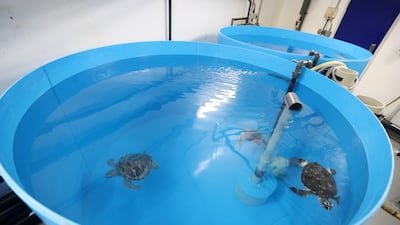
The quarantine area at Burj Al Arab Turtle Rehabilitation Centre -
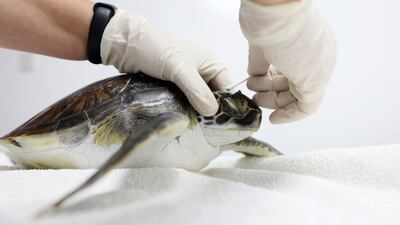
A turtle that was injured most likely in a boating accident -
While plastic pollution is still a major issue for marine conservation efforts, experts say national single-use plastic policies have improved the coastal environment -
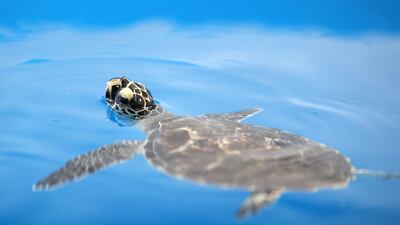
The increase in the turtle population in Abu Dhabi shows the success of the emirate's conservation strategy, experts say -
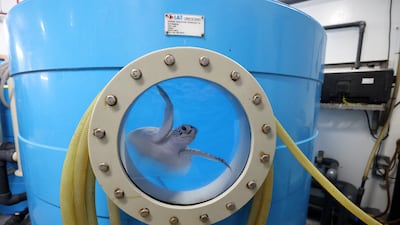
The quarantine area at Burj Al Arab Turtle Rehabilitation Centre


Positive steps
Other measures include, the agency said, combining MPAs with “active management, enforcement and regular review”.
“Protection inside MPAs are strengthened through measures such as speed limits for boats and seasonal restrictions,” the organisation said.
Activities such as fishing, boating and industrial operations are managed or restricted near turtle habitats, while the agency has since 2016 rescued 1,500 turtles through its rescue and rehabilitation programme.
In October, President Sheikh Mohamed directed an increase in the area of nature reserves in Abu Dhabi to reach 20 per cent of the emirate’s land area, including important turtle areas and beaches, and new marine reserves were designated.
Another scientist who has carried out research in the Gulf, Dr Bruno Díaz López, chief biologist and director of the Bottlenose Dolphin Research Institute, said that globally MPAs were “helping to keep certain marine environments protected”.
“It’s very complex because the marine environments change a lot. It’s not like land, where we can close. It’s open and the dimensions are much larger,” said Dr Díaz López, who was not connected to the sea turtle study.
He described Marawah off the UAE coast as “an important” MPA, as it hosts nesting grounds for sea turtles.
Scientists have previously called for MPAs in Abu Dhabi waters to be made larger to protect the Indo-Pacific Bottlenose Dolphin.

