

Nearly 20 years after Etihad Rail was established, 2026 promises to be a pivotal year for the UAE's railways.
The country is on the brink of a transport revolution, with passenger trains set to run next year.
The network will link key transport bases, education centres, and residential and commercial areas, adding capacity to the public transport system to cater to an increasing population, while boosting tourism, easing congestion and improving sustainability.

“Definitely there is pressure … but it's good pressure because we are creating a new system,” Azza Al Suwaidi, deputy chief executive of Etihad Rail Mobility, told The National in September.
“It's something everyone should be proud of. It's a national project and I'm really excited for next year once we start our passenger service.”
Etihad Rail was established in 2009, with freight operations beginning a few years later. The UAE-wide freight network was declared operational in 2023.
The company has gradually been revealing details about its long-awaited passenger network. So what can we expect?
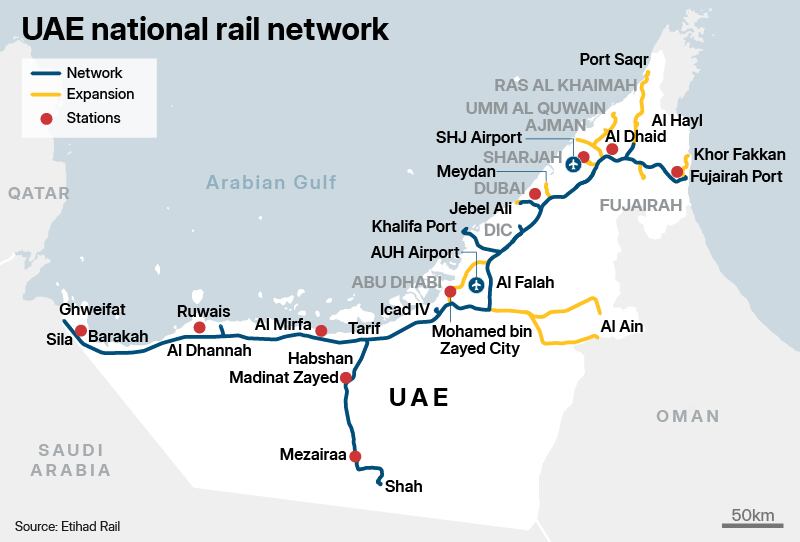
When will network start and where will trains go?
A launch date and the first passenger route have yet to be announced, but Etihad Rail in May confirmed services would begin in 2026.
Four stations have been announced, one each in Abu Dhabi, Dubai, Sharjah and Fujairah. Construction is progressing well and stations such as Jumeirah Golf Estates in Dubai and the Sakamkam neighbourhood in Fujairah, near the Al Hilal City development, can be seen from the road. In Abu Dhabi, a station is expected near Mussaffah, while in Sharjah one is planned near University City.
More stations are expected to be added. Etihad Rail has declined to comment on additional sites but has repeatedly stated its ambition to connect 11 cities across the UAE.
In October at the Global Rail Conference in Abu Dhabi, Etihad Rail announced a joint venture with Keolis International, the French company that runs Dubai Metro, to manage passenger train operations.
Passenger numbers across the Etihad Rail network are expected to reach 36 million by 2030. Trains will travel at speeds of up to 200kph and carry as many as 400 people, running on the same lines as freight trains.
A journey of 57 minutes is forecast from Abu Dhabi to Dubai and 105 minutes from Abu Dhabi to Fujairah.
On board
Etihad Rail has revealed more details about the passenger experience over the past year. At a media event in January, the company showcased one of its sleek new carriages.
Trains will offer three classes, including a business-class section. They will be equipped with Wi-Fi, entertainment systems, charging points and a range of food.
Stations, meanwhile, are expected to feature business-class lounges, shops and family-friendly amenities.
Stations access
Ensuring easy access to stations has been a key focus for Etihad Rail, with an emphasis on integration with existing and future transport networks.
In Dubai, the station will be connected to the Metro, with access to buses, taxis and ride-hailing services being developed.
At the Global Rail Conference, Etihad Rail signed an agreement with taxi company Yango Group to bolster access to passenger stations. The partnership aims to support pickup and drop-off points, streamline vehicle entry and exit procedures, and help reduce congestion.
This approach is known in transport parlance as “first and last-mile access”.
“Rail stations are the front door to a city, and are only as useful as the ease with which people can get to and from them,” said transport expert Martin Tillman.
“This last-mile issue requires a multi-modal solution to resolve. Station forecourt planning is critical to ensure a safe and seamless environment for passengers transferring from rail to other modes, such as ride-hailing services, with walkways, signage, shading, taxi queuing areas and bus waiting zones.”

Abu Dhabi to Dubai at high speed
This year also brought news of another major rail development. In January, it was announced a high-speed rail line will be built connecting Abu Dhabi and Dubai.
The line, separate from the passenger service starting next year, will cut journey time between the two emirates to just 30 minutes. Electrified trains travelling at speeds of up to 350kph will serve destinations such as Yas Island, Saadiyat Island, Abu Dhabi and Al Maktoum International Airport, before terminating near Dubai Creek.
It has yet to be disclosed whether the high-speed line will be integrated with the regular Etihad Rail network, which will use diesel trains.
The project is expected to contribute Dh145 billion ($39.48 billion) to UAE gross domestic product over the next five decades.
One thing is clear: the UAE is firmly on track for a public transport revolution.

