
Discover the best of The National's local journalism in The UAE Today newsletter. Sign up to receive it here.
Public and private sector workers will enjoy a long weekend in celebration of the UAE's 54th National Day, also known as Eid Al Etihad.
Authorities announced on Monday that employees would be granted leave on Monday and Tuesday, December 1 and 2.
The public holiday dates were announced by the Federal Authority for Government Human Resources and the Ministry of Human Resources and Emiratisation.
Official working hours are to resume on Wednesday, December 3, for both sectors, the ministries said.
Public and private sector workers are typically given the same number of public holidays under a unified UAE government calendar.
Citizens and residents come together each December to celebrate the birth of a nation that is now home to more than 200 nationalities.
Eid Al Etihad 2024 – in pictures
-
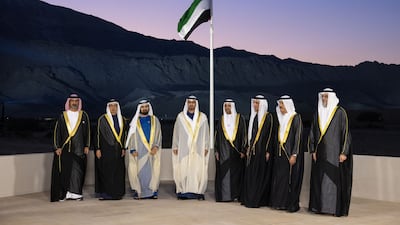
President Sheikh Mohamed and the Rulers of the Emirates attend the 53rd Eid Al Etihad ceremony in Al Ain. WAM -
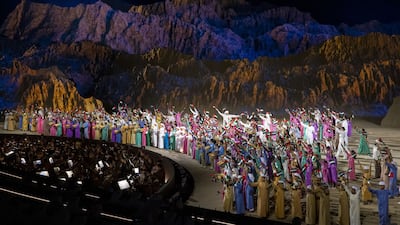
A dazzling drone show and camel train illuminated the spectacular backdrop of Jebel Hafeet. WAM -
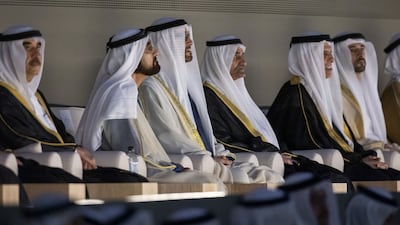
UAE leaders witnessed a spectacular light show to mark Eid Al Etihad. WAM -

Seven chapters told the story of UAE history and heritage in a spectacular display at Jebel Hafeet National Park to mark Eid Al Etihad. WAM -
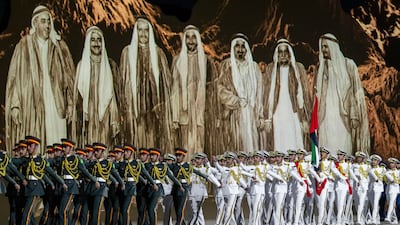
Members of the UAE Armed Force participated in the show, at the base of Jebel Hafeet. UAE Presidential Court -
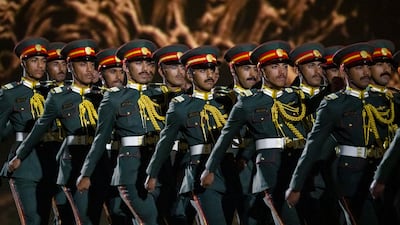
Accompanied by music from the London Philharmonic Orchestra, the rich heritage of the UAE was explored in a 40-minute show. UAE Presidential Court -
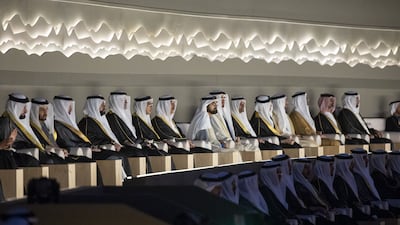
UAE leaders congregated in Al Ain to mark Eid Al Etihad. WAM -

The show featured 33 Emirati musicians alongside 66 international players. UAE Presidential Court -

More than 10,000 people of 81 nationalities were involved in the production. UAE Presidential Court -
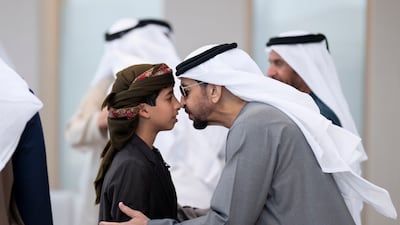
Sheikh Hamdan bin Zayed, Ruler’s Representative of Al Dhafra Region, right, greets Sheikh Zayed bin Omar bin Zayed. UAE Presidential Court -

Sheikh Abdullah bin Zayed, UAE Deputy Prime Minister and Minister of Foreign Affairs, right, greets Sheikh Mohamed bin Mansour bin Zayed. UAE Presidential Court -
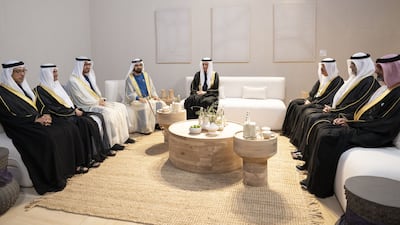
Sheikh Mohamed with the Rulers of the Emirates in Al Ain. WAM
It marks the anniversary of the founding of the UAE on December 2, 1971, when six of today's seven emirates united to form one country – Ras Al Khaimah joined in February 1972.
A spectacular live show – paying homage to the UAE's rich culture and highlighting its bold vision for the future – is typically the centrepiece of colourful festivities held across all seven emirates.
Citizens often display their patriotic pride by flying the UAE flag from their cars, which are also decorated with the nation's colours and images of Emirati leaders.
A host of cultural activities, concerts and dazzling firework displays will be held nationwide in honour of the festivities.

While you're here ...
Damien McElroy: The risk in extending a lockdown indefinitely
National Editorial: Muslims prepare for Eid under lockdown
Hussein Ibish: For Trump, it's public health vs the economy
The biog
Favourite book: Homegoing by Yaa Gyasi
Favourite holiday destination: Spain
Favourite film: Bohemian Rhapsody
Favourite place to visit in the UAE: The beach or Satwa
Children: Stepdaughter Tyler 27, daughter Quito 22 and son Dali 19
Iraq and the virus
Who's who in Yemen conflict
Houthis: Iran-backed rebels who occupy Sanaa and run unrecognised government
Yemeni government: Exiled government in Aden led by eight-member Presidential Leadership Council
Southern Transitional Council: Faction in Yemeni government that seeks autonomy for the south
Habrish 'rebels': Tribal-backed forces feuding with STC over control of oil in government territory
Benefits of first-time home buyers' scheme
- Priority access to new homes from participating developers
- Discounts on sales price of off-plan units
- Flexible payment plans from developers
- Mortgages with better interest rates, faster approval times and reduced fees
- DLD registration fee can be paid through banks or credit cards at zero interest rates
The biog
Favourite Quote: “Real victories are those that protect human life, not those that result from its destruction emerge from its ashes,” by The late king Hussain of Jordan.
Favourite Hobby: Writing and cooking
Favourite Book: The Prophet by Gibran Khalil Gibran
GIANT REVIEW
Starring: Amir El-Masry, Pierce Brosnan
Director: Athale
Rating: 4/5
Red flags
- Promises of high, fixed or 'guaranteed' returns.
- Unregulated structured products or complex investments often used to bypass traditional safeguards.
- Lack of clear information, vague language, no access to audited financials.
- Overseas companies targeting investors in other jurisdictions - this can make legal recovery difficult.
- Hard-selling tactics - creating urgency, offering 'exclusive' deals.
Courtesy: Carol Glynn, founder of Conscious Finance Coaching
THREE POSSIBLE REPLACEMENTS
Khalfan Mubarak
The Al Jazira playmaker has for some time been tipped for stardom within UAE football, with Quique Sanchez Flores, his former manager at Al Ahli, once labelling him a “genius”. He was only 17. Now 23, Mubarak has developed into a crafty supplier of chances, evidenced by his seven assists in six league matches this season. Still to display his class at international level, though.
Rayan Yaslam
The Al Ain attacking midfielder has become a regular starter for his club in the past 15 months. Yaslam, 23, is a tidy and intelligent player, technically proficient with an eye for opening up defences. Developed while alongside Abdulrahman in the Al Ain first-team and has progressed well since manager Zoran Mamic’s arrival. However, made his UAE debut only last December.
Ismail Matar
The Al Wahda forward is revered by teammates and a key contributor to the squad. At 35, his best days are behind him, but Matar is incredibly experienced and an example to his colleagues. His ability to cope with tournament football is a concern, though, despite Matar beginning the season well. Not a like-for-like replacement, although the system could be adjusted to suit.
Ten tax points to be aware of in 2026
1. Domestic VAT refund amendments: request your refund within five years
If a business does not apply for the refund on time, they lose their credit.
2. E-invoicing in the UAE
Businesses should continue preparing for the implementation of e-invoicing in the UAE, with 2026 a preparation and transition period ahead of phased mandatory adoption.
3. More tax audits
Tax authorities are increasingly using data already available across multiple filings to identify audit risks.
4. More beneficial VAT and excise tax penalty regime
Tax disputes are expected to become more frequent and more structured, with clearer administrative objection and appeal processes. The UAE has adopted a new penalty regime for VAT and excise disputes, which now mirrors the penalty regime for corporate tax.
5. Greater emphasis on statutory audit
There is a greater need for the accuracy of financial statements. The International Financial Reporting Standards standards need to be strictly adhered to and, as a result, the quality of the audits will need to increase.
6. Further transfer pricing enforcement
Transfer pricing enforcement, which refers to the practice of establishing prices for internal transactions between related entities, is expected to broaden in scope. The UAE will shortly open the possibility to negotiate advance pricing agreements, or essentially rulings for transfer pricing purposes.
7. Limited time periods for audits
Recent amendments also introduce a default five-year limitation period for tax audits and assessments, subject to specific statutory exceptions. While the standard audit and assessment period is five years, this may be extended to up to 15 years in cases involving fraud or tax evasion.
8. Pillar 2 implementation
Many multinational groups will begin to feel the practical effect of the Domestic Minimum Top-Up Tax (DMTT), the UAE's implementation of the OECD’s global minimum tax under Pillar 2. While the rules apply for financial years starting on or after January 1, 2025, it is 2026 that marks the transition to an operational phase.
9. Reduced compliance obligations for imported goods and services
Businesses that apply the reverse-charge mechanism for VAT purposes in the UAE may benefit from reduced compliance obligations.
10. Substance and CbC reporting focus
Tax authorities are expected to continue strengthening the enforcement of economic substance and Country-by-Country (CbC) reporting frameworks. In the UAE, these regimes are increasingly being used as risk-assessment tools, providing tax authorities with a comprehensive view of multinational groups’ global footprints and enabling them to assess whether profits are aligned with real economic activity.
Contributed by Thomas Vanhee and Hend Rashwan, Aurifer
Mercer, the investment consulting arm of US services company Marsh & McLennan, expects its wealth division to at least double its assets under management (AUM) in the Middle East as wealth in the region continues to grow despite economic headwinds, a company official said.
Mercer Wealth, which globally has $160 billion in AUM, plans to boost its AUM in the region to $2-$3bn in the next 2-3 years from the present $1bn, said Yasir AbuShaban, a Dubai-based principal with Mercer Wealth.
“Within the next two to three years, we are looking at reaching $2 to $3 billion as a conservative estimate and we do see an opportunity to do so,” said Mr AbuShaban.
Mercer does not directly make investments, but allocates clients’ money they have discretion to, to professional asset managers. They also provide advice to clients.
“We have buying power. We can negotiate on their (client’s) behalf with asset managers to provide them lower fees than they otherwise would have to get on their own,” he added.
Mercer Wealth’s clients include sovereign wealth funds, family offices, and insurance companies among others.
From its office in Dubai, Mercer also looks after Africa, India and Turkey, where they also see opportunity for growth.
Wealth creation in Middle East and Africa (MEA) grew 8.5 per cent to $8.1 trillion last year from $7.5tn in 2015, higher than last year’s global average of 6 per cent and the second-highest growth in a region after Asia-Pacific which grew 9.9 per cent, according to consultancy Boston Consulting Group (BCG). In the region, where wealth grew just 1.9 per cent in 2015 compared with 2014, a pickup in oil prices has helped in wealth generation.
BCG is forecasting MEA wealth will rise to $12tn by 2021, growing at an annual average of 8 per cent.
Drivers of wealth generation in the region will be split evenly between new wealth creation and growth of performance of existing assets, according to BCG.
Another general trend in the region is clients’ looking for a comprehensive approach to investing, according to Mr AbuShaban.
“Institutional investors or some of the families are seeing a slowdown in the available capital they have to invest and in that sense they are looking at optimizing the way they manage their portfolios and making sure they are not investing haphazardly and different parts of their investment are working together,” said Mr AbuShaban.
Some clients also have a higher appetite for risk, given the low interest-rate environment that does not provide enough yield for some institutional investors. These clients are keen to invest in illiquid assets, such as private equity and infrastructure.
“What we have seen is a desire for higher returns in what has been a low-return environment specifically in various fixed income or bonds,” he said.
“In this environment, we have seen a de facto increase in the risk that clients are taking in things like illiquid investments, private equity investments, infrastructure and private debt, those kind of investments were higher illiquidity results in incrementally higher returns.”
The Abu Dhabi Investment Authority, one of the largest sovereign wealth funds, said in its 2016 report that has gradually increased its exposure in direct private equity and private credit transactions, mainly in Asian markets and especially in China and India. The authority’s private equity department focused on structured equities owing to “their defensive characteristics.”
While you're here
Gavin Esler: Will 2021 be Boris Johnson's worst year?
Thomas Harding: US relations with Europe could change
Brodie Owen: How England’s new lockdown rules work


