
An ancient Christian cross has been unearthed on Abu Dhabi’s Sir Bani Yas Island, the emirate's Department of Culture and Tourism announced on Tuesday.
The artefact, thought to be about 1,400 years old, was discovered by teams from the department who restarted digs in January at the wider church and monastery site on the east of the island. The cross, moulded on a stucco plaque, was unearthed at a cluster of courtyard houses to the north of the main site where it is thought monks once lived.
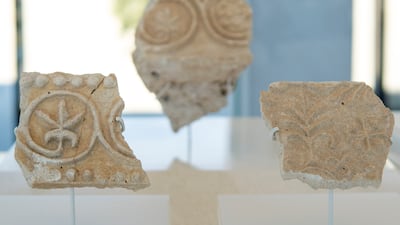
The artefact is larger and more intricate than the decorative cross found in the 1990s that first helped identify the location as a Christian site. It is thought the cross could have been an object of veneration and placed on a wall with worshippers kneeling before it.

“The discovery of this ancient Christian cross on Sir Bani Yas Island is a powerful testament to the UAE’s profound and enduring values of coexistence and cultural openness," Mohamed Khalifa Al Mubarak, chairman of the Abu Dhabi department, said on Tuesday. "It stirs within us a deep sense of pride and honour and reminds us that peaceful coexistence is not a modern construct but a principle woven into the very fabric of our region’s history."
Excavations this season – the first in about three decades – focused on courtyard buildings to the north of the main church and monastery site. “The plaster was resting face down and something about it caught my attention,” Hager Al Menhali, an Emirati archaeologist at the department, told The National. “There was a distinct fingerprint on the back,” she said, referring to the print of a person that could have worked on the plaster cross hundreds of years ago.
Ms Al Menhali suggested registering it as a special find, thinking the fingerprint alone made it interesting. “But when the team carefully turned it over, we were stunned,” she said. “There it was … a beautifully preserved cross [on] stucco plaster. This was one of the most significant discoveries of the season.”
The cross, which is 27cm long, 17cm wide and about 2cm thick, incorporates regional motifs that were common on artefacts in the Middle East, such as a representation of Golgotha, the hill where Christians believe Jesus was crucified.
-

One of the major findings as Archaeologists have begun new excavations at the ancient monastery on Sir Bani Yas Island, off the coast of Abu Dhabi. The site, overseen by the Department of Culture and Tourism – Abu Dhabi (DCT Abu Dhabi), offers a glimpse into the region’s deep-rooted Christian heritage. February 5, 2025. Photo credit: Ahmed Ramzan for The National -
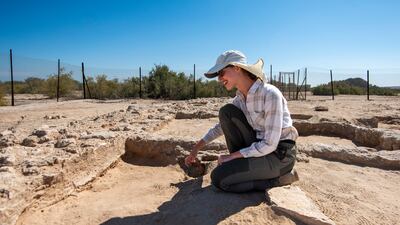
Maria Gajewska, archaeologist at the Department of Culture and Tourism – Abu Dhabi, showing the spot where the cross was found -

Hajer Al Menhali, an Emirati archaeologist who worked at the site, said it was a significant discovery -
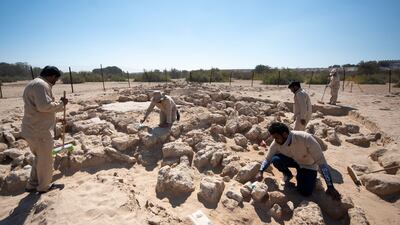
The church and monastery lie on the east of Sir Bani Yas Island -

The plaster cross bears traditional motifs and it could have been placed on a wall as an object of veneration -
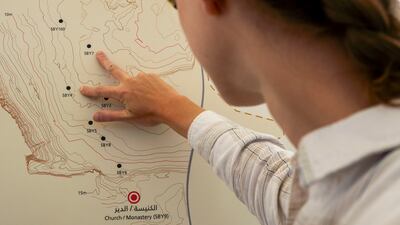
This year's dig focused on an area to the north of the existing monastery site -
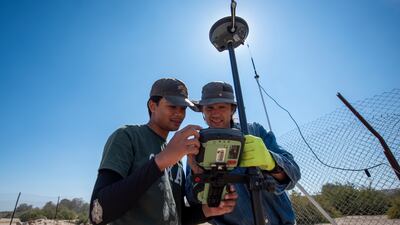
Work at the site took place over the winter season -
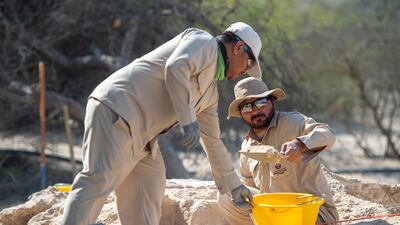
Painstaking excavation work also unearthed shards of pottery and glass at the site -
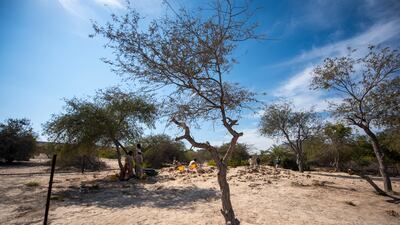
The find draws back the curtain on a lost world and offers new theories about who lived here and why -
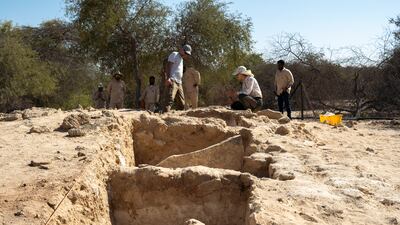
Senior monks could have lived in the buildings excavated this year for solitude. Another theory is that these buildings functioned as an ancient retreat for wealthy Christians -
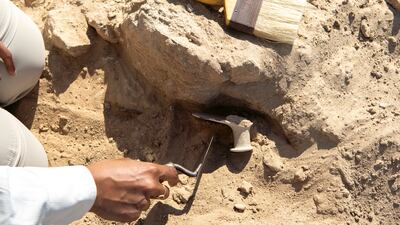
Ms Al Menhali excavates an artefact at the site -
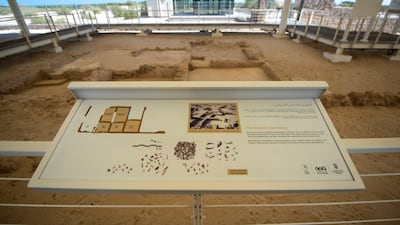
A visitor centre at the existing site is open to the public -
People can visit the island and learn about Abu Dhabi's rich and varied history


“Visually, every element of the plaster cross incorporates regional motifs,” Maria Gajewska, an archaeologist who leads the team on the island, told The National. “The stepped pyramid at the bottom, representing the Golgotha; the leaves sprouting from the base; the shape of the cross arms; the dots at the ends and the setting within a niche all find regional parallels in the Gulf and Mesopotamia.”
She said it was an “extremely exciting find” and a clear marker of who lived there, something rare in archaeology. “We were just digging in the right place,” she said, pointing to the spot where the cross was found in February. “Incredible.”
Long history
Today, Sir Bani Yas, about 170km south-west of Abu Dhabi, is a peaceful nature reserve where gazelles roam the dunes. But evidence for human activity there dates back more than 8,000 years and it once had a vibrant pearling industry. During the seventh and eighth centuries, it was also home to a Christian community.
The new discovery provides evidence of Christianity in the wider community on Sir Bani Yas, rather than just at the church and monastery, and draws back the curtain on the island's past.
“So much of what we do is interpretation and sometimes bordering on guesswork, frankly, and this was just lying there telling us, yes, they were Christian,” said Ms Gajewska. “We had settlements of Christians that were not just existing but were clearly flourishing.”
It is thought senior monks may have lived in solitude in the courtyard buildings and walked across to the church for mass or other services, before returning. Another theory is that the buildings could have functioned as an ancient retreat for wealthy Christians to get away from the world – living and praying by lamplight. Ms Gajewska said blackened earth found on the ground in the buildings could indicate places where residents had lamps.
One large stone building examined this season was built using limestone and coral from the island. Ms Gajewska said the buildings were unusual because they are extremely well made, featuring thick walls to tackle the heat and cisterns for water. That is an indication of a more comfortable existence than simple hermit life.
“They could have been places where senior monks who prayed at the church lived permanently, or else where people retreated to for periods of seclusion, perhaps during Christian Lent,” she said.
Experts said pilgrimage and spiritual retreats were part of the world during that time and people would walk across Europe to the Middle East.
Life on the island, however, would have been challenging, particularly during summer. They could have kept cattle, sheep and goats, as well as eating seafood. It is thought they were plugged into trade networks across the Middle East and Asia.
The Christian community was part of the “church of the east” – which stretched from the Middle East to China. Evidence of a church and monastery dating to the seventh to eighth centuries was first found at the site in the early 1990s. Another monastery, probably from the same church, was found in 2022 in Umm Al Quwain – also on an island. Others have been found in Kuwait, Iran and Saudi Arabia.
Archaeologists are investigating reasons for the decline of the site in Sir Bani Yas. It is believed the church was already fragmenting before the arrival of Islam. It was troubled by schisms, with different branches seeking to assert independence. But it is thought early Christian and Islamic communities communicated and traded. There is no evidence yet for any external event that led to the demise of the Christian site.
But archaeologists believe it is unusual for these buildings to be clean, suggesting residents intended to return. Sites typically show decline, with areas of rubble, but that is not the case at the site excavated this year.
This season’s dig also uncovered pottery and large amounts of glass. A standout piece of glass was a small bottle, sea green in colour, that could have been used for holding oil or rosewater.
Future plans
Further studies of the artefacts and radiocarbon analysis of samples will be carried out. It is hoped there will also be further digs at the site.
As part of restoration efforts undertaken by DCT Abu Dhabi in 2019, the church and monastery are protected by shelters. There is also a visitor centre with some artefacts from past excavations on display, including glass chalices, a cross-shaped stucco and a stamp seal with a scorpion motif. A multi-faith site has also been built next to the visitor centre.
Further excavations are planned and the department said the courtyard houses examined this year could be added to a broader visitor trail linked to the cultural sites on the island.
"The ongoing discoveries from Sir Bani Yas Island, even after 30 years of research and excavation, underscore the magnitude of our cultural legacy and the importance of our continued commitment to its preservation and understanding," Mr Al Mubarak said. "As DCT Abu Dhabi continues to uncover these valuable stories, we reaffirm our dedication to preserving, promoting and protecting Abu Dhabi’s diverse heritage, one that we are honoured to share with the world.
"These discoveries deepen our connection to the past and inspire future generations to embrace the spirit of unity and mutual respect that has long defined our community.”

