
Field teams have taken anthropometric measurements of women and children as part of the health initiative. Photo: Wam

UAE leads life-saving drive to tackle malnutrition in Yemen's Socotra


  • English
  • Arabic

The UAE has joined forces with the World Health Organisation to lead a campaign to reduce the number of deaths caused by malnutrition on the Yemeni island of Socotra.

Field teams from the UAE and the WHO have carried out assessments in the first phase of a drive aimed at bolstering health systems and improving patient care. Health workers have completed the first of four visits over the course of a year, as part of a mission to reduce the malnutrition death rate by up to 20 per cent within the next two to five years.

The initiative is being carried out with the support of Yemen’s Ministry of Public Health and Population, state news agency Wam reported on Monday.
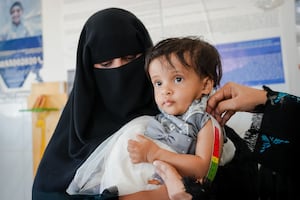
The baseline assessment covered 38 villages across 29 subdistricts of Socotra, which has an estimated population of 60,000. Data was collected from 4,214 households, with field teams interviewing more than 900 care providers and taking anthropometric measurements from children and mothers.

Such measurements are typically used to assess the height and weight of infants and adults. That data is an important indicator of nutrition and the risk of disease.

The findings will be used to compile a report that will detail the maternal and child health and nutrition status of the community. It will also examine the readiness of healthcare sites to respond to emergency situations and meet the needs of patients.

Future stages of the initiative will include the distribution of medical goods and other supplies, work by technical experts and service providers, and the launch of training programmes and community awareness campaigns.

Remote island of global significance

A dragon blood tree on the Yemeni island of Socotra. AFP

Socotra is part of one of the most isolated islands in the world. It is about 340km south-west of Yemen. While remote and small, it is known for its centuries-old, umbrella-shaped dragon blood trees and has been described as the Galapagos of the Indian Ocean because of its biodiversity.

The Socotra Archipelago – made up of six islands, including its largest, Socotra – received Unesco World Heritage Site status in 2008 in recognition of its biodiversity and high number of endemic species.

Socotra has endured a number of challenges in recent years, including two cyclones in 2015. The UAE provided $110 million in humanitarian aid to the people of Socotra from 2015 to 2021, offering assistance to its communities and helping to lay foundations for the future.

The aid was delivered by organisations including the Emirates Red Crescent, the Abu Dhabi Fund for Development, the Khalifa bin Zayed Al Nahyan Foundation, the Sheikh Sultan bin Khalifa Al Nahyan Humanitarian and Scientific Foundation, and the Abu Dhabi Waste Management Centre.

Key investment restored Socotra's airport and paid for the construction of two solar power stations, the establishment of four power plants and the installation of power generators in remote villages.


Four motivational quotes from Alicia's Dubai talk

“The only thing we need is to know that we have faith. Faith and hope in our own dreams. The belief that, when we keep going we’re going to find our way. That’s all we got.”

“Sometimes we try so hard to keep things inside. We try so hard to pretend it’s not really bothering us. In some ways, that hurts us more. You don’t realise how dishonest you are with yourself sometimes, but I realised that if I spoke it, I could let it go.”

“One good thing is to know you’re not the only one going through it. You’re not the only one trying to find your way, trying to find yourself, trying to find amazing energy, trying to find a light. Show all of yourself. Show every nuance. All of your magic. All of your colours. Be true to that. You can be unafraid.”

“It’s time to stop holding back. It’s time to do it on your terms. It’s time to shine in the most unbelievable way. It’s time to let go of negativity and find your tribe, find those people that lift you up, because everybody else is just in your way.”

Mercer, the investment consulting arm of US services company Marsh & McLennan, expects its wealth division to at least double its assets under management (AUM) in the Middle East as wealth in the region continues to grow despite economic headwinds, a company official said.

Mercer Wealth, which globally has $160 billion in AUM, plans to boost its AUM in the region to $2-$3bn in the next 2-3 years from the present $1bn, said Yasir AbuShaban, a Dubai-based principal with Mercer Wealth.

Within the next two to three years, we are looking at reaching $2 to $3 billion as a conservative estimate and we do see an opportunity to do so,” said Mr AbuShaban.

Mercer does not directly make investments, but allocates clients’ money they have discretion to, to professional asset managers. They also provide advice to clients.

“We have buying power. We can negotiate on their (client’s) behalf with asset managers to provide them lower fees than they otherwise would have to get on their own,” he added.

Mercer Wealth’s clients include sovereign wealth funds, family offices, and insurance companies among others.

From its office in Dubai, Mercer also looks after Africa, India and Turkey, where they also see opportunity for growth.

Wealth creation in Middle East and Africa (MEA) grew 8.5 per cent to $8.1 trillion last year from $7.5tn in 2015, higher than last year’s global average of 6 per cent and the second-highest growth in a region after Asia-Pacific which grew 9.9 per cent, according to consultancy Boston Consulting Group (BCG). In the region, where wealth grew just 1.9 per cent in 2015 compared with 2014, a pickup in oil prices has helped in wealth generation.

BCG is forecasting MEA wealth will rise to $12tn by 2021, growing at an annual average of 8 per cent.

Drivers of wealth generation in the region will be split evenly between new wealth creation and growth of performance of existing assets, according to BCG.

Another general trend in the region is clients’ looking for a comprehensive approach to investing, according to Mr AbuShaban.

“Institutional investors or some of the families are seeing a slowdown in the available capital they have to invest and in that sense they are looking at optimizing the way they manage their portfolios and making sure they are not investing haphazardly and different parts of their investment are working together,” said Mr AbuShaban.

Some clients also have a higher appetite for risk, given the low interest-rate environment that does not provide enough yield for some institutional investors. These clients are keen to invest in illiquid assets, such as private equity and infrastructure.

“What we have seen is a desire for higher returns in what has been a low-return environment specifically in various fixed income or bonds,” he said.

“In this environment, we have seen a de facto increase in the risk that clients are taking in things like illiquid investments, private equity investments, infrastructure and private debt, those kind of investments were higher illiquidity results in incrementally higher returns.”

The Abu Dhabi Investment Authority, one of the largest sovereign wealth funds, said in its 2016 report that has gradually increased its exposure in direct private equity and private credit transactions, mainly in Asian markets and especially in China and India. The authority’s private equity department focused on structured equities owing to “their defensive characteristics.”

Dr Amal Khalid Alias revealed a recent case of a woman with daughters, who specifically wanted a boy.

A semen analysis of the father showed abnormal sperm so the couple required IVF.

Out of 21 eggs collected, six were unused leaving 15 suitable for IVF.

A specific procedure was used, called intracytoplasmic sperm injection where a single sperm cell is inserted into the egg.

On day three of the process, 14 embryos were biopsied for gender selection.

The next day, a pre-implantation genetic report revealed four normal male embryos, three female and seven abnormal samples.

Day five of the treatment saw two male embryos transferred to the patient.

The woman recorded a positive pregnancy test two weeks later. 

MATCH INFO

English Premiership semi-finals

Saracens 57
Wasps 33

Exeter Chiefs 36
Newcastle Falcons 5

In%20the%20Land%20of%20Saints%20and%20Sinners
%3Cp%3E%3Cstrong%3EDirector%3A%20%3C%2Fstrong%3ERobert%20Lorenz%3C%2Fp%3E%0A%3Cp%3E%3Cstrong%3EStarring%3A%3C%2Fstrong%3E%20Liam%20Neeson%2C%20Kerry%20Condon%2C%20Jack%20Gleeson%2C%20Ciaran%20Hinds%3C%2Fp%3E%0A%3Cp%3E%3Cstrong%3ERating%3A%20%3C%2Fstrong%3E2%2F5%3C%2Fp%3E%0A
Updated: July 14, 2025, 3:39 PM