
The UAE on Monday launched a Dh750 million expansion plan for one of the country's busiest transport links in support of a nationwide drive to combat congestion.
Emirates Road development project, being led by the Ministry of Energy and Infrastructure, will increase the number of lanes from three to five on a 25km stretch linking Al Badee Interchange in Sharjah to Umm Al Quwain. The move will boost the capacity of the route to 9,000 vehicles an hour, an increase of 65 per cent.
The scheme will also include an upgrade of Interchange No 7 on Emirates Road, through the construction of six bridges to serve a combined 13,200 vehicles an hour. Work on the project is scheduled to begin in September and is expected to take two years.
The ministry said the road revamp is intended to reduce travel time by up to 45 per cent for commuters travelling between Ras Al Khaimah through Umm Al Quwain and Sharjah to Dubai.
Suhail Al Mazrouei, Minister of Energy and Infrastructure, said the initiative was part of the ministry's efforts to develop practical and sustainable solutions to traffic congestion.
“This project represents a significant step towards realising the UAE’s vision of establishing an integrated road network that meets the needs of the population and economic growth,” he said.
Emirates Road, known as the E611, stretches 110km and is a vital alternative route to Sheikh Zayed Road and Sheikh Mohammed bin Zayed Road for drivers in Ras Al Khaimah, Umm Al Quwain, Ajman and Sharjah. It allows motorists to travel to Abu Dhabi without having to go through central Dubai.
Congestion-cutting plans
-
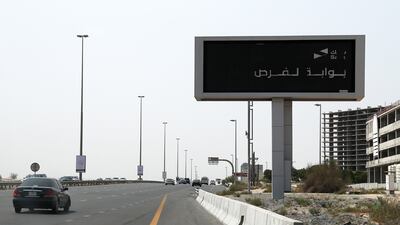
Electronic traffic signs on Umm Sequim St, which is being used to advertise the new Salik IPO scheme in Dubai. Pawan Singh / The National -

Vehicles pass under a toll gate on Sheikh Zayed Road in Dubai on Monday, September 5, 2022. Toll gate operator Salik will make an initial public offering on the emirate's stock market, becoming the latest state-linked company to list. AP -

Electronic traffic signs on Al Khail, which is being used to advertise the new Salik IPO scheme in Dubai. Pawan Singh / The National -
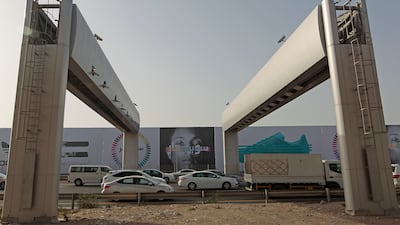
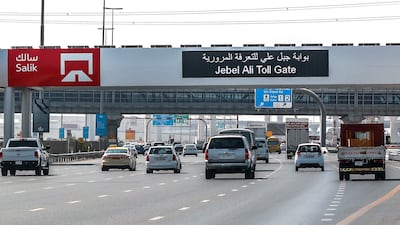
Drivers are charged Dh4 ($1.09) for each gate that they pass through. There are eight gates at present, but Salik's IPO prospectus says that more could be built. The National -
Motorists are required to have a tag on the windscreen of their car and an online account to use the high-speed motorway. Victor Besa / The National -
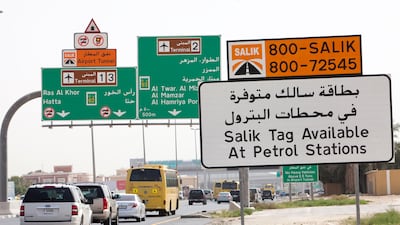
Signs warn drivers that they need a tag on their vehicle to use this road. Jaime Puebla / The National -
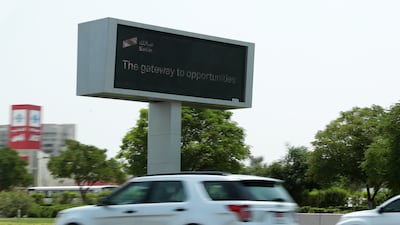
Electronic traffic signs on E311 highway, which is being used to advertise the new Salik IPO scheme in Dubai. Pawan Singh / The National


Authorities across the Emirates are stepping up road-building efforts to help meet the demands of a rapidly growing population.
Abu Dhabi's population crossed 4 million for the first time last month, while Dubai is fast approaching the same figure. A recent survey revealed that traffic jams continue to be the primary source of frustration for motorists.
The research, based on the canvassing of 1,021 people in the country, found that 86 per cent of motorists “typically experience traffic congestion”. Four fifths of respondents in the RoadSafety UAE and Al Wathba Insurance study said they have noticed heavier traffic congestion year on year.
The UAE has introduced congestion charges as one means to ease traffic flow on the country's roads. Dubai introduced its road toll system, Salik, in 2007, and the system has since been extended and modified, notably through this year's introduction of dynamic pricing, with levies increasing at peak times.
Abu Dhabi’s Darb road toll system, which was introduced four and a half years ago, charges at peak hours in the morning and early evening. Many other measures could alleviate the UAE’s traffic woes.
Surveys last year by Dubai’s Roads and Transport Authority and the Dubai Government Human Resources Department found flexible working hours and more working from home could cut peak-hour traffic by as much as 30 per cent.
The government is also encouraging residents to swap their cars for public transport. The Blue Line expansion of the Dubai Metro and ambitious plans for the Etihad Rail train network are central to the strategy.

