Sharjah road closures in place for two months due to Etihad Rail work


  • English
  • Arabic

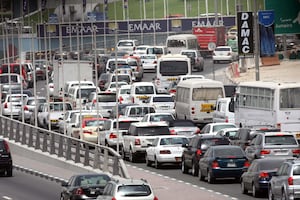
A major commuter link in Sharjah will be closed to traffic for two months to allow for Etihad Rail construction work to take place.

Sharjah Roads and Transport Authority said the route connecting Mleiha Road and Sharjah Ring Road, near University Bridge, would be closed to traffic with immediate effect until August 30.

The authority said the temporary measures were being introduced as part of Etihad Rail project works.
“We kindly urge all road users to use alternative routes and adhere to traffic safety guidelines to ensure everyone’s safety,” Sharjah RTA said on social media platform X.

The route is popular with motorists, with many using Sharjah Ring Road to gain access to the busy Emirates Road.

Rail plan gathers pace

Plans for an Etihad Rail passenger service station in Sharjah were announced in March last year.

The site will be situated close to the emirate's University City and be connected to the main UAE-wide line.

The area is a crucial location being close to Sharjah Airport and home to scores of educational institutions.

Once up and running, the new station will help to increase the number of passengers on Etihad Rail to about 14,000 a day during the week.

Etihad Rail's much-anticipated passenger train service is set to launch next year, marking a significant step forward for the country's infrastructure project.

The development was first revealed in message on X on May 9 that detailed a meeting between Sheikh Hamdan bin Zayed, Ruler's Representative in Al Dhafra Region, and a delegation from Etihad Rail. Progress made on construction and future plans were discussed at the meeting.

Etihad Rail in January said the first four passenger stations on the UAE-wide line would be in Abu Dhabi, Dubai, Sharjah and Fujairah.

The passenger trains are set to travel at 200kph carrying up to 400 passengers. Travelling from Abu Dhabi to Dubai will take about 57 minutes, while a journey from the capital to Fujairah will take 105 minutes.

Separately, Etihad Rail in January announced plans for an electrified high-speed passenger service between Abu Dhabi and Dubai with its own set of stations.

Full speed ahead

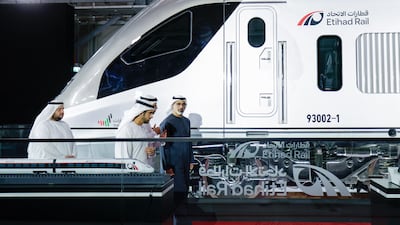
  • Sheikh Khaled bin Mohamed, Crown Prince of Abu Dhabi, and Sheikh Hamdan bin Mohammed, Crown Prince of Dubai, Deputy Prime Minister and Minister of Defence, inspect the UAE’s first passenger train fleet. Photo: Abu Dhabi Media Office
    Sheikh Khaled bin Mohamed, Crown Prince of Abu Dhabi, and Sheikh Hamdan bin Mohammed, Crown Prince of Dubai, Deputy Prime Minister and Minister of Defence, inspect the UAE’s first passenger train fleet. Photo: Abu Dhabi Media Office
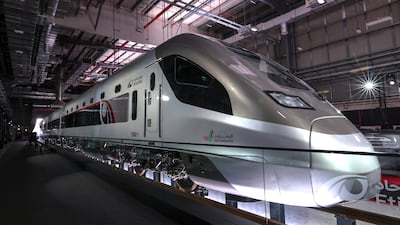
  • Etihad Rail has announced plans for a high-speed passenger rail service between Abu Dhabi and Dubai. Photo: Abu Dhabi Media Office
    Etihad Rail has announced plans for a high-speed passenger rail service between Abu Dhabi and Dubai. Photo: Abu Dhabi Media Office
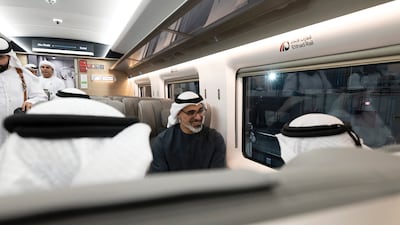
  • Sheikh Khaled on one of the trains. The service will cut the journey time between the emirates to 30 minutes. Photo: Abu Dhabi Media Office
    Sheikh Khaled on one of the trains. The service will cut the journey time between the emirates to 30 minutes. Photo: Abu Dhabi Media Office
  • Inside one of the carriages. The trains will travel at up to 350kph. Victor Besa / The National
    Inside one of the carriages. The trains will travel at up to 350kph. Victor Besa / The National
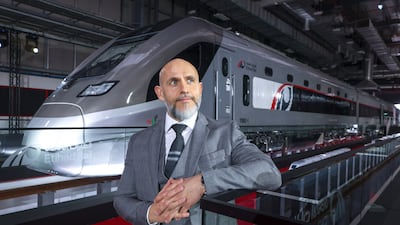
  • Sebastien Mangeant, executive director of high-speed rail at Etihad Rail, ha said the service will support tourism. Victor Besa / The National
    Sebastien Mangeant, executive director of high-speed rail at Etihad Rail, ha said the service will support tourism. Victor Besa / The National
  • Inside one of the passenger train carriages. The high-speed trains will help to reduce traffic between Abu Dhabi and Dubai. Victor Besa / The National
    Inside one of the passenger train carriages. The high-speed trains will help to reduce traffic between Abu Dhabi and Dubai. Victor Besa / The National
  • Plans are also in place for a railway connecting the UAE with Oman. Victor Besa / The National
    Plans are also in place for a railway connecting the UAE with Oman. Victor Besa / The National

Work on Etihad Rail began in 2009. Since 2016, two tracks spanning 264km have been in operation – with trains taking granulated sulphur from gasfields in Shah and Habshan to an export point in Ruwais.

When complete, the network will connect the seven emirates to the five neighbouring GCC states.

The line will ultimately link the UAE and Saudi Arabia from Fujairah Port to Ghuwaifat, through Khalifa Port and Jebel Ali Port.

A railway connecting the UAE with Oman is also planned.

The%C2%A0specs%20
%3Cp%3E%3Cstrong%3EEngine%3A%20%3C%2Fstrong%3E3.5-litre%2C%20twin-turbo%20V6%0D%3Cbr%3E%3Cstrong%3ETransmission%3A%20%3C%2Fstrong%3E10-speed%20auto%0D%3Cbr%3E%3Cstrong%3EPower%3A%20%3C%2Fstrong%3E410hp%0D%3Cbr%3E%3Cstrong%3ETorque%3A%20%3C%2Fstrong%3E495Nm%0D%3Cbr%3E%3Cstrong%3EPrice%3A%20%3C%2Fstrong%3Estarts%20from%20Dh495%2C000%20(Dh610%2C000%20for%20the%20F-Sport%20launch%20edition%20tested)%0D%3Cbr%3E%3Cstrong%3EOn%20sale%3A%20%3C%2Fstrong%3Enow%3C%2Fp%3E%0A
Bullet%20Train
%3Cp%3E%3Cstrong%3EDirector%3A%3C%2Fstrong%3E%20David%20Leitch%3Cbr%3E%3Cstrong%3EStars%3A%3C%2Fstrong%3E%20Brad%20Pitt%2C%20Aaron%20Taylor-Johnson%2C%20Brian%20Tyree%20Henry%2C%20Sandra%20Bullock%3Cbr%3E%3Cstrong%3ERating%3A%3C%2Fstrong%3E%203%2F5%3C%2Fp%3E%0A
One in nine do not have enough to eat

Created in 1961, the World Food Programme is pledged to fight hunger worldwide as well as providing emergency food assistance in a crisis.

One of the organisation’s goals is the Zero Hunger Pledge, adopted by the international community in 2015 as one of the 17 Sustainable Goals for Sustainable Development, to end world hunger by 2030.

The WFP, a branch of the United Nations, is funded by voluntary donations from governments, businesses and private donations.

Almost two thirds of its operations currently take place in conflict zones, where it is calculated that people are more than three times likely to suffer from malnutrition than in peaceful countries.

It is currently estimated that one in nine people globally do not have enough to eat.

On any one day, the WFP estimates that it has 5,000 lorries, 20 ships and 70 aircraft on the move.

Outside emergencies, the WFP provides school meals to up to 25 million children in 63 countries, while working with communities to improve nutrition. Where possible, it buys supplies from developing countries to cut down transport cost and boost local economies.


Mercer, the investment consulting arm of US services company Marsh & McLennan, expects its wealth division to at least double its assets under management (AUM) in the Middle East as wealth in the region continues to grow despite economic headwinds, a company official said.

Mercer Wealth, which globally has $160 billion in AUM, plans to boost its AUM in the region to $2-$3bn in the next 2-3 years from the present $1bn, said Yasir AbuShaban, a Dubai-based principal with Mercer Wealth.

Within the next two to three years, we are looking at reaching $2 to $3 billion as a conservative estimate and we do see an opportunity to do so,” said Mr AbuShaban.

Mercer does not directly make investments, but allocates clients’ money they have discretion to, to professional asset managers. They also provide advice to clients.

“We have buying power. We can negotiate on their (client’s) behalf with asset managers to provide them lower fees than they otherwise would have to get on their own,” he added.

Mercer Wealth’s clients include sovereign wealth funds, family offices, and insurance companies among others.

From its office in Dubai, Mercer also looks after Africa, India and Turkey, where they also see opportunity for growth.

Wealth creation in Middle East and Africa (MEA) grew 8.5 per cent to $8.1 trillion last year from $7.5tn in 2015, higher than last year’s global average of 6 per cent and the second-highest growth in a region after Asia-Pacific which grew 9.9 per cent, according to consultancy Boston Consulting Group (BCG). In the region, where wealth grew just 1.9 per cent in 2015 compared with 2014, a pickup in oil prices has helped in wealth generation.

BCG is forecasting MEA wealth will rise to $12tn by 2021, growing at an annual average of 8 per cent.

Drivers of wealth generation in the region will be split evenly between new wealth creation and growth of performance of existing assets, according to BCG.

Another general trend in the region is clients’ looking for a comprehensive approach to investing, according to Mr AbuShaban.

“Institutional investors or some of the families are seeing a slowdown in the available capital they have to invest and in that sense they are looking at optimizing the way they manage their portfolios and making sure they are not investing haphazardly and different parts of their investment are working together,” said Mr AbuShaban.

Some clients also have a higher appetite for risk, given the low interest-rate environment that does not provide enough yield for some institutional investors. These clients are keen to invest in illiquid assets, such as private equity and infrastructure.

“What we have seen is a desire for higher returns in what has been a low-return environment specifically in various fixed income or bonds,” he said.

“In this environment, we have seen a de facto increase in the risk that clients are taking in things like illiquid investments, private equity investments, infrastructure and private debt, those kind of investments were higher illiquidity results in incrementally higher returns.”

The Abu Dhabi Investment Authority, one of the largest sovereign wealth funds, said in its 2016 report that has gradually increased its exposure in direct private equity and private credit transactions, mainly in Asian markets and especially in China and India. The authority’s private equity department focused on structured equities owing to “their defensive characteristics.”

The burning issue

The internal combustion engine is facing a watershed moment – major manufacturer Volvo is to stop producing petroleum-powered vehicles by 2021 and countries in Europe, including the UK, have vowed to ban their sale before 2040. The National takes a look at the story of one of the most successful technologies of the last 100 years and how it has impacted life in the UAE.

Read part three: the age of the electric vehicle begins

Read part two: how climate change drove the race for an alternative 

Read part one: how cars came to the UAE

PSA DUBAI WORLD SERIES FINALS LINE-UP

Men’s:
Mohamed El Shorbagy (EGY)
Ali Farag (EGY)
Simon Rosner (GER)
Tarek Momen (EGY)
Miguel Angel Rodriguez (COL)
Gregory Gaultier (FRA)
Karim Abdel Gawad (EGY)
Nick Matthew (ENG)

Women's:
Nour El Sherbini (EGY)
Raneem El Welily (EGY)
Nour El Tayeb (EGY)
Laura Massaro (ENG)
Joelle King (NZE)
Camille Serme (FRA)
Nouran Gohar (EGY)
Sarah-Jane Perry (ENG)

The specs

Engine: 2.0-litre 4-cyl turbo

Power: 247hp at 6,500rpm

Torque: 370Nm from 1,500-3,500rpm

Transmission: 10-speed auto

Fuel consumption: 7.8L/100km

Price: from Dh94,900

On sale: now

Updated: July 03, 2025, 8:07 AM