

Dubai Municipality on Wednesday announced the completion of a sewerage and rainwater drainage network at a total cost of Dh277 million.
It is the first major step towards completing the Tasreef project – the vision of Sheikh Mohammed bin Rashid, Vice President and Ruler of Dubai, who last year approved the Dh30 billion plan to improve the emirate’s water drainage following record flooding in April.
The new network in Nad Al Sheba 3 spans a total of 24km and adds 11km of household connections to Dubai's main sewerage system.
An advanced pumping station has been installed, which can handle 4,000 litres of water per second. This is complemented by a 31km gravity-based drainage pipeline network, which will maintain system readiness during periods of heavy rainfall and mitigate flooding risks.
The overall Tasreef project is set to be completed by 2033.
How will the new drainage network help?
“This project is part of Dubai Municipality’s strategic efforts to develop and deliver world-class infrastructure that keeps pace with Dubai’s ambitions for global leadership and urban sustainability,” Marwan Ahmed bin Ghalita, director general of Dubai Municipality, said.
“Completing the Nad Al Sheba 3 project is a significant step towards connecting all areas of Dubai to a fully integrated sewerage and rainwater drainage network, ensuring the emirate’s readiness to face future climate challenges for the next 100 years.”
In addition to being part of the Tasreef project, the Nad Al Sheba 3 development is part of a planned Dh80 billion sewerage upgrade programme to help public health standards.
The pumping station and drainage pipeline will improve rainwater management and ensure efficient water flow towards the main network.
What is the Tasreef project?
The strategic project is a continuation of drainage projects launched by Dubai in 2019, covering the Expo Dubai area, Al Maktoum International Airport City and Jebel Ali.
The new projects will serve vital areas including Nad Al Hamar, and around Dubai International Airport, Garhoud, Rashidiya, Al Quoz, Zabeel, Al Wasl, Jumeirah and Al Badaa.
The system aims to increase rainwater drainage capacity by 700 per cent, meet the emirate’s needs for 100 years and ensure the city is ready to face “climate-related challenges”.
How floods make an impact
In April 2024, the UAE recorded its heaviest rain in 75 years. Buildings and roads were flooded, while cars were abandoned on motorways and flights were cancelled, delayed or diverted as a result of the severe storm.
While the floods' impact was immediate and wide-ranging, they continue to shape the Emirates – and not only in terms of government policy.
The flooding caused an increase in greenery in the country's desert landscapes. Vegetation in some areas grew by up to 40 per cent compared to the same time in 2023, and this has had a lasting impact, research discovered.
The study, co-written by Dr Diana Francis of Khalifa University and published in the npj Climate and Atmospheric Science journal, confirmed that human-driven climate change made last year's rainfall in the UAE far more likely in the future.
Its analysis of the effect of the flooding on urban infrastructure suggests existing drainage systems and land use policies need to be enhanced to cope with such extreme weather.
“Our cities are not designed to absorb these volumes of water,” Dr Francis said. “If we keep covering land with impermeable concrete, water has nowhere to go. We need to rethink urban planning with more green space and better drainage to reduce future damage.”
It is hoped this is where the Tasreef project will come in as, once completed, Dubai’s infrastructure will be able to handle more than 20 million cubic metres of water per day.
Aftermath of April 2024 floods – in pictures
-
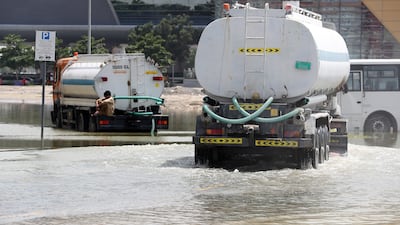
Tankers clearing waterlogged roads near Discovery Gardens metro station in Dubai on April 22. Pawan Singh / The National -

Many roads in Dubai have been flooded since last week's torrential rainfall. Pawan Singh / The National -
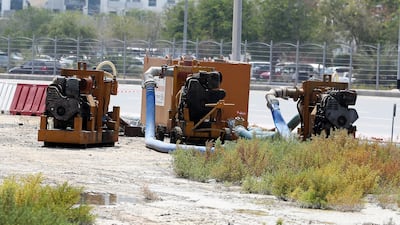
The tankers are pumping the water from the roads. Pawan Singh / The National -
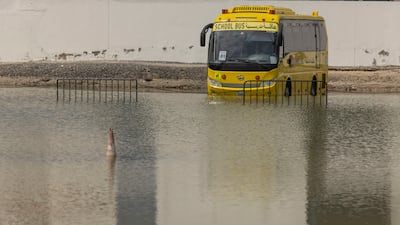
School buses on hand to drive pupils through the water after the flood. Antonie Robertson / The National -
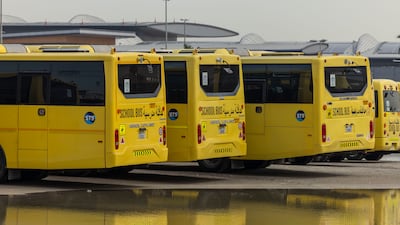
Pupils are returning to school after many were closed due to the heavy rain and flooding. Antonie Robertson / The National -

The clean-up is under way in District 5, Jumeirah Park. Antonie Robertson / The National -
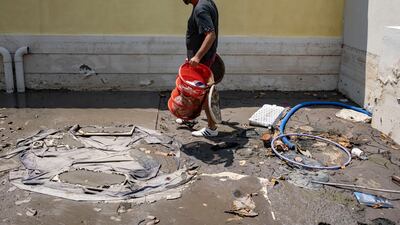
District 5 residents deal with the aftermath of the flooding one week on. Antonie Robertson / The National



