

The emergency and trauma unit at a Lebanese hospital that was destroyed in the 2020 Beirut port blast is ready to welcome patients again, thanks to a major UAE donation.
The Big Heart Foundation, a global humanitarian organisation based in Sharjah, contributed Dh8.7 million ($2.36 million) to reconstruct and expand the facility at the 147-year-old Saint George Hospital University Medical Centre in Lebanon's capital.
The hospital is about half a kilometre from the port and bore the brunt of the devastating explosion, which killed more than 200 people and left thousands injured.
Four members of the hospital’s nursing staff died, as well as 12 patients and a visitor. More than 100 doctors, nurses and administrative staff suffered injuries ranging from mild to critical, according to the hospital’s website.
The upgraded unit reopened on Tuesday. It has state-of-the-art medical equipment, expanded capacity, enhanced trauma-care facilities, and a new paediatric section.
It is expected to serve 40,000 patients per year. Its inauguration has enabled the hospital to operate at full capacity for the first time since the disaster on August 4, 2020.
Beirut blast aftermath – in pictures
-

Fahed Abu Salah’s film 'Beirut After the Blast' aims to highlight how the healing process for many people is being strained by the lack of accountability. All Photos: MContent -

It features interviews with several people affected by the blast, as well as with activists trying to secure justice for the victims. -
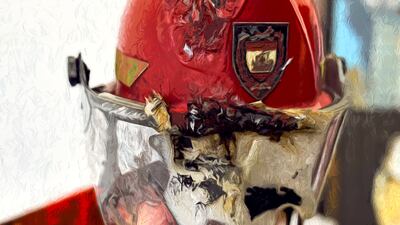
The film also honours the firefighters who died trying to contain the fire that led to the blast. -
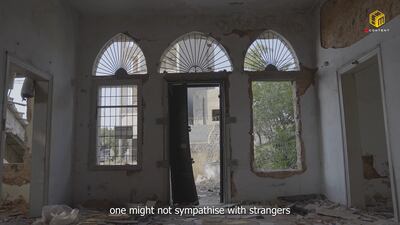
The documentary was filmed over the course of 50 days and aims to show the humanitarian issues caused by the blast. -

A shorter director’s cut of the documentary was shown in the metaverse in an event at the Waldorf Astoria Hotel in the DIFC. -

Abu Salah says it was also important for him that the documentary makes it to MContent and the 'cineverse', to encourage other Arab filmmakers to make use of the metaverse as well.


The crucial funding was made possible by the Salam Beirut campaign, which raised more than Dh30 million for recovery work following the explosion.
At the inauguration ceremony, Alya Al Musaiebi, director of The Big Heart Foundation, reaffirmed Sharjah’s long-standing friendship with Lebanon and praised the strength of its people.
“The reconstructed and expanded [centre] symbolises our belief that humanitarian work must be meaningful, long-term, and grounded in the dignity of those we serve,” she said.
“The devastation caused by the Port of Beirut explosion was not just structural – it was deeply human, and our response through Salam Beirut was committed to investing in systems that give people back not just services, but stability and self-worth.”
Dr Joseph Wehbe, chief of staff and head of the emergency and trauma centre, said: “The rehabilitation, restoration and expansion of the emergency and trauma unit marks a moment of great pride for everyone at Saint George University Hospital.
“The hospital was among the most severely affected institutions by the tragic explosion that rocked the Port of Beirut, resulting in a complete shutdown for the first time since its founding in 1878.
“Despite the magnitude of the disaster, our determination never wavered. Through the dedication and perseverance of our medical and administrative teams, we managed to resume operations via a temporary emergency unit within a record time of just two weeks.”

