

Dubai is to introduce six new dedicated bus and taxi lanes this year under a major drive to ease congestion on the roads and capitalise on the growth of the emirate's public transport network.
Dubai's Roads and Transport Authority set out the expansion strategy on Sunday after announcing 188 million journeys were made on public buses last year – up 8 per cent on the previous year.
Mattar Al Tayer, director general of the RTA, said bus services now cover 88 per cent of the emirate, with a fleet of 1,390 buses making 11,000 trips each day which span 333,000 kilometres.
“RTA is committed to enhancing the public bus service to encourage residents to choose public transport for their daily commutes,” Mr Al Tayer said.
“We aim to improve connectivity between residential, commercial, and industrial areas by seamlessly integrating the bus service with Dubai Metro.
“Buses serve as a vital link to other modes of transport, such as the metro, tram, and taxis. This year, RTA would implement a plan to expand dedicated bus and taxi lanes, adding six new lanes spanning 13 kilometres.
“With this expansion, the total length of dedicated lanes would reach 20 kilometres.”
Mr Al Tayer said the extension of bus and taxi lanes aimed to increase passenger numbers by 10 per cent, improve bus arrival times by 42 per cent and reduce journey times by 41 per cent.
Dubai public buses currently operate across 187 routes, with 64 linked to Metro stations as part of an integrated public transport plan.
“Last year, RTA launched nine express bus routes, added nine metro link routes, and introduced four new taxi routes in high-demand areas.
“Furthermore, the activation of the bus priority system at traffic signals on busy intersections has improved bus arrival times by up to 12 per cent,” he said.
Public transport key as population grows
Bolstering Dubai's public transport network is viewed as crucial to efforts to address traffic congestion as the emirate's population increases at a rapid pace.
Dubai's population stood at 3.94 million on Sunday, according to Dubai Statistic Centre's daily population clock.
This figure is up from 3.73 million on the same day last year.
While Dubai public bus passenger numbers show a healthy rise, the number of vehicles on the roads each day continues to increase.
Salik, Dubai's Road toll operator, said this week the number of registered active vehicles, including motorcycles, increased 9.3 per cent year-on-year to 4.47 million.
There was a 7.3 per cent increase in registered drivers for the same period.
In its report for the first three months of 2025, the toll operator said it recorded 210.8 million trips, up 35.1 per cent year-on-year.
National rail project on track
-
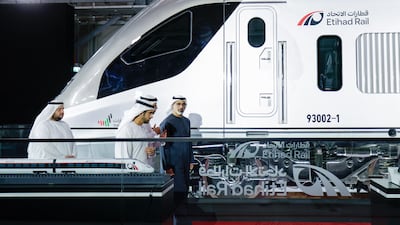
Sheikh Khaled bin Mohamed, Crown Prince of Abu Dhabi, and Sheikh Hamdan bin Mohammed, Crown Prince of Dubai, Deputy Prime Minister and Minister of Defence, inspect the UAE’s first passenger train fleet. Photo: Abu Dhabi Media Office -

Etihad Rail has announced plans for a high-speed passenger rail service between Abu Dhabi and Dubai. Photo: Abu Dhabi Media Office -
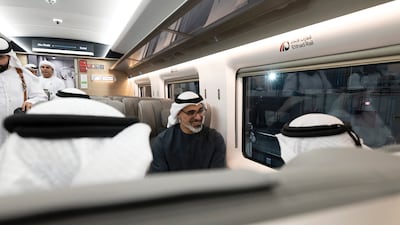
Sheikh Khaled on one of the trains. The service will cut the journey time between the emirates to 30 minutes. Photo: Abu Dhabi Media Office -
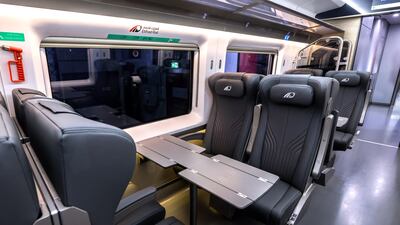
Inside one of the carriages. The trains will travel at up to 350kph. Victor Besa / The National -
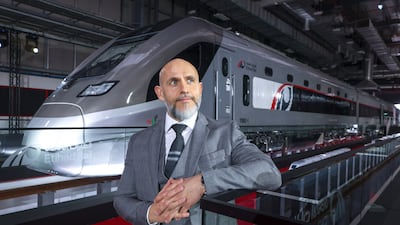
Sebastien Mangeant, executive director of high-speed rail at Etihad Rail, ha said the service will support tourism. Victor Besa / The National -

Inside one of the passenger train carriages. The high-speed trains will help to reduce traffic between Abu Dhabi and Dubai. Victor Besa / The National -
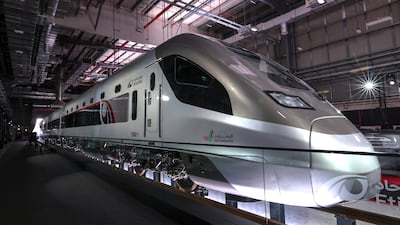
Plans are also in place for a railway connecting the UAE with Oman. Victor Besa / The National


Etihad Rail's much-anticipated passenger train service is set to launch next year, marking a significant step forward for the country's landmark infrastructure project.
In a post on X, Etihad Rail said the UAE-wide line will start operations in 2026. This was confirmed on Thursday by a media relations group working for Etihad Rail.
The rail scheme is viewed as critical to efforts to encourage more people to ditch their cars and embrace public transport.
Etihad Rail in January said the first four passenger stations on the UAE-wide line would be in Abu Dhabi, Dubai, Sharjah and Fujairah. The stations in Sharjah and Fujairah had been announced previously.
Separately, Etihad Rail in January announced plans for an electrified high-speed passenger service between Abu Dhabi and Dubai with its own set of stations.
Construction has yet to start and a date for the launch of services has yet to be revealed.
Work on Etihad Rail began in 2009. Since 2016, two tracks spanning 264km have been in operation – with trains transporting granulated sulphur from gasfields in Shah and Habshan to an export point in Ruwais.
When complete, the network will connect the seven emirates to the five neighbouring GCC states.
The line will ultimately link the UAE and Saudi Arabia from Fujairah Port to Ghuwaifat, through Khalifa Port and Jebel Ali Port.
A railway connecting the UAE with Oman is also planned.

