

Dubai motorists can soon look forward to filling up their cars using neither cash nor card under a new smart payment partnership between the emirate's road toll gate operator and a leading petrol station company.
An agreement announced on Thursday between Salik Company and Emirates National Oil Company (Enoc) will allow for fuel payments at service stations to be deducted from Salik e-wallets.
The move is part of a broader government drive to promote digital services, boost efficiency and raise customer service standards.
When the new digital system will be introduced has yet to be revealed but the companies are to launch joint marketing campaigns to publicise the scheme.
Salik e-wallets are used by drivers as a payment method for charges incurred after passing through the city's 10 toll gates. The account balance can be topped up online to ensure sufficient funds are in place at all times.
Under the plan, cameras with automatic number-plate recognition technology will be used at Enoc's network of service stations to identify the driver's Salik registration.
Payment can then be deducted automatically from the Salik account linked to the number plate.
Enoc has more than 200 service stations across the UAE, including 114 in Dubai.
“Our collaboration with Enoc supports Salik’s broader strategy to drive digital transformation across the transportation and services sector," said Ibrahim Al Haddad, chief executive of Salik Company.
"By introducing innovative, secure and seamless payment methods, we aim to enhance convenience for customers and road users.
"This partnership reinforces our commitment to delivering advanced technologies that simplify transactions, improve operational efficiency, and strengthen Salik’s position as a key enabler of sustainable and intelligent mobility solutions across the emirate of Dubai.”
Saif Al Falasi, group chief executive of Enoc, said the agreement was a "significant step towards enhancing the customer journey at our service stations".
Why Dubai introduced toll gates
-
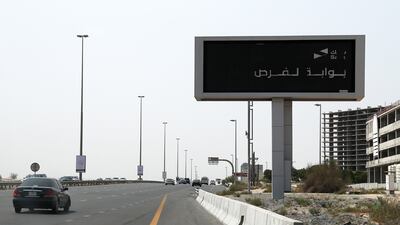
Electronic traffic signs on Umm Sequim St, which is being used to advertise the new Salik IPO scheme in Dubai. Pawan Singh / The National -

Vehicles pass under a toll gate on Sheikh Zayed Road in Dubai on Monday, September 5, 2022. Toll gate operator Salik will make an initial public offering on the emirate's stock market, becoming the latest state-linked company to list. AP -

Electronic traffic signs on Al Khail, which is being used to advertise the new Salik IPO scheme in Dubai. Pawan Singh / The National -
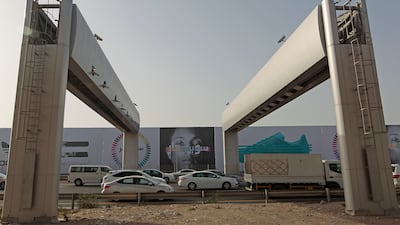
Drivers are charged Dh4 ($1.09) for each gate that they pass through. There are eight gates at present, but Salik's IPO prospectus says that more could be built. The National -
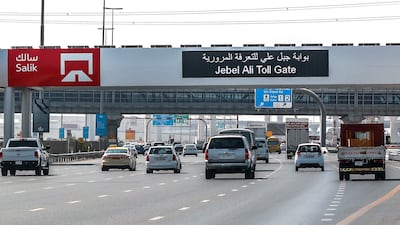
Motorists are required to have a tag on the windscreen of their car and an online account to use the high-speed motorway. Victor Besa / The National -
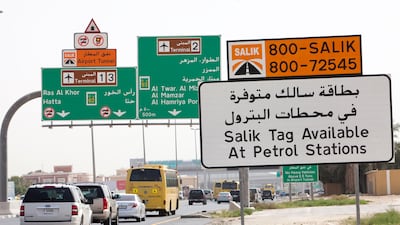
Signs warn drivers that they need a tag on their vehicle to use this road. Jaime Puebla / The National -
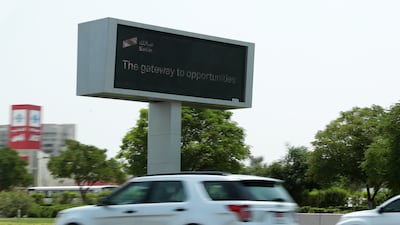
Electronic traffic signs on E311 highway, which is being used to advertise the new Salik IPO scheme in Dubai. Pawan Singh / The National


The Salik system was introduced in 2007 to ease traffic congestion, raise state revenue and encourage residents to use public transport.
The first two gates were installed in Gharoud and Barsha, with Safa and Maktoum bridge gates added a year later. In 2013, three more were introduced, at Airport Tunnel, and two at Mamzar – south and north. In 2018, the Jebel Ali gate was created.
Two new Salik gates – at the Business Bay Crossing on Al Khail Road and at Al Safa South on Sheikh Zayed Road – were activated in November.
Motorists are charged to pass through each gate, with the amount deducted automatically from tags fixed to vehicle windscreens. The tags can be bought online or at service stations, and topped up online or through recharge cards.

