


UK health chiefs have underlined the need to protect a treasure trove of medical data as the industry embarks on a new digital era, amid the growing threat posed by cyber criminals to hospitals and their patients.
Speaking at the Arab Health conference in Dubai, senior NHS officials said there was huge potential in vast amounts of data mined in UK hospitals and clinics, every day.
Health data could be used to improve patient care, and the way they interact with treatments and medications, while also helping hospitals operate with greater efficiency.
NHS Trust chief executive
“Our inability to transfer data is a problem to us and continues to be a problem,” said Ged Byrne, NHS director of global health and a surgical oncologist.
“We have 76 years of unfiltered data for the largest and oldest universal health public system in history. The amount of data that could potentially be useful if cleaned is limitless, and could potentially have a very positive impact on world health. That is for shaping healthcare response, pathway spend and governance. We've got data on just about everything you can possibly think of. It's genuinely big and extraordinary.”
Data-sharing challenges
Challenges include how to store huge volumes of data, and share it securely with other health systems around the world, including the UAE.
Cyber attacks on health systems have impacted millions of patients around the world in recent years, leaking sensitive information from names and social security numbers, to credit card numbers, medical data and sensitive clinical information.
In June last year, NHS England confirmed patient data was stolen in a ransomware attack by a Russian cyber criminal group. More than 3,000 hospitals and GP surgeries were disrupted as criminals attempted to extort money from the pathology testing company contract by the NHS, Synnovis.
“We're doing a million interactions over 16 hours, and our ability to record that in the data is improving, but sharing data is the issue,” Prof Byrne told The National.
“We have not yet developed a safe mechanism which satisfies all parties. There needs to be a much clearer set of standards against which we share data – that's really important, to understand how we leverage that data.”
UK-UAE collaboration
Medical tourism is a major aspect of the UAE's health industry. UK health institutions view the UAE and wider GCC as prime locations to establish outposts of existing hospitals and clinics.
London’s Kings College Hospital has a gleaming centre in Dubai Hills, while Moorfields Eye Hospital also has centres in Dubai and Abu Dhabi.
NHS leaders were in the UAE during Arab Health to discuss further collaboration and sharing of innovation, including the greater use of advanced technology.
AI can bring efficiencies
Ayub Bhayat, director of data services and deputy chief data and analytics officer at NHS England, said the use of AI will process the data to speed up care, cut waiting times and find new ways to deliver existing drugs for several conditions.
“We're on a journey to organise all the data assets into one repository, so AI will then do the heavy lifting, making clinicians’ lives easier to focus on the really important stuff,” Mr Bhayat said.

Mr Bhayat was responsible for the largest non-clinical procurement in NHS history – the £330 million ($410 million) Federated Data Platform – and is now leading the strategy of data transformation for the NHS.
The platform is being used to resolve common problems facing the NHS such as elective waiting lists and hospital capacity. It is being used by 71 NHS organisations.
AI can maximise availability in operating theatres, by prioritising patients based on their clinical data. In each hospital where it is used, doctors are seeing 119 extra patients a month, Mr Bhayat said.
Drug discovery is another area due to benefit from improved AI systems and data collection. By locating the right patients for the right trials, it is hoped AI can find wider suitability for certain medicines.
A vaccine for shingles, anti-inflammatory drug Ibuprofen and some antiviral drugs have been found to potentially delay the onset of dementia, in early research.
“These models can be run at speed as well to understand the impact of that drug,” said Mr Bhayat. “Since we've implemented this data platform, there's been a 54,000 additional surgeries taking place – that’s just using existing capacity of existing people. As we get more and more sophisticated, Generative AI will see the models start to self learn even more.”
Staffing and the global health workforce was another topic for discussion with NHS leaders during Arab Health. A long-standing global health worker shortage has gathered pace since the pandemic.
Global workforce shortage
In the US, hospitals heavily rely on foreign workers, with more than 2.6 million immigrants working in healthcare roles.
Meanwhile in the UK, Filipino workers make up 27 per cent of healthcare staff. A shortfall of 10 million health workers worldwide has been predicted by the WHO by 2030, with one in five nurses considering leaving the profession in the UK, Canada, the US, France and Belgium.
Matthew Trainer, chief executive of Barking, Havering and Redbridge University Hospitals NHS Trust (BHRUT), employs more than 8,000 staff. At Arab Health, he told The National that competition has made recruitment harder.

“Internationally, we all have the same set of challenges; the ageing population and workforce,” Mr Trainer said. “The pandemic has been a challenge because people have seen what it's like to work at the very sharp end of acute healthcare, and that was a very difficult phase for everybody.
“What we still see coming through in our newer recruits is people are attracted to the values of the NHS, particularly a younger workforce. Health care is an area where when you do your job well, someone else's life is better. If we get it right for them, it really is life-changing.”
Arab Health 2025 – in pictures
-

Visitors on the first day of the Arab Health Conference held at Dubai World Trade Centre. Pawan Singh / The National -

Visitors on the first day of the Arab Health Conference, which is celebrating its 50th year. Pawan Singh / The National -
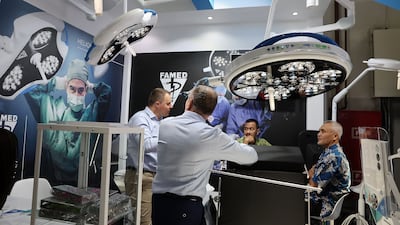
The latest medical devices and diagnostic scanners were on display at the exhibition. Pawan Singh / The National -
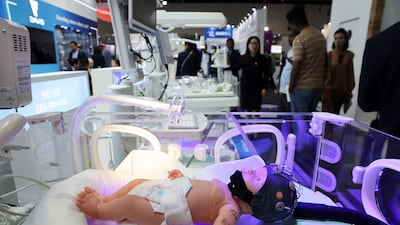
An infant incubator on display at the event. Pawan Singh / The National -
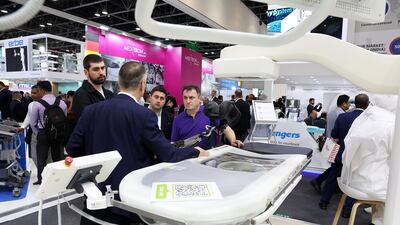
The Arab Health Conference runs until Thursday. Pawan Singh / The National -
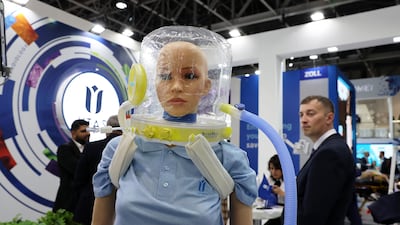
Significant focus has been placed on technology during the conference. Automation will be integral across all future medical operations. Pawan Singh / The National -
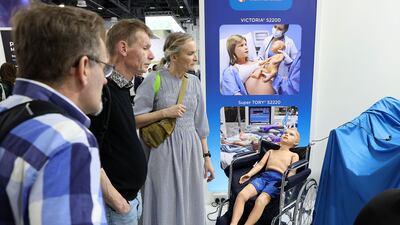
Visitors on the first day of the Arab Health Conference. Pawan Singh / The National -
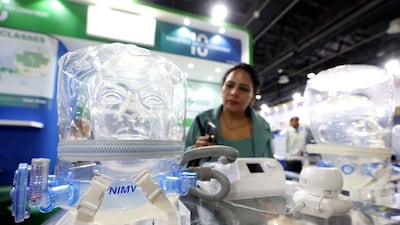
A helmet mask for breathing in an ICU is displayed on the second day of Arab Health 2025 at the conference. Chris Whiteoak / The National -
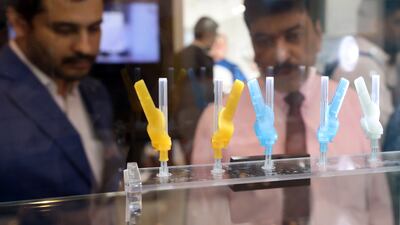
Safety needles on display at the Dubai conference. Chris Whiteoak / The National -
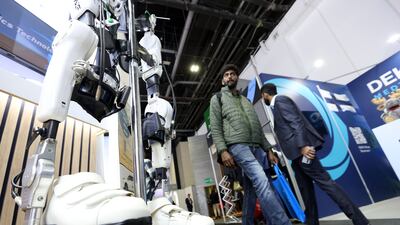
Cyberdyne's active exoskeleton with bioelectrical signals at the Arab Health Conference. Chris Whiteoak / The National



