


Estonia is leading the way in how the world could one day become 100 per cent digital, with health care the most likely industry to improve as a result.
On day two of Arab Health 2025, delegates from the Baltic state, which has a population of about 1.3 million, were displaying the latest developments in a digitalised society that has become a beacon for the rest of the world.
The foundation stone for Estonia’s digital ecosystem has been in place for more than 20 years, with almost all government services now online, and records held securely for users and government departments to access with a few smartphone finger swipes.
Estonians can now access all government services through a portal using a single, centralised log-in, connecting them to an entire online network, from education and employment records, to marriage and divorce.
But it is in the healthcare sector, where the country is 100 per cent digital, that the results are proving most transformative. With patient permission, doctors can access entire medical history, from dental records to prescriptions and scan results.
Agreements are also in place for records to be shared among neighbouring countries under agreed partnerships, allowing Estonians to collect medication in nations such as Latvia and Finland.
Model nation
Estonia's data-driven network came first in last year's Digital Health Index by Bertelsmann Stiftung, making it a model that is being replicated not only in the UAE but across the world.
“Digitalisation started in 1996 when the government actually took the decision to bring computers to all schools and everybody got access to some first level programming,” said Reet Reinart-Okugbeni, a leading R&D expert at Estonia’s Applied Research Programme.
“It has been very gradual but it has prepared the country for this process. Now you can access most of your health history from this one platform. We can access records from our mobile phones to see the different appointments we've taken and the different kind of prescriptions we were prescribed.”

The digital process uses emerging technology and digital tools that can help diagnose ailments in the home and better manage patient flow through health systems. By cutting the need for physical movement, processes can be more easily automated, preparing health systems for advancements in technology.
"Our fully integrated digital health system empowers every citizen with secure access to their online health records, seamlessly connecting data from healthcare providers across the nation,” said Maria Belovas, Estonia’s ambassador to the UAE. “This initiative exemplifies how a collaborative approach between state-backed innovation and private-sector expertise can revolutionise healthcare accessibility and enhance efficiency.”
The country is also developing home-grown solutions to tackle everyday health challenges for Estonians. Estonia’s pioneering e-prescription system, Helmes, connects doctors, pharmacies and patients to enhance efficiency, while the National Health Record, Nortal, uses blockchain security for data integrity, ensuring transparency in all digital systems.
Superbrain
Another Estonian device is the Superbrain headset by Tallinn company, 7Sense. The €9,000 ($9,384) device uses patented haptic technology that helps blind people safely navigate the outside world, similar to a guide dog.
A number of cameras monitor the surrounding area, creating soft touch-like sensations to warn users of objects and hazards.
“This device allows the blind to feel the surrounding environment with the sense of touch, they can feel the surrounding objects, motion and speed,” said Madis Paev, co-founder of 7Sense. “Usually if you hand something to a blind person, you have to take their hand and put the object there. With this device they can actually understand where the object is.”
The headset has been designed and manufactured in Estonia, from where it is also being sold. It is also being used in Germany and the UK.

What about the UAE?
The UAE is fast catching up with the digital success of Estonia and is leading the way in its own transformation in Gulf countries.
“In Abu Dhabi I can comfortably say we are 100 per cent digitised through our Health Services platform, Malaffi,” said Dr Fahed Al Marzooqi, chief executive of integrated health solutions platform M42. “All of the hospitals are connected, as are the labs and pharmacies.
“So if you see a physician in Cleveland Clinic AD and then later a physician in NMC, we can see your journey digitally, what has been ordered, what has been prescribed and what tests you have gone through. This is providing optimal care to the patient and expediting care delivery. It is also minimising harm and impacting healthcare expenditure because we're not repeating tests.”
Innovation and the use of AI is also a key part of the digital transformation across many of the UAE’s private facilities, including at Saudi German Hospital.
The hospital group recently partnered with iO Health to integrate AI in all its operations, including clinical decision-making and to optimise resources.
It also aims to simplify complex healthcare pathways, improve patient engagement and also hand doctors the most advanced tools for more precise treatments.
“This is a pivotal step in our journey toward a fully digitalised healthcare ecosystem,” said Dr Ahmed Eissa, Group CEO of Saudi German Hospital, UAE.
“By integrating AI into our operations, we are not just improving efficiency; we are transforming the way healthcare is delivered in the UAE.
“Our focus is on creating a system that empowers patients, supports clinicians, and ensures better health outcomes.”
Arab Health 2025 - in pictures
-

Visitors on the first day of the Arab Health Conference held at Dubai World Trade Centre. Pawan Singh / The National -

Visitors on the first day of the Arab Health Conference, which is celebrating its 50th year. Pawan Singh / The National -
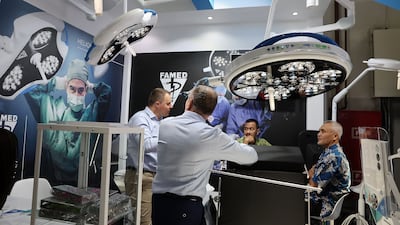
The latest medical devices and diagnostic scanners were on display at the exhibition. Pawan Singh / The National -
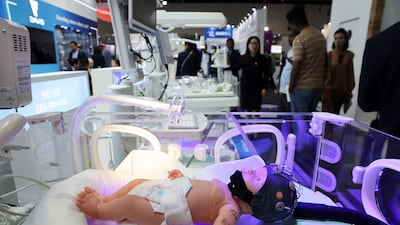
An infant incubator on display at the event. Pawan Singh / The National -
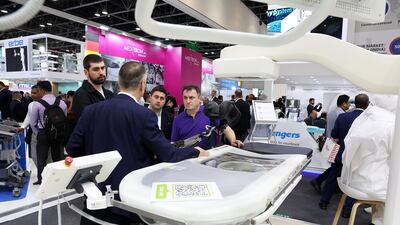
The Arab Health Conference runs until Thursday. Pawan Singh / The National -
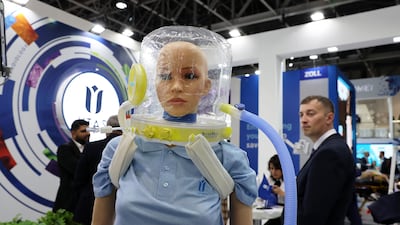
Significant focus has been placed on technology during the conference. Automation will be integral across all future medical operations. Pawan Singh / The National -
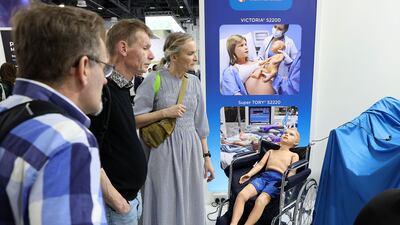
Visitors on the first day of the Arab Health Conference. Pawan Singh / The National -
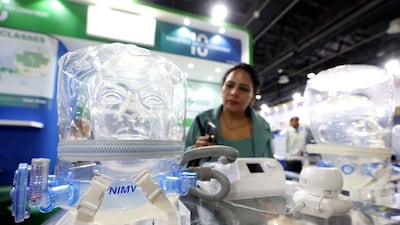
A helmet mask for breathing in an ICU is displayed on the second day of Arab Health 2025 at the conference. Chris Whiteoak / The National -
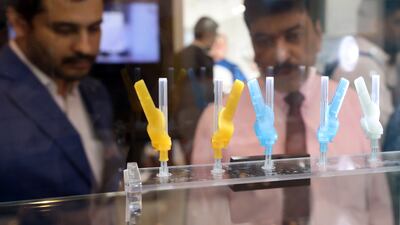
Safety needles on display at the Dubai conference. Chris Whiteoak / The National -
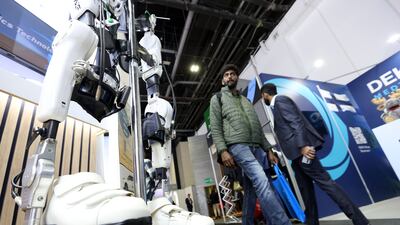
Cyberdyne's active exoskeleton with bioelectrical signals at the Arab Health Conference. Chris Whiteoak / The National



