• Sheikh Khaled bin Mohamed, Crown Prince of Abu Dhabi, and Sheikh Hamdan bin Mohammed, Crown Prince of Dubai, Deputy Prime Minister and Minister of Defence, inspect the UAE’s first passenger train fleet. Photo: Abu Dhabi Media Office
    Sheikh Khaled bin Mohamed, Crown Prince of Abu Dhabi, and Sheikh Hamdan bin Mohammed, Crown Prince of Dubai, Deputy Prime Minister and Minister of Defence, inspect the UAE’s first passenger train fleet. Photo: Abu Dhabi Media Office
  • Etihad Rail has announced plans for a high-speed passenger rail service between Abu Dhabi and Dubai. Photo: Abu Dhabi Media Office
    Etihad Rail has announced plans for a high-speed passenger rail service between Abu Dhabi and Dubai. Photo: Abu Dhabi Media Office
  • Sheikh Khaled on one of the trains. The service will cut the journey time between the emirates to 30 minutes. Photo: Abu Dhabi Media Office
    Sheikh Khaled on one of the trains. The service will cut the journey time between the emirates to 30 minutes. Photo: Abu Dhabi Media Office
  • Inside one of the carriages. The trains will travel at up to 350kph. Victor Besa / The National
    Inside one of the carriages. The trains will travel at up to 350kph. Victor Besa / The National
  • Sebastien Mangeant, executive director of high-speed rail at Etihad Rail, ha said the service will support tourism. Victor Besa / The National
    Sebastien Mangeant, executive director of high-speed rail at Etihad Rail, ha said the service will support tourism. Victor Besa / The National
  • Inside one of the passenger train carriages. The high-speed trains will help to reduce traffic between Abu Dhabi and Dubai. Victor Besa / The National
    Inside one of the passenger train carriages. The high-speed trains will help to reduce traffic between Abu Dhabi and Dubai. Victor Besa / The National
  • Plans are also in place for a railway connecting the UAE with Oman. Victor Besa / The National
    Plans are also in place for a railway connecting the UAE with Oman. Victor Besa / The National

Etihad Rail announces 30-minute high-speed passenger service between Abu Dhabi and Dubai


John Dennehy
  • English
  • Arabic

A high-speed passenger rail service between Abu Dhabi and Dubai is set to become a reality, it was announced on Thursday.

Detailing the plans, Abu Dhabi Media Office said the new line from Etihad Rail would cut the journey time between the two emirates to 30 minutes.

Trains will run at up to 350kph on a route that will pass through "key destinations and tourist attractions".

The new high-speed electrified line will feature six stations at Reem Island, Yas Island, Saadiyat Island, Zayed Airport, close to Al Maktoum Airport in Dubai and Jaddaf, near Dubai Creek, Etihad Rail said.

Construction has yet to start and a date for the launch of services was not revealed but tenders for contracts have been issued and network designs approved, Etihad Rail said.

Thursday's announcement at Al Faya Depot in Abu Dhabi was witnessed by Sheikh Khaled bin Mohamed, Crown Prince of Abu Dhabi, and Sheikh Hamdan bin Mohammed, Crown Prince of Dubai, Deputy Prime Minister and Minister of Defence.

The project reflects the nation's vision to advance national infrastructure and elevate mobility services to the highest standards, state news agency Wam reported Sheikh Khaled as saying. He added that the high-speed trains would bolster the UAE’s global competitiveness, support sustainable development and solidify the nation’s position as a global model for progress.

The project will transform the daily commute between Abu Dhabi and Dubai to enhance the lives of citizens, residents and tourists, Sheikh Hamdan said.

Sebastien Mangeant, executive director for high speed at Etihad Rail, told The National that people could expect a high-frequency service to enable commuters to reach their destination safer, faster and avoiding driving for long periods.

“This is really the main appeal of this and ... of course the safety of the rail, which you can't beat," he said. "And the support for tourism.”

Designs of the stations and their precise locations have yet to be revealed but more areas than those outlined on Thursday could be served. “It's not the end of the adventure,” said Mr Mangeant. “It's just a phase one."

He said a typical high-speed train can carry 400 passengers but this could go as high as 600 depending on the stock which has not yet been selected.

The high-speed project is separate from the previously announced Etihad Rail passenger service, in which trains will travel at 200kph carrying up to 400 passengers when the service is launched. That regular service also uses the same network as the UAE’s freight trains.

It has yet to be disclosed whether the high-speed line will be integrated with the regular Etihad Rail line, which will use diesel locomotives.

Mr Mangeant said the high-speed line is “not a stand-alone project in itself” and “you don't want to arrive in the middle of nowhere and then have no link”. While both can be integrated in certain ways, “they are different animals”.

“We don't know yet,” he said. “We're not announcing anything right now.” But he did say a considerable amount of work was being done to ensure passengers had a seamless experience. “We're taking care of this,” he added.

It has yet known how much fares will cost. Nor was a cost for the construction of the line disclosed – high-speed rail networks tend to be significantly more expensive than regular lines. However, they reduce travel times and also lead to less congestion and lower emissions.

Currently, the only way of travelling between the emirates is by car or bus.

“We're not announcing anything such as planning and cost right now,” Mr Mangeant said.

According to the International Railway Journal, the cost of high-speed lines in Europe designed for operation at 300kph or faster is estimated to be $25 million-$39 million per km and as high as $52 million per km in California. In other countries it can be more cost effective.

The project will also relieve pressure on busy UAE roads and has the potential to transform transport, commerce, tourism and even property prices across both emirates. Officials say the high-speed train is expected to contribute Dh145 billion ($40 billion) to the UAE's GDP in the next five decades.

First passenger stations

Also announced on Thursday were the first four passenger stations on the regular line to be built in the UAE, in Abu Dhabi, Dubai, Sharjah and Fujairah. Two in Sharjah and Fujairah had already been announced.

The stations will integrate with Metro and bus lines, and be equipped with business-class lounges, shops and family-friendly amenities. A model of a station was on display at Al Faya Depot showing a distinctive concrete facade.

“This is the look and feel of the conventional stations," said Mr Mangeant. "The model is your typical station look and feel.”

Also on display was a new passenger train, which is expected to be one that carries people across the UAE when the regular service is launched.

Inside the feel is slick and sleek, with three classes including a separate business-class section. Walking through the train, Mr Mangeant was inspired by the scale of the project. “It's a dream come true," he said.

The network

The main Etihad Rail passenger network will link 11 cities and regions across the country. No date has been confirmed for when the UAE-wide passenger service will start.

Etihad Rail has previously announced travelling from Abu Dhabi to Dubai on the regular line will take 57 minutes, while a journey from the capital to Fujairah will take 105 minutes. Officials have said they expect more than 36 million people a year to be using the service by 2030.

Etihad Rail’s freight network is already up and running.

Trains to Oman

A railway connecting the UAE with Oman is also planned. Hafeet Rail, a joint venture between Etihad Rail, Oman Rail and Mubadala Investment Company, is developing the project.

The network will connect Sohar, via Sohar Port, to Abu Dhabi. Trains are estimated to take 1 hour 40 minutes from Abu Dhabi to Sohar, and only 47 minutes from Al Ain to Sohar.

A start date for this service has also yet to be announced.

The Etihad Rail network - in pictures

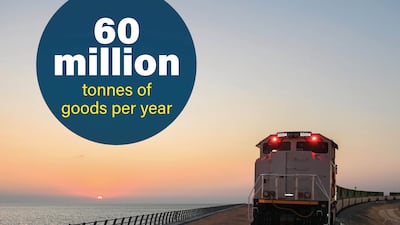
  • Etihad Rail's freight network is now operational. It can transport 60 million tonnes of goods a year. All photos: Etihad Rail
    Etihad Rail's freight network is now operational. It can transport 60 million tonnes of goods a year. All photos: Etihad Rail
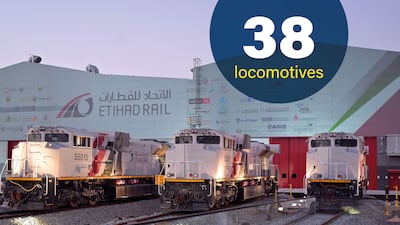
  • The new freight service has 38 locomotives
    The new freight service has 38 locomotives
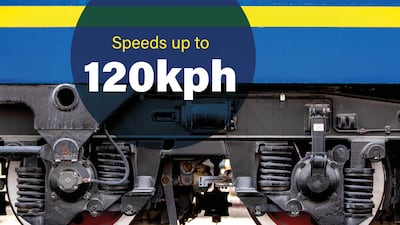
  • The freight trains will run up to 120kph, with each locomotive operating at 4,500 horsepower
    The freight trains will run up to 120kph, with each locomotive operating at 4,500 horsepower
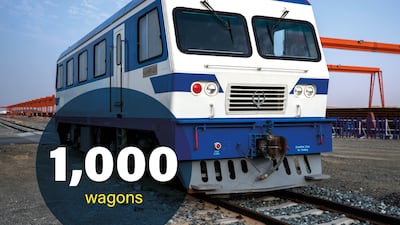
  • The locomotives pull a total of 1,000 wagons, transporting goods ranging from shipping containers to industrial material
    The locomotives pull a total of 1,000 wagons, transporting goods ranging from shipping containers to industrial material
  • The tracks cross the UAE and feature 593 bridges
    The tracks cross the UAE and feature 593 bridges
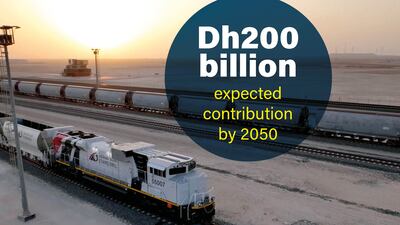
  • The network will contribute Dh200 billion ($54.4 billion) to the UAE economy and save Dh8 billion in road maintenance costs
    The network will contribute Dh200 billion ($54.4 billion) to the UAE economy and save Dh8 billion in road maintenance costs
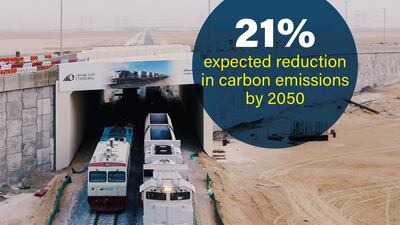
  • The project also aims to reduce carbon emissions from the road transport sector by 21 per cent by 2050, boosting the country's efforts to become net zero
    The project also aims to reduce carbon emissions from the road transport sector by 21 per cent by 2050, boosting the country's efforts to become net zero
What is the FNC?

The Federal National Council is one of five federal authorities established by the UAE constitution. It held its first session on December 2, 1972, a year to the day after Federation.
It has 40 members, eight of whom are women. The members represent the UAE population through each of the emirates. Abu Dhabi and Dubai have eight members each, Sharjah and Ras al Khaimah six, and Ajman, Fujairah and Umm Al Quwain have four.
They bring Emirati issues to the council for debate and put those concerns to ministers summoned for questioning. 
The FNC’s main functions include passing, amending or rejecting federal draft laws, discussing international treaties and agreements, and offering recommendations on general subjects raised during sessions.
Federal draft laws must first pass through the FNC for recommendations when members can amend the laws to suit the needs of citizens. The draft laws are then forwarded to the Cabinet for consideration and approval. 
Since 2006, half of the members have been elected by UAE citizens to serve four-year terms and the other half are appointed by the Ruler’s Courts of the seven emirates.
In the 2015 elections, 78 of the 252 candidates were women. Women also represented 48 per cent of all voters and 67 per cent of the voters were under the age of 40.
 

Who's who in Yemen conflict

Houthis: Iran-backed rebels who occupy Sanaa and run unrecognised government

Yemeni government: Exiled government in Aden led by eight-member Presidential Leadership Council

Southern Transitional Council: Faction in Yemeni government that seeks autonomy for the south

Habrish 'rebels': Tribal-backed forces feuding with STC over control of oil in government territory

UAE SQUAD

Khalid Essa, Ali Khaseif, Fahad Al Dhanhani, Adel Al Hosani, Bandar Al Ahbabi, Mohammad Barghash, Salem Rashid, Khalifa Al Hammadi, Shaheen Abdulrahman, Hassan Al Mahrami, Walid Abbas, Mahmoud Khamis, Yousef Jaber, Majed Sorour, Majed Hassan, Ali Salmeen, Abdullah Ramadan, Abdullah Al Naqbi, Khalil Al Hammadi, Fabio De Lima, Khalfan Mubarak, Tahnoon Al Zaabi, Ali Saleh, Caio Canedo, Ali Mabkhout, Sebastian Tagliabue, Zayed Al Ameri

Libya's Gold

UN Panel of Experts found regime secretly sold a fifth of the country's gold reserves. 

The panel’s 2017 report followed a trail to West Africa where large sums of cash and gold were hidden by Abdullah Al Senussi, Qaddafi’s former intelligence chief, in 2011.

Cases filled with cash that was said to amount to $560m in 100 dollar notes, that was kept by a group of Libyans in Ouagadougou, Burkina Faso.

A second stash was said to have been held in Accra, Ghana, inside boxes at the local offices of an international human rights organisation based in France.

Islamophobia definition

A widely accepted definition was made by the All Party Parliamentary Group on British Muslims in 2019: “Islamophobia is rooted in racism and is a type of racism that targets expressions of Muslimness or perceived Muslimness.” It further defines it as “inciting hatred or violence against Muslims”.

Ziina users can donate to relief efforts in Beirut

Ziina users will be able to use the app to help relief efforts in Beirut, which has been left reeling after an August blast caused an estimated $15 billion in damage and left thousands homeless. Ziina has partnered with the United Nations High Commissioner for Refugees to raise money for the Lebanese capital, co-founder Faisal Toukan says. “As of October 1, the UNHCR has the first certified badge on Ziina and is automatically part of user's top friends' list during this campaign. Users can now donate any amount to the Beirut relief with two clicks. The money raised will go towards rebuilding houses for the families that were impacted by the explosion.”

Moon Music

Artist: Coldplay

Label: Parlophone/Atlantic

Number of tracks: 10

Rating: 3/5

WHY%20AAYAN%20IS%20'PERFECT%20EXAMPLE'
%3Cp%3EDavid%20White%20might%20be%20new%20to%20the%20country%2C%20but%20he%20has%20clearly%20already%20built%20up%20an%20affinity%20with%20the%20place.%3Cbr%3E%3Cbr%3EAfter%20the%20UAE%20shocked%20Pakistan%20in%20the%20semi-final%20of%20the%20Under%2019%20Asia%20Cup%20last%20month%2C%20White%20was%20hugged%20on%20the%20field%20by%20Aayan%20Khan%2C%20the%20team%E2%80%99s%20captain.%3Cbr%3E%3Cbr%3EWhite%20suggests%20that%20was%20more%20a%20sign%20of%20Aayan%E2%80%99s%20amiability%20than%20anything%20else.%20But%20he%20believes%20the%20young%20all-rounder%2C%20who%20was%20part%20of%20the%20winning%20Gulf%20Giants%20team%20last%20year%2C%20is%20just%20the%20sort%20of%20player%20the%20country%20should%20be%20seeking%20to%20produce%20via%20the%20ILT20.%3Cbr%3E%3Cbr%3E%E2%80%9CHe%20is%20a%20delightful%20young%20man%2C%E2%80%9D%20White%20said.%20%E2%80%9CHe%20played%20in%20the%20competition%20last%20year%20at%2017%2C%20and%20look%20at%20his%20development%20from%20there%20till%20now%2C%20and%20where%20he%20is%20representing%20the%20UAE.%3Cbr%3E%3Cbr%3E%E2%80%9CHe%20was%20influential%20in%20the%20U19%20team%20which%20beat%20Pakistan.%20He%20is%20the%20perfect%20example%20of%20what%20we%20are%20all%20trying%20to%20achieve%20here.%3Cbr%3E%3Cbr%3E%E2%80%9CIt%20is%20about%20the%20development%20of%20players%20who%20are%20going%20to%20represent%20the%20UAE%20and%20go%20on%20to%20help%20make%20UAE%20a%20force%20in%20world%20cricket.%E2%80%9D%C2%A0%3C%2Fp%3E%0A
Haircare resolutions 2021

From Beirut and Amman to London and now Dubai, hairstylist George Massoud has seen the same mistakes made by customers all over the world. In the chair or at-home hair care, here are the resolutions he wishes his customers would make for the year ahead.

1. 'I will seek consultation from professionals'

You may know what you want, but are you sure it’s going to suit you? Haircare professionals can tell you what will work best with your skin tone, hair texture and lifestyle.

2. 'I will tell my hairdresser when I’m not happy'

Massoud says it’s better to offer constructive criticism to work on in the future. Your hairdresser will learn, and you may discover how to communicate exactly what you want more effectively the next time.

3. ‘I will treat my hair better out of the chair’

Damage control is a big part of most hairstylists’ work right now, but it can be avoided. Steer clear of over-colouring at home, try and pursue one hair brand at a time and never, ever use a straightener on still drying hair, pleads Massoud.

Everybody%20Loves%20Touda
%3Cp%3E%3Cstrong%3EDirector%3A%3C%2Fstrong%3E%20Nabil%20Ayouch%C2%A0%3C%2Fp%3E%0A%3Cp%3E%3Cstrong%3EStarring%3A%3C%2Fstrong%3E%20Nisrin%20Erradi%2C%20Joud%20Chamihy%2C%20Jalila%20Talemsi%3C%2Fp%3E%0A%3Cp%3E%3Cstrong%3ERating%3A%20%3C%2Fstrong%3E4%2F5%3C%2Fp%3E%0A
Company%C2%A0profile
%3Cp%3E%3Cstrong%3EDate%20started%3A%20%3C%2Fstrong%3EMay%202022%3Cbr%3E%3Cstrong%3EFounder%3A%20%3C%2Fstrong%3EHusam%20Aboul%20Hosn%3Cbr%3E%3Cstrong%3EBased%3A%20%3C%2Fstrong%3EDIFC%3Cbr%3E%3Cstrong%3ESector%3A%20%3C%2Fstrong%3EFinTech%20%E2%80%94%20Innovation%20Hub%3Cbr%3E%3Cstrong%3EEmployees%3A%20%3C%2Fstrong%3Eeight%3Cbr%3E%3Cstrong%3EStage%3A%20%3C%2Fstrong%3Epre-seed%3Cbr%3E%3Cstrong%3EInvestors%3A%20%3C%2Fstrong%3Epre-seed%20funding%20raised%20from%20family%20and%20friends%20earlier%20this%20year%3C%2Fp%3E%0A
TEACHERS' PAY - WHAT YOU NEED TO KNOW

Pay varies significantly depending on the school, its rating and the curriculum. Here's a rough guide as of January 2021:

- top end schools tend to pay Dh16,000-17,000 a month - plus a monthly housing allowance of up to Dh6,000. These tend to be British curriculum schools rated 'outstanding' or 'very good', followed by American schools

- average salary across curriculums and skill levels is about Dh10,000, recruiters say

- it is becoming more common for schools to provide accommodation, sometimes in an apartment block with other teachers, rather than hand teachers a cash housing allowance

- some strong performing schools have cut back on salaries since the pandemic began, sometimes offering Dh16,000 including the housing allowance, which reflects the slump in rental costs, and sheer demand for jobs

- maths and science teachers are most in demand and some schools will pay up to Dh3,000 more than other teachers in recognition of their technical skills

- at the other end of the market, teachers in some Indian schools, where fees are lower and competition among applicants is intense, can be paid as low as Dh3,000 per month

- in Indian schools, it has also become common for teachers to share residential accommodation, living in a block with colleagues

Mercer, the investment consulting arm of US services company Marsh & McLennan, expects its wealth division to at least double its assets under management (AUM) in the Middle East as wealth in the region continues to grow despite economic headwinds, a company official said.

Mercer Wealth, which globally has $160 billion in AUM, plans to boost its AUM in the region to $2-$3bn in the next 2-3 years from the present $1bn, said Yasir AbuShaban, a Dubai-based principal with Mercer Wealth.

Within the next two to three years, we are looking at reaching $2 to $3 billion as a conservative estimate and we do see an opportunity to do so,” said Mr AbuShaban.

Mercer does not directly make investments, but allocates clients’ money they have discretion to, to professional asset managers. They also provide advice to clients.

“We have buying power. We can negotiate on their (client’s) behalf with asset managers to provide them lower fees than they otherwise would have to get on their own,” he added.

Mercer Wealth’s clients include sovereign wealth funds, family offices, and insurance companies among others.

From its office in Dubai, Mercer also looks after Africa, India and Turkey, where they also see opportunity for growth.

Wealth creation in Middle East and Africa (MEA) grew 8.5 per cent to $8.1 trillion last year from $7.5tn in 2015, higher than last year’s global average of 6 per cent and the second-highest growth in a region after Asia-Pacific which grew 9.9 per cent, according to consultancy Boston Consulting Group (BCG). In the region, where wealth grew just 1.9 per cent in 2015 compared with 2014, a pickup in oil prices has helped in wealth generation.

BCG is forecasting MEA wealth will rise to $12tn by 2021, growing at an annual average of 8 per cent.

Drivers of wealth generation in the region will be split evenly between new wealth creation and growth of performance of existing assets, according to BCG.

Another general trend in the region is clients’ looking for a comprehensive approach to investing, according to Mr AbuShaban.

“Institutional investors or some of the families are seeing a slowdown in the available capital they have to invest and in that sense they are looking at optimizing the way they manage their portfolios and making sure they are not investing haphazardly and different parts of their investment are working together,” said Mr AbuShaban.

Some clients also have a higher appetite for risk, given the low interest-rate environment that does not provide enough yield for some institutional investors. These clients are keen to invest in illiquid assets, such as private equity and infrastructure.

“What we have seen is a desire for higher returns in what has been a low-return environment specifically in various fixed income or bonds,” he said.

“In this environment, we have seen a de facto increase in the risk that clients are taking in things like illiquid investments, private equity investments, infrastructure and private debt, those kind of investments were higher illiquidity results in incrementally higher returns.”

The Abu Dhabi Investment Authority, one of the largest sovereign wealth funds, said in its 2016 report that has gradually increased its exposure in direct private equity and private credit transactions, mainly in Asian markets and especially in China and India. The authority’s private equity department focused on structured equities owing to “their defensive characteristics.”

Avatar: Fire and Ash

Director: James Cameron

Starring: Sam Worthington, Sigourney Weaver, Zoe Saldana

Rating: 4.5/5

Updated: January 27, 2025, 3:55 AM