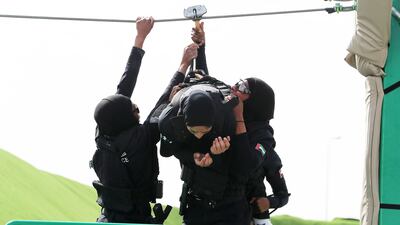
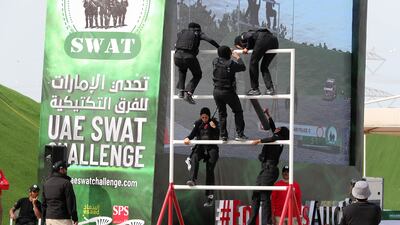
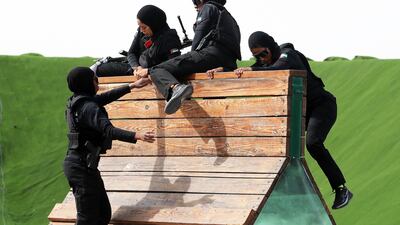
Aspiring UAE police officers will be given the chance to pit their wits against elite crimefighters from around the globe at this year's UAE Swat Challenge in Dubai.
Three teams from Dubai Police Academy will be among 114 squads drawn from 48 countries competing for a total of Dh1 million in prizes at the sixth annual event, being staged at the Dubai Police training centre in Al Ruwayyah from February 1 to 5.
Six student teams will line up for the competition, marking the first time academies have taken part.
The UAE Swat Challenge offers seasoned task forces an opportunity to sharpen their skills, while promoting co-operation and the sharing of international expertise.
Entrants will be put through their paces in a series of challenges, including tactical exercises, assault and obstacle courses, officer rescues and tower climbs, designed to assess tactical acumen, mental focus and physical endurance.
First Lt Yaser Al Zarouni, leader of the Dubai Police teams said the force's student teams were ready to rise to the challenge next month.
“The students were trained by the same coaches who prepare Dubai’s specialised tactical units,” he said.
“Their passion and drive are impressive, and they are eager to prove their capabilities. If they win, they will receive the same prizes as the professional teams.”
Five all-women teams and eight debutant outfits will be hitting the ground running in Dubai.
The UAE will be represented by three teams from Abu Dhabi Police, three from Dubai Police, one from Ajman Police, one from Fujairah Police, one from Ras Al Khaimah Police, three teams from the Police College under the Ministry of Interior, two teams from the Ministry of Interior’s Special Security Forces, and one team from the National Guard.
Gearing up for success
A new voluntary test, the "Mountain Biking Challenge", is scheduled for January 31 and will serve as a curtain-raiser for the high-octane action.
Riders will navigate a winding, 1.35km track then dismount to compete in a shooting challenge before racing to the finish line.
“The challenge not only allows teams to show their tactical excellence but it also fosters international collaboration,” said Maj Gen Abdullah Al Ghaithi, assistant commander in chief for operations at Dubai Police.
“Organising this large-scale event involves significant logistical co-ordination, including the secure transport, storage, and return of weapons and equipment brought by participating teams.
“However the UAE is capable of managing such operations smoothly, further underscoring the country’s leadership in hosting global events.”
A panel of 33 referees will lay down the law during the five-day extravaganza, with 28 officials drawn from Duabi Police joined by five experts from the US.
“The referees have undergone workshops and rule review sessions to maintain high standards of judging,” said Maj Jamal Al Zaabi the head of the technical committee.
The UAE Swat Challenge, which was launched in 2019, is organised by Dubai Police and held under the patronage of Sheikh Saif bin Zayed, Deputy Prime Minister and Minister of Interior.

Ten tax points to be aware of in 2026
1. Domestic VAT refund amendments: request your refund within five years
If a business does not apply for the refund on time, they lose their credit.
2. E-invoicing in the UAE
Businesses should continue preparing for the implementation of e-invoicing in the UAE, with 2026 a preparation and transition period ahead of phased mandatory adoption.
3. More tax audits
Tax authorities are increasingly using data already available across multiple filings to identify audit risks.
4. More beneficial VAT and excise tax penalty regime
Tax disputes are expected to become more frequent and more structured, with clearer administrative objection and appeal processes. The UAE has adopted a new penalty regime for VAT and excise disputes, which now mirrors the penalty regime for corporate tax.
5. Greater emphasis on statutory audit
There is a greater need for the accuracy of financial statements. The International Financial Reporting Standards standards need to be strictly adhered to and, as a result, the quality of the audits will need to increase.
6. Further transfer pricing enforcement
Transfer pricing enforcement, which refers to the practice of establishing prices for internal transactions between related entities, is expected to broaden in scope. The UAE will shortly open the possibility to negotiate advance pricing agreements, or essentially rulings for transfer pricing purposes.
7. Limited time periods for audits
Recent amendments also introduce a default five-year limitation period for tax audits and assessments, subject to specific statutory exceptions. While the standard audit and assessment period is five years, this may be extended to up to 15 years in cases involving fraud or tax evasion.
8. Pillar 2 implementation
Many multinational groups will begin to feel the practical effect of the Domestic Minimum Top-Up Tax (DMTT), the UAE's implementation of the OECD’s global minimum tax under Pillar 2. While the rules apply for financial years starting on or after January 1, 2025, it is 2026 that marks the transition to an operational phase.
9. Reduced compliance obligations for imported goods and services
Businesses that apply the reverse-charge mechanism for VAT purposes in the UAE may benefit from reduced compliance obligations.
10. Substance and CbC reporting focus
Tax authorities are expected to continue strengthening the enforcement of economic substance and Country-by-Country (CbC) reporting frameworks. In the UAE, these regimes are increasingly being used as risk-assessment tools, providing tax authorities with a comprehensive view of multinational groups’ global footprints and enabling them to assess whether profits are aligned with real economic activity.
Contributed by Thomas Vanhee and Hend Rashwan, Aurifer
Tamkeen's offering
- Option 1: 70% in year 1, 50% in year 2, 30% in year 3
- Option 2: 50% across three years
- Option 3: 30% across five years
The bio
Studied up to grade 12 in Vatanappally, a village in India’s southern Thrissur district
Was a middle distance state athletics champion in school
Enjoys driving to Fujairah and Ras Al Khaimah with family
His dream is to continue working as a social worker and help people
Has seven diaries in which he has jotted down notes about his work and money he earned
Keeps the diaries in his car to remember his journey in the Emirates
Our legal consultant
Name: Dr Hassan Mohsen Elhais
Position: legal consultant with Al Rowaad Advocates and Legal Consultants.
What is blockchain?
Blockchain is a form of distributed ledger technology, a digital system in which data is recorded across multiple places at the same time. Unlike traditional databases, DLTs have no central administrator or centralised data storage. They are transparent because the data is visible and, because they are automatically replicated and impossible to be tampered with, they are secure.
The main difference between blockchain and other forms of DLT is the way data is stored as ‘blocks’ – new transactions are added to the existing ‘chain’ of past transactions, hence the name ‘blockchain’. It is impossible to delete or modify information on the chain due to the replication of blocks across various locations.
Blockchain is mostly associated with cryptocurrency Bitcoin. Due to the inability to tamper with transactions, advocates say this makes the currency more secure and safer than traditional systems. It is maintained by a network of people referred to as ‘miners’, who receive rewards for solving complex mathematical equations that enable transactions to go through.
However, one of the major problems that has come to light has been the presence of illicit material buried in the Bitcoin blockchain, linking it to the dark web.
Other blockchain platforms can offer things like smart contracts, which are automatically implemented when specific conditions from all interested parties are reached, cutting the time involved and the risk of mistakes. Another use could be storing medical records, as patients can be confident their information cannot be changed. The technology can also be used in supply chains, voting and has the potential to used for storing property records.
The Gandhi Murder
- 71 - Years since the death of MK Gandhi, also christened India's Father of the Nation
- 34 - Nationalities featured in the film The Gandhi Murder
- 7 - million dollars, the film's budget
Results:
5pm: Conditions (PA) Dh80,000 1,400m | Winner: AF Tahoonah, Richard Mullen (jockey), Ernst Oertel (trainer)
5.30pm: Handicap (TB) Dh90,000 1,400m | Winner: Ajwad, Gerald Avranche, Rashed Bouresly
6pm: Maiden (PA) Dh80,000 1,600m | Winner: RB Lam Tara, Fabrice Veron, Eric Lemartinel
6.30pm: Handicap (PA) Dh80,000 1,600m | Winner: Duc De Faust, Szczepan Mazur, Younis Al Kalbani
7pm: Wathba Stallions Cup (PA) Dh70,000 2,200m | Winner: Shareef KB, Fabrice Veron, Ernst Oertel
7.30pm: Handicap (PA) Dh90,000 1,500m | Winner: Bainoona, Pat Cosgrave, Eric Lemartinel
Graduated from the American University of Sharjah
She is the eldest of three brothers and two sisters
Has helped solve 15 cases of electric shocks
Enjoys travelling, reading and horse riding
MORE ON CORONAVIRUS & THE ECONOMY
COMPANY PROFILE
Name: Kumulus Water
Started: 2021
Founders: Iheb Triki and Mohamed Ali Abid
Based: Tunisia
Sector: Water technology
Number of staff: 22
Investment raised: $4 million
How to apply for a drone permit
- Individuals must register on UAE Drone app or website using their UAE Pass
- Add all their personal details, including name, nationality, passport number, Emiratis ID, email and phone number
- Upload the training certificate from a centre accredited by the GCAA
- Submit their request
What are the regulations?
- Fly it within visual line of sight
- Never over populated areas
- Ensure maximum flying height of 400 feet (122 metres) above ground level is not crossed
- Users must avoid flying over restricted areas listed on the UAE Drone app
- Only fly the drone during the day, and never at night
- Should have a live feed of the drone flight
- Drones must weigh 5 kg or less