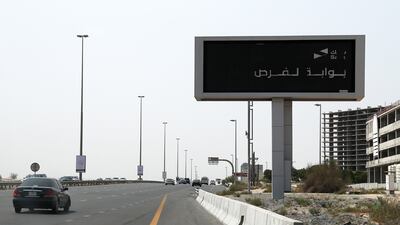
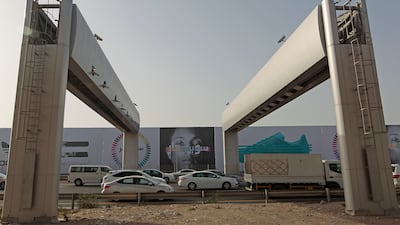
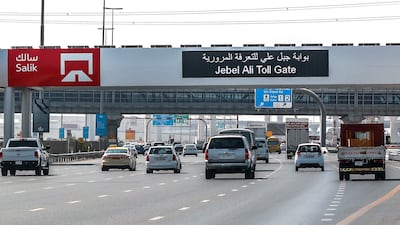
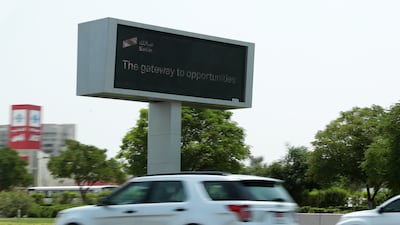
The Jebel Ali Salik gate was established in 2018 and was set to reduce traffic by about 25 per cent. Victor Besa / The National

Dubai's two new Salik toll gates to be activated on November 24


  • English
  • Arabic

Two new Salik road toll gates in Dubai will be brought into operation on Sunday, November 24, it was announced on Friday.

The gates have been installed at the Business Bay Crossing on Al Khail Road and in Al Safa South, on Sheikh Zayed Road, between Al Meydan Street and Umm Al Sheif Street.

The activation date was confirmed in a notice sent by Ibrahim Al Haddad, chief executive of Salik, to Hamed Ali, chief executive of the Dubai Financial Market. Plans to introduce the additional charging points – which bring the number of Salik gates in the emirate to 10 – were first announced in January.

Authorities previously said the locations had been chosen after extensive traffic studies, in an effort to reduce congestion. Salik Company – the operator of Dubai's toll gates – was directed to establish the new gates by the Roads and Transport Authority.

Cutting congestion

The authority expects the new Business Bay gate to help reduce traffic congestion by between 12 per cent to 15 per cent, while the gate in Al Safa South is set to cut congestion by 15 per cent.

“The addition of new toll gates in two increasingly busy locations marks the latest milestone in the growth plan that we set out at the time of Salik’s initial public offering," Mr Al Haddad said in January.

After the January announcement, Mattar Al Tayer, director general of the RTA, said Dubai's road toll strategy was key to its efforts to reduce traffic.

"The existing toll gates contributed to reducing the total travel time in Dubai by six million hours annually, decreasing traffic volumes on Al Maktoum and Al Garhoud bridges by 26 per cent, reducing travel times on Sheikh Zayed Road and Al Ittihad Street by 24 per cent, and increasing the number of mass transit users by nine million riders per annum," he said.

Boosting revenue

Salik was established in its current form as a public joint stock company in June 2022. Tolls represent about 87 per cent of its revenue.

Since July 2022, Salik has been operating as a separate legal entity from the RTA through a 49-year concession agreement. Salik raised Dh3.73 billion ($1 billion) in September 2022 from its initial public offering, which was more than 49 times oversubscribed across all tranches, with total gross demand at Dh184.2 billion.

In December, Salik joined Emaar Malls to deliver a parking management system at Dubai Mall. The plan aimed to use Salik technology for automatic fee collection for ticketless parking and vehicle plate recognition to deduct fees from Salik user accounts.

Why were tolls introduced in Dubai?

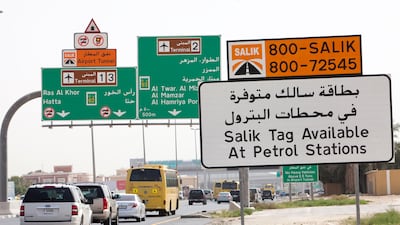
The Salik system was introduced in 2007 to ease congestion on Sheikh Zayed Road and raise state revenue. Tags fixed to windscreens can be purchased online or at service stations. They can be topped up online or through recharge cards.

Motorists are charged Dh4 to pass through each gate, with the amount is deducted automatically. The eight other toll gates are at the following locations:

  • Al Barsha
  • Al Garhoud
  • Al Maktoum
  • Al Mamzar South
  • Al Mamzar North
  • Al Safa
  • Airport Tunnel
  • Jebel Ali

When the most recent toll gate was introduced in Jebel Ali in 2018, transport officials said it could reduce traffic by about 25 per cent. The RTA aims to reduce traffic levels through a comprehensive road-building strategy and is also working to bolster public transport options to take more cars off the roads.


How to improve Arabic reading in early years

One 45-minute class per week in Standard Arabic is not sufficient

The goal should be for grade 1 and 2 students to become fluent readers

Subjects like technology, social studies, science can be taught in later grades

Grade 1 curricula should include oral instruction in Standard Arabic

First graders must regularly practice individual letters and combinations

Time should be slotted in class to read longer passages in early grades

Improve the appearance of textbooks

Revision of curriculum should be undertaken as per research findings

Conjugations of most common verb forms should be taught

Systematic learning of Standard Arabic grammar

Breast cancer in men: the facts

1) Breast cancer is men is rare but can develop rapidly. It usually occurs in those over the ages of 60, but can occasionally affect younger men.

2) Symptoms can include a lump, discharge, swollen glands or a rash. 

3) People with a history of cancer in the family can be more susceptible. 

4) Treatments include surgery and chemotherapy but early diagnosis is the key. 

5) Anyone concerned is urged to contact their doctor


Mercer, the investment consulting arm of US services company Marsh & McLennan, expects its wealth division to at least double its assets under management (AUM) in the Middle East as wealth in the region continues to grow despite economic headwinds, a company official said.

Mercer Wealth, which globally has $160 billion in AUM, plans to boost its AUM in the region to $2-$3bn in the next 2-3 years from the present $1bn, said Yasir AbuShaban, a Dubai-based principal with Mercer Wealth.

Within the next two to three years, we are looking at reaching $2 to $3 billion as a conservative estimate and we do see an opportunity to do so,” said Mr AbuShaban.

Mercer does not directly make investments, but allocates clients’ money they have discretion to, to professional asset managers. They also provide advice to clients.

“We have buying power. We can negotiate on their (client’s) behalf with asset managers to provide them lower fees than they otherwise would have to get on their own,” he added.

Mercer Wealth’s clients include sovereign wealth funds, family offices, and insurance companies among others.

From its office in Dubai, Mercer also looks after Africa, India and Turkey, where they also see opportunity for growth.

Wealth creation in Middle East and Africa (MEA) grew 8.5 per cent to $8.1 trillion last year from $7.5tn in 2015, higher than last year’s global average of 6 per cent and the second-highest growth in a region after Asia-Pacific which grew 9.9 per cent, according to consultancy Boston Consulting Group (BCG). In the region, where wealth grew just 1.9 per cent in 2015 compared with 2014, a pickup in oil prices has helped in wealth generation.

BCG is forecasting MEA wealth will rise to $12tn by 2021, growing at an annual average of 8 per cent.

Drivers of wealth generation in the region will be split evenly between new wealth creation and growth of performance of existing assets, according to BCG.

Another general trend in the region is clients’ looking for a comprehensive approach to investing, according to Mr AbuShaban.

“Institutional investors or some of the families are seeing a slowdown in the available capital they have to invest and in that sense they are looking at optimizing the way they manage their portfolios and making sure they are not investing haphazardly and different parts of their investment are working together,” said Mr AbuShaban.

Some clients also have a higher appetite for risk, given the low interest-rate environment that does not provide enough yield for some institutional investors. These clients are keen to invest in illiquid assets, such as private equity and infrastructure.

“What we have seen is a desire for higher returns in what has been a low-return environment specifically in various fixed income or bonds,” he said.

“In this environment, we have seen a de facto increase in the risk that clients are taking in things like illiquid investments, private equity investments, infrastructure and private debt, those kind of investments were higher illiquidity results in incrementally higher returns.”

The Abu Dhabi Investment Authority, one of the largest sovereign wealth funds, said in its 2016 report that has gradually increased its exposure in direct private equity and private credit transactions, mainly in Asian markets and especially in China and India. The authority’s private equity department focused on structured equities owing to “their defensive characteristics.”

Alan%20Wake%20Remastered%20
%3Cp%3E%3Cstrong%3EDeveloper%3A%20%3C%2Fstrong%3ERemedy%20Entertainment%3Cbr%3E%3Cstrong%3EPublisher%3A%3C%2Fstrong%3E%20Microsoft%20Game%20Studios%3Cbr%3E%3Cstrong%3EConsoles%3A%3C%2Fstrong%3E%20PlayStation%204%20%26amp%3B%205%2C%20Xbox%3A%20360%20%26amp%3B%20One%20%26amp%3B%20Series%20X%2FS%20and%20Nintendo%20Switch%3Cbr%3E%3Cstrong%3ERating%3A%3C%2Fstrong%3E%204%2F5%3C%2Fp%3E%0A
Updated: November 01, 2024, 5:56 AM