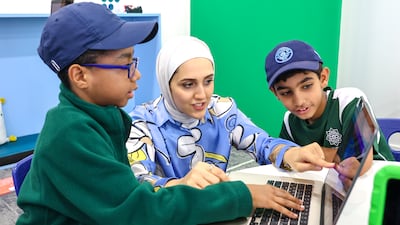
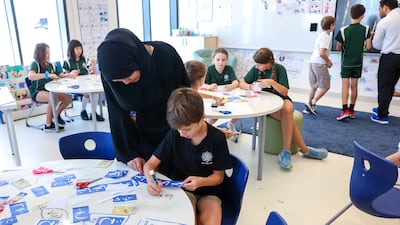
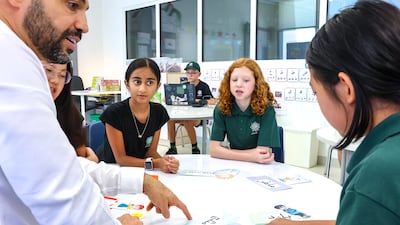
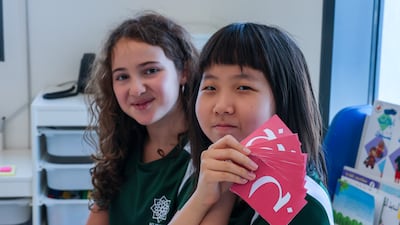
Nurseries in Abu Dhabi will be required to employ at least one Arabic-speaking teacher and encouraged to provide additional training staff in support of a new drive to immerse children in the language from an early age.
Abu Dhabi's Department of Education and Knowledge said the mandate would be introduced at the emirate's 200-plus nurseries – referred to as early childhood institutes by the authority – for the 2025/26 academic year, which typically begins at the end of August.
Currently, Arabic lessons are compulsory for private school pupils in the capital from year 2 to year 10 (about six to 15) for non-native speakers and year 2 to 13 (about six to 18) for Arabic speakers.
While formal Arabic teaching will not be provided to nursery children – usually aged from about six weeks old to four – they will be exposed to the language through song, sounds and play.
“The idea is that language acquisition starts at the earliest age," said Sylvie Wald, education policy office director at the department.
"The idea is to expose them from an early age, because eventually, if they're going to stay in Abu Dhabi, they're going to be integrated into the school system and will have that foundational basis."
She said it was important to share the country's language and customs with expatriate children. "Here, we don't have very many opportunities for that, so being able to integrate that into the early education sector is something that we want to offer all of our expats," said Ms Wald.
Nurseries are also being urged to train staff – who may not be in a teaching position - to take on the role of introducing children to the Arabic language.
Nurseries which fail to comply with the requirements will be warned before facing fines or other penalties. The department will conduct visits to ensure centres are following the rules and gather feedback from private schools and nurseries.
“The idea is to start by working with the schools to help them improve,” said Ms Wald. ". We don't want to penalise them."
Multilingual learners
Dr Hanadi Dayyeh, director of Arabic studies at the American Community School of Abu Dhabi, said the decision would be beneficial for young learners.
“I think this is a very, very powerful thing that they're doing,” Dr Dayyeh. “Children, up to the age of seven, can pick up four, five or six languages and they manage to navigate them.
“It comes naturally to them. It's definitely an added value to start as early as possible in being exposed to the language, whatever one you're learning.”
Abu Dhabi institute to revamp Arabic teaching - in pictures
UAE leaders have consistently highlighted the need to preserve and protect the Arabic language for generations to come.
Sheikh Abdullah bin Zayed, Deputy Prime Minister and Minister of Foreign Affairs, said in May there was an urgent need to foster Arabic language skills in young people. Sheikh Dr Sultan bin Muhammad Al Qasimi, Ruler of Sharjah, has also has long championed the preservation of a language spoken by more than 300 million people around the world.
Education action plan
The directive was one of more than 60 updated policies for private schools and nurseries issued by the authority on Wednesday, focusing on teaching and learning, health, safety, and the well-being of children and staff, as well as how schools are governed.
Under the strategy, nurseries must include Emirati dishes on their weekly meal plans and educate children about sustainability.
The department has also set out a new engagement policy, which will mean parents will be more involved in their children’s schools and receive regular updates.
Ms Wald said the department has considered the impact the new policies could have on education costs for nurseries and schools, and whether this will affect fees paid by parents.
“School fees are regulated by Adek based on the education cost index," she said. "We have looked at what type of financial impact this will have, and this has been built into future plans.
“Of course, any sort of increases will still have to come to Adek for approval and it will need to be justified but nonetheless there will not be any major differences from the previous increases that were sought by schools because they were already on a path for continuous improvement, which involved a lot of these changes.”
Sara Musallam, chairman of the department, said the strategy was key to the development of the capital's education sector. “By setting clear, research-based regulatory requirements, we create a path for continuous improvement across our private schools and early education institutes, ensuring our students are prepared to contribute to a globally competitive society," she said.
“The policies also ensure equity and consistency in the quality of education, providing transparency and accountability for educators, while enhancing the overall education experience for students and parents.”

The specs
Engine: 3.8-litre twin-turbo V8
Power: 611bhp
Torque: 620Nm
Transmission: seven-speed automatic
Price: upon application
On sale: now
Janet Yellen's Firsts
- In 2014, she became the first woman to lead the US Federal Reserve
- In 1999, she became the first female chair of the White House Council of Economic Advisers
Real estate tokenisation project
Dubai launched the pilot phase of its real estate tokenisation project last month.
The initiative focuses on converting real estate assets into digital tokens recorded on blockchain technology and helps in streamlining the process of buying, selling and investing, the Dubai Land Department said.
Dubai’s real estate tokenisation market is projected to reach Dh60 billion ($16.33 billion) by 2033, representing 7 per cent of the emirate’s total property transactions, according to the DLD.
HAEMOGLOBIN DISORDERS EXPLAINED
Thalassaemia is part of a family of genetic conditions affecting the blood known as haemoglobin disorders.
Haemoglobin is a substance in the red blood cells that carries oxygen and a lack of it triggers anemia, leaving patients very weak, short of breath and pale.
The most severe type of the condition is typically inherited when both parents are carriers. Those patients often require regular blood transfusions - about 450 of the UAE's 2,000 thalassaemia patients - though frequent transfusions can lead to too much iron in the body and heart and liver problems.
The condition mainly affects people of Mediterranean, South Asian, South-East Asian and Middle Eastern origin. Saudi Arabia recorded 45,892 cases of carriers between 2004 and 2014.
A World Health Organisation study estimated that globally there are at least 950,000 'new carrier couples' every year and annually there are 1.33 million at-risk pregnancies.
Know before you go
- Jebel Akhdar is a two-hour drive from Muscat airport or a six-hour drive from Dubai. It’s impossible to visit by car unless you have a 4x4. Phone ahead to the hotel to arrange a transfer.
- If you’re driving, make sure your insurance covers Oman.
- By air: Budget airlines Air Arabia, Flydubai and SalamAir offer direct routes to Muscat from the UAE.
- Tourists from the Emirates (UAE nationals not included) must apply for an Omani visa online before arrival at evisa.rop.gov.om. The process typically takes several days.
- Flash floods are probable due to the terrain and a lack of drainage. Always check the weather before venturing into any canyons or other remote areas and identify a plan of escape that includes high ground, shelter and parking where your car won’t be overtaken by sudden downpours.
Email sent to Uber team from chief executive Dara Khosrowshahi
From: Dara
To: Team@
Date: March 25, 2019 at 11:45pm PT
Subj: Accelerating in the Middle East
Five years ago, Uber launched in the Middle East. It was the start of an incredible journey, with millions of riders and drivers finding new ways to move and work in a dynamic region that’s become so important to Uber. Now Pakistan is one of our fastest-growing markets in the world, women are driving with Uber across Saudi Arabia, and we chose Cairo to launch our first Uber Bus product late last year.
Today we are taking the next step in this journey—well, it’s more like a leap, and a big one: in a few minutes, we’ll announce that we’ve agreed to acquire Careem. Importantly, we intend to operate Careem independently, under the leadership of co-founder and current CEO Mudassir Sheikha. I’ve gotten to know both co-founders, Mudassir and Magnus Olsson, and what they have built is truly extraordinary. They are first-class entrepreneurs who share our platform vision and, like us, have launched a wide range of products—from digital payments to food delivery—to serve consumers.
I expect many of you will ask how we arrived at this structure, meaning allowing Careem to maintain an independent brand and operate separately. After careful consideration, we decided that this framework has the advantage of letting us build new products and try new ideas across not one, but two, strong brands, with strong operators within each. Over time, by integrating parts of our networks, we can operate more efficiently, achieve even lower wait times, expand new products like high-capacity vehicles and payments, and quicken the already remarkable pace of innovation in the region.
This acquisition is subject to regulatory approval in various countries, which we don’t expect before Q1 2020. Until then, nothing changes. And since both companies will continue to largely operate separately after the acquisition, very little will change in either teams’ day-to-day operations post-close. Today’s news is a testament to the incredible business our team has worked so hard to build.
It’s a great day for the Middle East, for the region’s thriving tech sector, for Careem, and for Uber.
Uber on,
Dara
Padmaavat
Director: Sanjay Leela Bhansali
Starring: Ranveer Singh, Deepika Padukone, Shahid Kapoor, Jim Sarbh
3.5/5
Golden Shoe top five (as of March 1):
Harry Kane, Tottenham, Premier League, 24 goals, 48 points
Edinson Cavani, PSG, Ligue 1, 24 goals, 48 points
Ciro Immobile, Lazio, Serie A, 23 goals, 46 points
Mohamed Salah, Liverpool, Premier League, 23 goals, 46 points
Lionel Messi, Barcelona, La Liga, 22 goals, 44 points
More from Rashmee Roshan Lall
The specs
Engine: 3.8-litre twin-turbo flat-six
Power: 650hp at 6,750rpm
Torque: 800Nm from 2,500-4,000rpm
Transmission: 8-speed dual-clutch auto
Fuel consumption: 11.12L/100km
Price: From Dh796,600
On sale: now
Disposing of non-recycleable masks
- Use your ‘black bag’ bin at home
- Do not put them in a recycling bin
- Take them home with you if there is no litter bin
- No need to bag the mask
HWJN
%3Cp%3EDirector%3A%20Yasir%20Alyasiri%3C%2Fp%3E%0A%3Cp%3EStarring%3A%20Baraa%20Alem%2C%20Nour%20Alkhadra%2C%20Alanoud%20Saud%3C%2Fp%3E%0A%3Cp%3ERating%3A%203%2F5%3C%2Fp%3E%0A%3Cp%3E%3C%2Fp%3E%0A
The specs
Engine: 3.0-litre six-cylinder turbo
Power: 398hp from 5,250rpm
Torque: 580Nm at 1,900-4,800rpm
Transmission: Eight-speed auto
Fuel economy, combined: 6.5L/100km
On sale: December
Price: From Dh330,000 (estimate)
The President's Cake
Director: Hasan Hadi
Starring: Baneen Ahmad Nayyef, Waheed Thabet Khreibat, Sajad Mohamad Qasem
Rating: 4/5