
Abu Dhabi's Sheikh Zayed Grand Mosque welcomed more than 4.3 million visits in the first half of the year, including its largest number of daily worshippers during Ramadan.
The place of worship has cemented its status as a leading global religious and cultural centre in recent years – with the latest six-monthly total well up on the 3.3 million visits recorded from January to the end of June last year and the 1.5 million registered in 2022.
This year's 4,379,258 visitors comprised of 2,584,425 residents and tourists and 1,765,698 worshippers.
A further 29,135 people used the jogging track on the grounds of the mosque during the period.
The mosque received a record 87,186 worshippers on April 5, which marked the 27th day of Ramadan.
Of this number, 70,680 Muslims gathered during the evening to observe Laylat Al Qadr, a significant occasion in the Islamic faith.
Sheikh Zayed Mosque is a striking focal point for celebrations during the holy month, opening its doors to thousands of worshippers to enjoy iftar.
The Sheikh Zayed Grand Mosque Centre – which operates the mosque – prepared 2.15 million iftar meals this year, with 650,000 of these served up within the mosque.
Another 1.5 million meals were distributed across the capital to honour the generous spirit of the religious festival.
Global appeal
-

More than 60,000 worshippers attend Sheikh Zayed Grand Mosque in Abu Dhabi to mark Laylat Al Qadr. All photos: Wam -
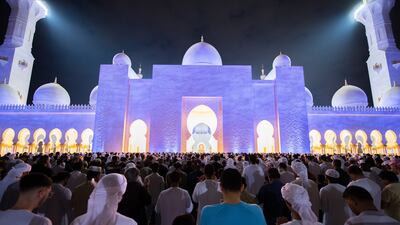
This is the largest number of worshippers hosted by the grand mosque since its opening, said news agency Wam -
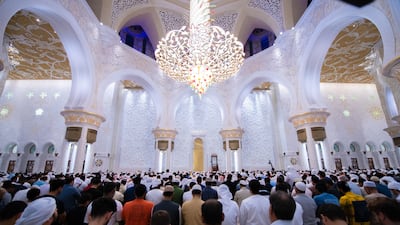
Laylat Al Qadr — or the Night of Power — has a special significance in Islam. It is one of the odd-numbered nights during the last 10 days of Ramadan in which the first verses of the Quran were revealed to the Prophet Mohammed -

Many Muslims are keen to spend the last 10 nights of the holy month in worship, prayer and acts of kindness -
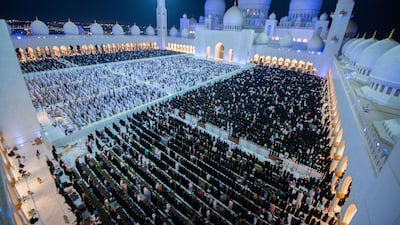
The reward for any good deed or act of worship conducted on that night is counted as more than 1,000 months of doing it
The mosque continues to draw visitors from all parts of the world
Official figures show 81 per cent of visits made were by people from outside the Emirates.
Asia led the way with 52 per cent of all visits, followed by Europe at 34 per cent, North America at 7 per cent, Africa and South America at 3 per cent each, and Australia at 1 per cent.
India had the largest number of visits at 22 per cent, followed by China at 11 per cent, Russia at 8 per cent and Germany and the USA at 4 per cent.
The mosque is a hugely popular attraction, ranking high on the travel itineraries of international visitors.
The place of worship was ranked first in the Top Attractions category in the Middle East by TripAdvisor.
Completed in 2007, the Sheikh Zayed Grand Mosque is the largest in the UAE, spreading across 22,000 square metres.
It can host more than 40,000 worshippers at once.
it commemorates the legacy of the man whose name it bears, the UAE Founding Father, the late Sheikh Zayed bin Sultan Al Nahyan.
In December, the mosque launched night tours aimed at travellers in transit who have limited time in the capital but wish to visit the landmark.

UAE%20athletes%20heading%20to%20Paris%202024
Getting%20there%20and%20where%20to%20stay
Killing of Qassem Suleimani
Mina Al Oraibi: Air strike casts a long shadow over the decade ahead
Jack Moore: Why the assassination is such a monumental gamble
Matthew Levitt: Iran retains its ability to launch terror attacks
Damien McElroy: A CEO tasked with spreading Iran's influence
Hussein Ibish: Trump's order on solid constitutional ground
Simon Waldman: Cautious Israel keeping a low profile
Match info
Manchester City 3 (Jesus 22', 50', Sterling 69')
Everton 1 (Calvert-Lewin 65')
The biog
Favourite book: Men are from Mars Women are from Venus
Favourite travel destination: Ooty, a hill station in South India
Hobbies: Cooking. Biryani, pepper crab are her signature dishes
Favourite place in UAE: Marjan Island
Mina Cup winners
Under 12 – Minerva Academy
Under 14 – Unam Pumas
Under 16 – Fursan Hispania
Under 18 – Madenat
Ten tax points to be aware of in 2026
1. Domestic VAT refund amendments: request your refund within five years
If a business does not apply for the refund on time, they lose their credit.
2. E-invoicing in the UAE
Businesses should continue preparing for the implementation of e-invoicing in the UAE, with 2026 a preparation and transition period ahead of phased mandatory adoption.
3. More tax audits
Tax authorities are increasingly using data already available across multiple filings to identify audit risks.
4. More beneficial VAT and excise tax penalty regime
Tax disputes are expected to become more frequent and more structured, with clearer administrative objection and appeal processes. The UAE has adopted a new penalty regime for VAT and excise disputes, which now mirrors the penalty regime for corporate tax.
5. Greater emphasis on statutory audit
There is a greater need for the accuracy of financial statements. The International Financial Reporting Standards standards need to be strictly adhered to and, as a result, the quality of the audits will need to increase.
6. Further transfer pricing enforcement
Transfer pricing enforcement, which refers to the practice of establishing prices for internal transactions between related entities, is expected to broaden in scope. The UAE will shortly open the possibility to negotiate advance pricing agreements, or essentially rulings for transfer pricing purposes.
7. Limited time periods for audits
Recent amendments also introduce a default five-year limitation period for tax audits and assessments, subject to specific statutory exceptions. While the standard audit and assessment period is five years, this may be extended to up to 15 years in cases involving fraud or tax evasion.
8. Pillar 2 implementation
Many multinational groups will begin to feel the practical effect of the Domestic Minimum Top-Up Tax (DMTT), the UAE's implementation of the OECD’s global minimum tax under Pillar 2. While the rules apply for financial years starting on or after January 1, 2025, it is 2026 that marks the transition to an operational phase.
9. Reduced compliance obligations for imported goods and services
Businesses that apply the reverse-charge mechanism for VAT purposes in the UAE may benefit from reduced compliance obligations.
10. Substance and CbC reporting focus
Tax authorities are expected to continue strengthening the enforcement of economic substance and Country-by-Country (CbC) reporting frameworks. In the UAE, these regimes are increasingly being used as risk-assessment tools, providing tax authorities with a comprehensive view of multinational groups’ global footprints and enabling them to assess whether profits are aligned with real economic activity.
Contributed by Thomas Vanhee and Hend Rashwan, Aurifer
How England have scored their set-piece goals in Russia
Three Penalties
v Panama, Group Stage (Harry Kane)
v Panama, Group Stage (Kane)
v Colombia, Last 16 (Kane)
Four Corners
v Tunisia, Group Stage (Kane, via John Stones header, from Ashley Young corner)
v Tunisia, Group Stage (Kane, via Harry Maguire header, from Kieran Trippier corner)
v Panama, Group Stage (Stones, header, from Trippier corner)
v Sweden, Quarter-Final (Maguire, header, from Young corner)
One Free-Kick
v Panama, Group Stage (Stones, via Jordan Henderson, Kane header, and Raheem Sterling, from Tripper free-kick)
UPI facts
More than 2.2 million Indian tourists arrived in UAE in 2023
More than 3.5 million Indians reside in UAE
Indian tourists can make purchases in UAE using rupee accounts in India through QR-code-based UPI real-time payment systems
Indian residents in UAE can use their non-resident NRO and NRE accounts held in Indian banks linked to a UAE mobile number for UPI transactions
FIXTURES
All times UAE ( 4 GMT)
Friday
Saint-Etienne v Montpellier (10.45pm)
Saturday
Monaco v Caen (7pm)
Amiens v Bordeaux (10pm)
Angers v Toulouse (10pm)
Metz v Dijon (10pm)
Nantes v Guingamp (10pm)
Rennes v Lille (10pm)
Sunday
Nice v Strasbourg (5pm)
Troyes v Lyon (7pm)
Marseille v Paris Saint-Germain (11pm)
The language of diplomacy in 1853
Treaty of Peace in Perpetuity Agreed Upon by the Chiefs of the Arabian Coast on Behalf of Themselves, Their Heirs and Successors Under the Mediation of the Resident of the Persian Gulf, 1853
(This treaty gave the region the name “Trucial States”.)
We, whose seals are hereunto affixed, Sheikh Sultan bin Suggar, Chief of Rassool-Kheimah, Sheikh Saeed bin Tahnoon, Chief of Aboo Dhebbee, Sheikh Saeed bin Buyte, Chief of Debay, Sheikh Hamid bin Rashed, Chief of Ejman, Sheikh Abdoola bin Rashed, Chief of Umm-ool-Keiweyn, having experienced for a series of years the benefits and advantages resulting from a maritime truce contracted amongst ourselves under the mediation of the Resident in the Persian Gulf and renewed from time to time up to the present period, and being fully impressed, therefore, with a sense of evil consequence formerly arising, from the prosecution of our feuds at sea, whereby our subjects and dependants were prevented from carrying on the pearl fishery in security, and were exposed to interruption and molestation when passing on their lawful occasions, accordingly, we, as aforesaid have determined, for ourselves, our heirs and successors, to conclude together a lasting and inviolable peace from this time forth in perpetuity.
Taken from Britain and Saudi Arabia, 1925-1939: the Imperial Oasis, by Clive Leatherdale
While you're here
Watch: Davos 2021 panel discusses the future of work for women
Alice Haine: Investing in gender parity 'makes good business sense'
Kareem Shaheen: How the pandemic could set Arab women back
Simon Rushton: Home schooling forces UK mothers to quit jobs
Try out the test yourself
Q1 Suppose you had $100 in a savings account and the interest rate was 2 per cent per year. After five years, how much do you think you would have in the account if you left the money to grow?
a) More than $102
b) Exactly $102
c) Less than $102
d) Do not know
e) Refuse to answer
Q2 Imagine that the interest rate on your savings account was 1 per cent per year and inflation was 2 per cent per year. After one year, how much would you be able to buy with the money in this account?
a) More than today
b) Exactly the same as today
c) Less than today
d) Do not know
e) Refuse to answer
Q4 Do you think that the following statement is true or false? “Buying a single company stock usually provides a safer return than a stock mutual fund.”
a) True
b) False
d) Do not know
e) Refuse to answer
The “Big Three” financial literacy questions were created by Professors Annamaria Lusardi of the George Washington School of Business and Olivia Mitchell, of the Wharton School of the University of Pennsylvania.
Answers: Q1 More than $102 (compound interest). Q2 Less than today (inflation). Q3 False (diversification).
While you're here
Gavin Esler: The Good Friday Agreement teaches us some important lessons
Damien McElroy: Boris must listen to Churchill's comments on Irish divisions
Janine di Giovanni: Track 2 diplomacy key to lasting peace in 21st century
Mercer, the investment consulting arm of US services company Marsh & McLennan, expects its wealth division to at least double its assets under management (AUM) in the Middle East as wealth in the region continues to grow despite economic headwinds, a company official said.
Mercer Wealth, which globally has $160 billion in AUM, plans to boost its AUM in the region to $2-$3bn in the next 2-3 years from the present $1bn, said Yasir AbuShaban, a Dubai-based principal with Mercer Wealth.
“Within the next two to three years, we are looking at reaching $2 to $3 billion as a conservative estimate and we do see an opportunity to do so,” said Mr AbuShaban.
Mercer does not directly make investments, but allocates clients’ money they have discretion to, to professional asset managers. They also provide advice to clients.
“We have buying power. We can negotiate on their (client’s) behalf with asset managers to provide them lower fees than they otherwise would have to get on their own,” he added.
Mercer Wealth’s clients include sovereign wealth funds, family offices, and insurance companies among others.
From its office in Dubai, Mercer also looks after Africa, India and Turkey, where they also see opportunity for growth.
Wealth creation in Middle East and Africa (MEA) grew 8.5 per cent to $8.1 trillion last year from $7.5tn in 2015, higher than last year’s global average of 6 per cent and the second-highest growth in a region after Asia-Pacific which grew 9.9 per cent, according to consultancy Boston Consulting Group (BCG). In the region, where wealth grew just 1.9 per cent in 2015 compared with 2014, a pickup in oil prices has helped in wealth generation.
BCG is forecasting MEA wealth will rise to $12tn by 2021, growing at an annual average of 8 per cent.
Drivers of wealth generation in the region will be split evenly between new wealth creation and growth of performance of existing assets, according to BCG.
Another general trend in the region is clients’ looking for a comprehensive approach to investing, according to Mr AbuShaban.
“Institutional investors or some of the families are seeing a slowdown in the available capital they have to invest and in that sense they are looking at optimizing the way they manage their portfolios and making sure they are not investing haphazardly and different parts of their investment are working together,” said Mr AbuShaban.
Some clients also have a higher appetite for risk, given the low interest-rate environment that does not provide enough yield for some institutional investors. These clients are keen to invest in illiquid assets, such as private equity and infrastructure.
“What we have seen is a desire for higher returns in what has been a low-return environment specifically in various fixed income or bonds,” he said.
“In this environment, we have seen a de facto increase in the risk that clients are taking in things like illiquid investments, private equity investments, infrastructure and private debt, those kind of investments were higher illiquidity results in incrementally higher returns.”
The Abu Dhabi Investment Authority, one of the largest sovereign wealth funds, said in its 2016 report that has gradually increased its exposure in direct private equity and private credit transactions, mainly in Asian markets and especially in China and India. The authority’s private equity department focused on structured equities owing to “their defensive characteristics.”
Plastic tipping points
The story in numbers
18
This is how many recognised sects Lebanon is home to, along with about four million citizens
450,000
More than this many Palestinian refugees are registered with UNRWA in Lebanon, with about 45 per cent of them living in the country’s 12 refugee camps
1.5 million
There are just under 1 million Syrian refugees registered with the UN, although the government puts the figure upwards of 1.5m
73
The percentage of stateless people in Lebanon, who are not of Palestinian origin, born to a Lebanese mother, according to a 2012-2013 study by human rights organisation Frontiers Ruwad Association
18,000
The number of marriages recorded between Lebanese women and foreigners between the years 1995 and 2008, according to a 2009 study backed by the UN Development Programme
77,400
The number of people believed to be affected by the current nationality law, according to the 2009 UN study
4,926
This is how many Lebanese-Palestinian households there were in Lebanon in 2016, according to a census by the Lebanese-Palestinian dialogue committee

