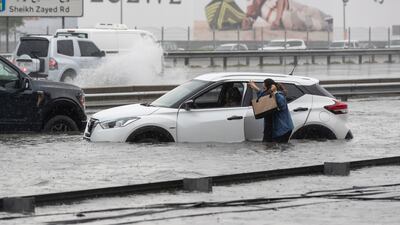
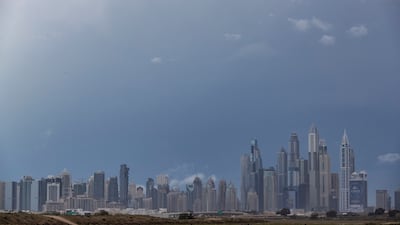
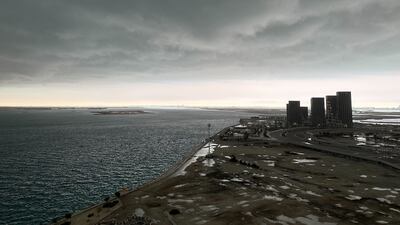
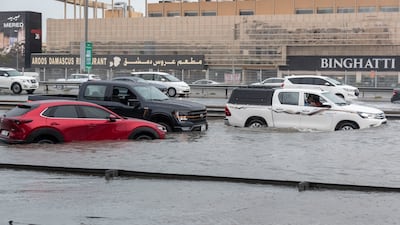
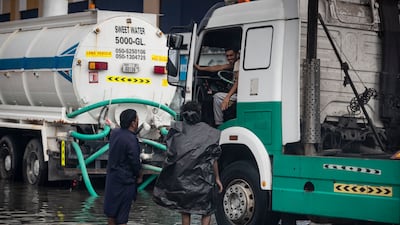
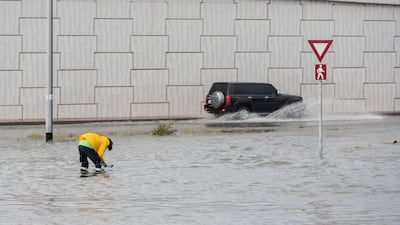
The floods in Dubai this year may have reminded some of Cyclone Gonu in 2007, which killed 10 people in Fujairah. Chris Whiteoak/ The National / AFP

A look at some of the UAE's most extreme weather events after record rain and floods


James Langton
  • English
  • Arabic

Record rainfall pummelled the UAE and Oman during last week’s storm, and a brief look back at historic weather data shows just how unusual it was.

The National Centre of Meteorology reported that the daily rainfall total, which reached 142mm in Dubai and an astonishing 254.8mm in parts of Al Ain, was the highest since records began in 1949.

Bringing widespread flooding and destruction of property, the storm dumped a year’s worth of rain in a day. But records also show that weather events with almost equal ferocity have taken place in the past.

Accurate readings of rainfall were previously taken at what was once the Royal Air Force base at Sharjah Airport, dating back to the mid 1930s.

They reveal that December 1944 received a total of 173.5mm of rain, compared to the usual average of 27.9mm for the month.

Overall, between 1934 and 1964, the average total yearly rainfall for the seven emirates was 106.9mm. To put it into perspective, the UK recently experienced one of its wettest winters on record, with 445.8mm of rain in just four months.

Sharjah RAF airbase kept accurate weather readings. Courtesy Taff John

The great storm of April 1957

One event stands out as coming close to this week’s weather. The great storm of April 8, 1957, is still remembered for its ferocity, borne out by the records.

That day, 97.3mm of rain is known to have fallen on Sharjah alone, in a year that recorded 340.4mm of rain.

While this week’s storm washed away roads in Al Ain, and inundated shopping malls, the death toll in the UAE was mercifully low.

That was not the case in 1957, when many people lived in palm frond arish or traditional barasti houses and when weather warnings were not available in the absence of radio, television and even telephones.

Susan Hillyard, who lived in Abu Dhabi from 1954 to 1958, was travelling to Dubai with her husband in an oil company dhow, unaware that a storm was about to break. Friends feared the couple had drowned but they survived, passing another dhow near the Creek that had capsized, drowning its seven crew members.

On land, she found widespread destruction, writing later in her memoir: “Outside, where there had been a whole suburb of barastis; there was but one … otherwise the devastation was complete. Not only had the wretched people [lost] their houses but all their belongings too.”

Drought followed by floods

The 1961-1962 period was one of the driest on record, with only 7.8mm of rain. But wet weather returned with a vengeance the following year, when a November storm struck the country.

Abu Dhabi had yet to build the sea defences along the Corniche and the Breakwater, and the low-lying areas of the city were inundated. Large quantities of goods, in those days unloaded on to the beach, were lost.

Dubai was hit hardest. The homes not destroyed were left knee-deep in floodwater. At the new Dubai International Airport, light aircraft and gliders were tossed around like toys.

A report for the Emirates Natural History Group journal Tribulus further analysed data from Sharjah up to 2006 and found that the drought of 2000 to 2003 was the worst in 70 years, with only 9mm of rain in 2001.

By contrast, the years 1995 to 1998 were the wettest four years on record. A remarkable total of 1,023.2mm of rain fell during that period, with 318.9mm alone in 1997. The winter of 1995/96 also received more than 376mm of rain between December and March.

Heavy rains in 1982 flooded parts of Abu Dhabi so extensively that some residents used small boats to leave their homes, while in March 9, 2016, winds of 126 kph were recorded at Al Bateen airport.

Two years later, a combination of high winds and driving rain forced the cancellation of a concert by pop star Dua Lipa.

Deadliest of all are the tropical cyclones emerging from the Indian Ocean. By the time they reach the UAE, their worst force is largely spent, although Cyclone Gonu in 2007 killed ten passengers after a boat sank in Fujairah Port.

Gonu killed about 50 people in Oman, whose coastal regions bear the brunt of cyclones.

There have been dozens over the years, with the UK’s consul general in Muscat writing of a storm in May 1963 that: “Part of the wall surrounding the British Bank of the Middle East, which is built in the main wadi of the town, collapsed under the weight of the floodwater. The inside of the bank was flooded to a depth of 4 feet 6 inches [1,371mm].

“Barasti and stone houses in the path of the floodwater were destroyed and many others destroyed or damaged by the heavy rainfall.”

In Oman, 18 people were killed in this week’s heavy rain, including 12 schoolchildren who drowned when their bus was swept away by floodwaters.

These events are a reminder that the region is a place of weather extremes, a parched and hot desert land that, from time to time, experiences storms and heavy rains. For the future, the impact of climate change means both are more likely to become more extreme.

Heavy rain hits Dubai and Abu Dhabi in April 2024

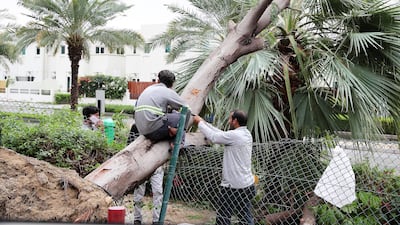
  • Workers cut down a tree that was uprooted by the storm in Dubai. Pawan Singh / The National
    Workers cut down a tree that was uprooted by the storm in Dubai. Pawan Singh / The National
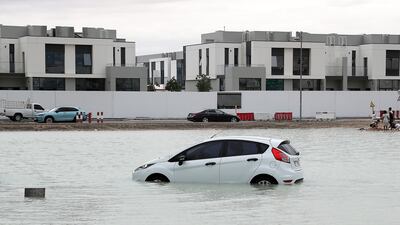
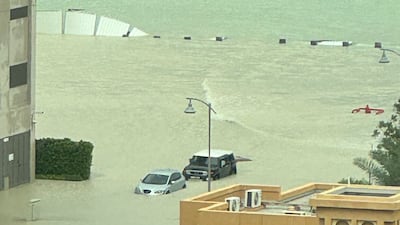
  • A vehicle submerged on a waterlogged road in Dubai. Pawan Singh / The National
    A vehicle submerged on a waterlogged road in Dubai. Pawan Singh / The National
  • A fence is blown over during the storm in Dubai. Chris Whiteoak / The National
    A fence is blown over during the storm in Dubai. Chris Whiteoak / The National
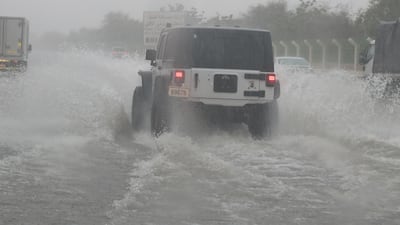
  • Vehicles splash through the Dubai – Abu Dhabi motorway during the heavy rain in Abu Dhabi. Pawan Singh / The National
    Vehicles splash through the Dubai – Abu Dhabi motorway during the heavy rain in Abu Dhabi. Pawan Singh / The National
  • A vehicle drives through a flooded road on a wet day in Dubai. Chris Whiteoak / The National
    A vehicle drives through a flooded road on a wet day in Dubai. Chris Whiteoak / The National
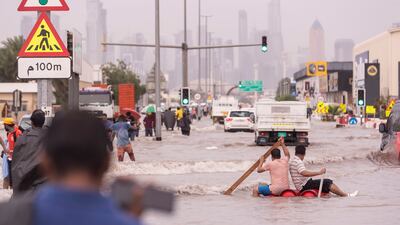
  • Two men navigate Dubai's flooded roads on a raft made from gas cylinders. Antonie Robertson / The National
    Two men navigate Dubai's flooded roads on a raft made from gas cylinders. Antonie Robertson / The National
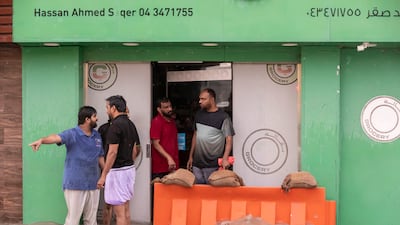
  • Trying to keep flooding out of a business in Al Quoz, Dubai. According to some measurements, 158mm of rain fell in 24 hours. Antonie Robertson / The National
    Trying to keep flooding out of a business in Al Quoz, Dubai. According to some measurements, 158mm of rain fell in 24 hours. Antonie Robertson / The National
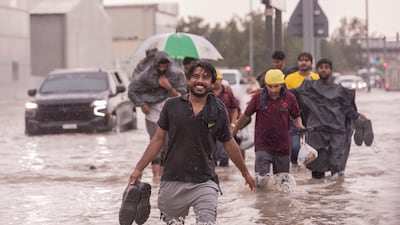
  • One pedestrian is still smiling despite the flooding, in Al Quoz, Dubai. Antonie Robertson / The National
    One pedestrian is still smiling despite the flooding, in Al Quoz, Dubai. Antonie Robertson / The National
  • Waves form in Dubai floodwaters. Nic Ridley/ The National
    Waves form in Dubai floodwaters. Nic Ridley/ The National
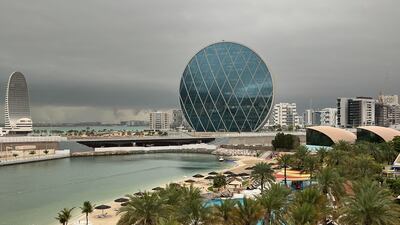
  • Dark clouds over Aldar headquarters in Al Raha, Abu Dhabi. Evelyn Lau / The National
    Dark clouds over Aldar headquarters in Al Raha, Abu Dhabi. Evelyn Lau / The National
  • Wrapped up for the elements in Dubai. Chris Whiteoak / The National
    Wrapped up for the elements in Dubai. Chris Whiteoak / The National
  • More storms are forecast for Dubai, with dark skies overhead. Nic Ridley/ The National
    More storms are forecast for Dubai, with dark skies overhead. Nic Ridley/ The National
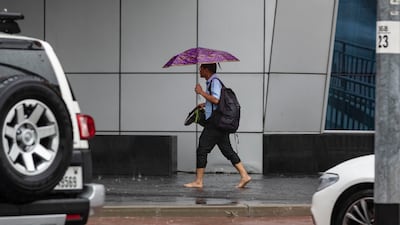
  • A young boy goes for a walk on a rainy day in Dubai. Chris Whiteoak / The National
    A young boy goes for a walk on a rainy day in Dubai. Chris Whiteoak / The National
  • Heavy rain fell for several hours in Dubai on Tuesday morning, in what forecasters said was the first wave of stormy weather. Antonie Robertson / The National
    Heavy rain fell for several hours in Dubai on Tuesday morning, in what forecasters said was the first wave of stormy weather. Antonie Robertson / The National
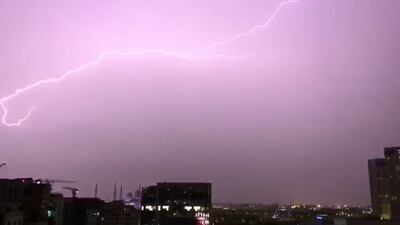
  • Lightning strikes in Abu Dhabi on Monday. Roy Cooper/ The National
    Lightning strikes in Abu Dhabi on Monday. Roy Cooper/ The National
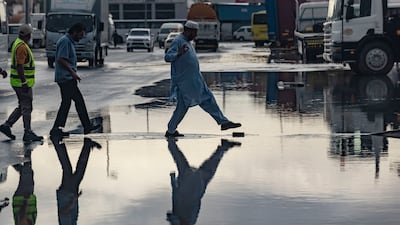
  • There were large puddles in Dubai after heavy rain overnight. Antonie Robertson/The National
    There were large puddles in Dubai after heavy rain overnight. Antonie Robertson/The National
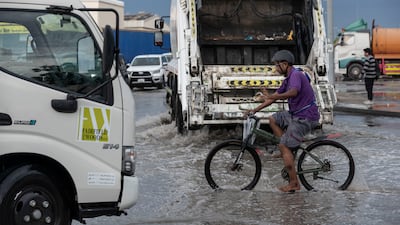
  • A cyclist travels amid clean-up efforts in Dubai. Antonie Robertson/The National
    A cyclist travels amid clean-up efforts in Dubai. Antonie Robertson/The National
  • A motorist's car is stranded on a flooded Dubai road, following torrential rain. Antonie Robertson / The National
    A motorist's car is stranded on a flooded Dubai road, following torrential rain. Antonie Robertson / The National
  • Clean-up efforts are under way in Dubai after heavy rain. Antonie Robertson/The National
    Clean-up efforts are under way in Dubai after heavy rain. Antonie Robertson/The National
  • Dark clouds linger over Dubai with more adverse weather forecast. Antonie Robertson/The National
    Dark clouds linger over Dubai with more adverse weather forecast. Antonie Robertson/The National
  • Dark skies over Reem Island in Abu Dhabi. Zoya Thomas/ The National
    Dark skies over Reem Island in Abu Dhabi. Zoya Thomas/ The National
  • Forecasters warned of 'hazardous weather events' until Wednesday evening. Antonie Robertson/The National
    Forecasters warned of 'hazardous weather events' until Wednesday evening. Antonie Robertson/The National
  • Workers clear standing water in Dubai. Antonie Robertson/The National
    Workers clear standing water in Dubai. Antonie Robertson/The National
  • Drivers faced a difficult commute after heavy rain in Dubai. Antonie Robertson/The National
    Drivers faced a difficult commute after heavy rain in Dubai. Antonie Robertson/The National
  • Clean-up efforts began in Dubai after heavy rain. Antonie Robertson/The National
    Clean-up efforts began in Dubai after heavy rain. Antonie Robertson/The National
Disability on screen

Empire — neuromuscular disease myasthenia gravis; bipolar disorder; post-traumatic stress disorder (PTSD)

Rosewood and Transparent — heart issues

24: Legacy — PTSD;

Superstore and NCIS: New Orleans — wheelchair-bound

Taken and This Is Us — cancer

Trial & Error — cognitive disorder prosopagnosia (facial blindness and dyslexia)

Grey’s Anatomy — prosthetic leg

Scorpion — obsessive compulsive disorder and anxiety

Switched at Birth — deafness

One Mississippi, Wentworth and Transparent — double mastectomy

Dragons — double amputee

Engine: 5.6-litre V8

Transmission: seven-speed automatic

Power: 400hp

Torque: 560Nm

Price: Dh234,000 - Dh329,000

On sale: now

Mercer, the investment consulting arm of US services company Marsh & McLennan, expects its wealth division to at least double its assets under management (AUM) in the Middle East as wealth in the region continues to grow despite economic headwinds, a company official said.

Mercer Wealth, which globally has $160 billion in AUM, plans to boost its AUM in the region to $2-$3bn in the next 2-3 years from the present $1bn, said Yasir AbuShaban, a Dubai-based principal with Mercer Wealth.

Within the next two to three years, we are looking at reaching $2 to $3 billion as a conservative estimate and we do see an opportunity to do so,” said Mr AbuShaban.

Mercer does not directly make investments, but allocates clients’ money they have discretion to, to professional asset managers. They also provide advice to clients.

“We have buying power. We can negotiate on their (client’s) behalf with asset managers to provide them lower fees than they otherwise would have to get on their own,” he added.

Mercer Wealth’s clients include sovereign wealth funds, family offices, and insurance companies among others.

From its office in Dubai, Mercer also looks after Africa, India and Turkey, where they also see opportunity for growth.

Wealth creation in Middle East and Africa (MEA) grew 8.5 per cent to $8.1 trillion last year from $7.5tn in 2015, higher than last year’s global average of 6 per cent and the second-highest growth in a region after Asia-Pacific which grew 9.9 per cent, according to consultancy Boston Consulting Group (BCG). In the region, where wealth grew just 1.9 per cent in 2015 compared with 2014, a pickup in oil prices has helped in wealth generation.

BCG is forecasting MEA wealth will rise to $12tn by 2021, growing at an annual average of 8 per cent.

Drivers of wealth generation in the region will be split evenly between new wealth creation and growth of performance of existing assets, according to BCG.

Another general trend in the region is clients’ looking for a comprehensive approach to investing, according to Mr AbuShaban.

“Institutional investors or some of the families are seeing a slowdown in the available capital they have to invest and in that sense they are looking at optimizing the way they manage their portfolios and making sure they are not investing haphazardly and different parts of their investment are working together,” said Mr AbuShaban.

Some clients also have a higher appetite for risk, given the low interest-rate environment that does not provide enough yield for some institutional investors. These clients are keen to invest in illiquid assets, such as private equity and infrastructure.

“What we have seen is a desire for higher returns in what has been a low-return environment specifically in various fixed income or bonds,” he said.

“In this environment, we have seen a de facto increase in the risk that clients are taking in things like illiquid investments, private equity investments, infrastructure and private debt, those kind of investments were higher illiquidity results in incrementally higher returns.”

The Abu Dhabi Investment Authority, one of the largest sovereign wealth funds, said in its 2016 report that has gradually increased its exposure in direct private equity and private credit transactions, mainly in Asian markets and especially in China and India. The authority’s private equity department focused on structured equities owing to “their defensive characteristics.”

Qosty Byogaani

Starring: Hani Razmzi, Maya Nasir and Hassan Hosny

Four stars

Company%20Profile
%3Cp%3E%3Cstrong%3EName%3A%3C%2Fstrong%3E%20Raha%3Cbr%3E%3Cstrong%3EStarted%3A%3C%2Fstrong%3E%202022%3Cbr%3E%3Cstrong%3EBased%3A%3C%2Fstrong%3E%20Kuwait%2FSaudi%3Cbr%3E%3Cstrong%3EIndustry%3A%3C%2Fstrong%3E%20Tech%20Logistics%3Cbr%3E%3Cstrong%3EFunding%3A%3C%2Fstrong%3E%20%2414%20million%3Cbr%3E%3Cstrong%3EInvestors%3A%3C%2Fstrong%3E%20Soor%20Capital%2C%20eWTP%20Arabia%20Capital%2C%20Aujan%20Enterprises%2C%20Nox%20Management%2C%20Cedar%20Mundi%20Ventures%3Cbr%3E%3Cstrong%3ENumber%20of%20employees%3A%3C%2Fstrong%3E%20166%3C%2Fp%3E%0A

Sting & Shaggy

44/876

(Interscope)

Updated: April 22, 2024, 8:31 AM