Presidents Donald Trump, Vladimir Putin, and Xi Jinping stood on a platform before a blue backdrop inscribed "China-Russia-US Shenzhen summit" in three languages, with flags arranged on both sides.
The historic and unprecedented meeting at the foot of Kylin Mountain beside Shenzhen’s Xili Lake was anything but short on symbolism, from the leaders’ choice of ties to the meeting room's setting.
Here are five key takeaways that capture the significance of the talks, held against a backdrop of global conflicts, escalating threats and intensifying competition between major powers:
Family’s legacy
The talks were held at Kylin Villa, a secluded 38-hectare state guesthouse. Opened in 1997, the compound of villas, guesthouses, and banquet halls set among forested grounds has long hosted Chinese leaders and foreign dignitaries.
The choice of venue carried personal and political symbolism for President Xi. His father, Xi Zhongxun, spent his final months resting and walking in the villa’s gardens after being diagnosed with cancer in 2002. As Communist Party chief of Guangdong from 1978 to 1980, the elder Xi played a central role in creating China’s first special economic zones, including Shenzhen, which grew from a small border town into one of the world’s leading tech hubs.
By hosting the leaders of the US and Russia there, Mr Xi may have chosen a city that stands for China’s rise and a place tied to his family’s legacy.
'Shanshui'
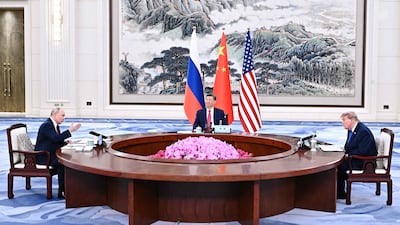
The leaders met around a round wooden table, a layout with no head seat that suggested three powers meeting as equals. A large arrangement of pink flowers sat in the centre, and the flags of Russia, China and the United States stood behind it.
Mr Xi sat in the middle of the frame, flanked by Mr Putin on his right, the position traditionally reserved in diplomatic protocol for the most honoured guest, and Mr Trump on his left.

Behind the Chinese President, hung a vast painting in the classical Chinese "shanshui", or mountains and water style, showing rugged peaks rising above a sea of clouds, pine trees and the Great Wall winding along a ridge beneath a reddish sky: Mountains for stability, pines for longevity, and the Great Wall for national strength.
Underfoot, a vast carpet of swirling blue and white, standing for good fortune and harmony. It evoked clouds or waves, spread across the room, echoing the sea of clouds in the painting above and completing a classically Chinese scene of mountains and water.
Fashion choice
The leaders’ ties drew attention. Mr Xi wore red, China’s colour of good fortune and of the Communist Party, a familiar choice for the Chinese leader at major state occasions.
Mr Trump, whose signature tie is a Republican red, opted instead for blue, while Mr Putin wore the maroon that has long been a staple of his formal wardrobe.
Friends, frowns
The three leaders held separate bilateral meetings before their trilateral summit. Before, during and after the meetings, smiles were frequently exchanged. But there were also moments of visible tension, with Mr Trump making little effort to conceal his frowns, particularly as he walked alongside his two counterparts, towering over both.
Despite the occasional frowns, Mr Trump repeatedly referred to both leaders as friends, emphasising his personal relationships with them and projecting an image of familiarity despite the deep divisions between their countries.

Speaking about Mr Putin, he said: “Who is he? He's my friend. … Thank you very much. We look forward to our meeting. We've had a great relationship for many years. We knew each other for a long time, and I think a lot of wonderful things can come out of this, or at least start".
Mr Trump was similarly complimentary towards Mr Xi, thanking him for an “incredibly warm welcome” and congratulating him on the Apec meeting. He also praised their “outstanding personal relationship”, while making clear that economic interests remained high on his agenda, saying he would ask the Chinese leader “to do some more for our farmers”.
The meeting
The trilateral meeting between the leaders of Russia, China and the US is the first of its kind in history. Beyond the leaders themselves, its symbolism lies in the image of three of the world's great powers engaging at the highest level amid growing competition and conflict between major powers.
The gathering has drawn comparisons with the 1945 Yalta Conference when the "Big Three" of the time - the leaders of the US, Britain and the Soviet Union - met to discuss the post-war world order. The optics also carry a message to countries outside the room, particularly European states, given that decisions on their security could be discussed without their participation.
For Mr Xi, hosting the meeting reinforces China's position as a central diplomatic power, while Mr Putin gains an opportunity to present Russia as an equal partner to the US despite its international isolation over Ukraine.

