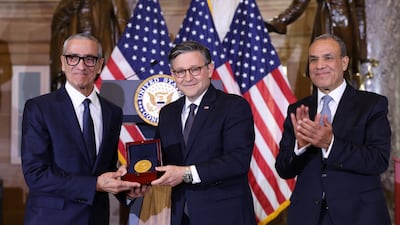

Egypt's Anwar Sadat has been posthumously awarded the US Congressional Gold Medal in recognition of the late president's efforts to bring peace to the Middle East.
His son Gamal was presented with the medal, which is the highest civilian honour bestowed by the US Congress, at a ceremony in Washington attended by Egyptian Foreign Minister Badr Abdelatty.
A US Marine band performed Laylat Hob, meaning A Night of Love, by the late Egyptian singer and composer Mohammed Abdel Wahab, during the ceremony at the US Capitol.

Mr Sadat shocked the world when he visited Israel, then an archenemy of Egypt, and addressed the Knesset in 1977 to argue the case for regional peace, four years after the two neighbours fought their fourth and final war since 1948.
Two years later, the two countries signed the first peace treaty between Israel and an Arab nation. The accord remains a cornerstone of Middle East stability and one which Egypt views as a strategic choice it has no intention of abandoning.
The US-brokered treaty, however, led to the ostracism of Egypt by fellow Arab nations, and Sadat was assassinated in 1981 by Muslim militants during a Cairo military parade marking the anniversary of the 1973 war against Israel.

Mr Sadat earned international acclaim for making peace with Israel. Much of the world regarded him as a statesman whose peace efforts offered a model for others to follow. His shift away from Egypt's alliance with the Soviet Union in the 1970s earned him a partnership with the US that endures to this day.
However, the respect and admiration Mr Sadat commanded internationally contrasted sharply with his standing among his own people. Although hailed as a “hero of war and peace”, his decision to remove bread subsidies in January 1977 sparked street riots that the army was called in to suppress.
A month before his assassination, he ordered the arrest of hundreds of his critics at home. They were released shortly after Hosni Mubarak succeeded him in October 1981.
Mr Sadat's funeral was attended by leaders from all corners of the world. They followed his coffin in a funeral procession that ordinary Egyptians stayed away from and instead watched on television at home.
His funeral contrasted sharply with that of his predecessor, nationalist leader Gamal Abdel Nasser, whose death in 1970 brought millions on to the streets of Cairo to bid him farewell.

President Abdel Fattah El Sisi, who has led Egypt for 12 years, welcomed the US Congress's honouring of Mr Sadat in a post on Facebook. He said it showed “appreciation of his [Sadat's] historic legacy, which embodies the value of peace and the ability to achieve it when the political will and the courage to make a decision are available”.
Mr Abdelatty paid tribute to Mr Sadat during Wednesday's ceremony, and cited Egypt's current foreign policy as evidence of his enduring legacy.
“Egypt's stability, diplomacy and unwavering commitment to the cause of Middle East peace have advanced regional security and complemented American interests for decades,” the Foreign Minister said.
“We will remain a steadfast partner, a credible mediator and a nation that regards peace not as a slogan but as a strategic commitment.”

