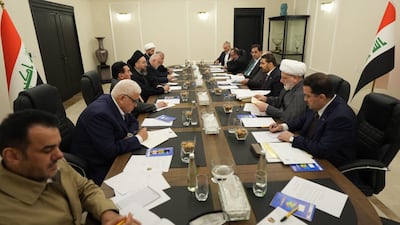

Iraq's largest parliamentary bloc, the Co-ordination Framework, failed to agree in a crisis meeting late on Monday on a plan to end the standoff between government troops and an influential militia in Jurf Al Sakhar city.
The federal government is massing troops outside the stronghold of the army-affiliated Kataib Hezbollah, south of Baghdad.
Authorities are preparing for a confrontation if the militia fails to withdraw from the city, amid tension over the large-scale smuggling of oil, a senior security official said.

But leaders of the Co-ordination Framework, a coalition of Shiite political parties and parliamentary blocs, are divided between a negotiated, phased handover and backing Prime Minister Ali Al Zaidi’s plan for a limited military operation, sources have said.
The official deadline for Kataib Hezbollah's withdrawal from the area is 8pm on Friday, November 20, according to a security source. But sources told The National that did not mean immediate military operations would follow, as several options would remain on the table once the deadline lapsed.
Former prime minister Nouri Al Maliki, and politicians Hadi Al Ameri and Humam Hammoudi, are backing a gradual handover of the territory, rather than the immediate withdrawal of Kataib Hezbollah - a scenario that is being viewed as the most likely.
Under this proposal, Kataib Hezbollah would withdraw from the six oil sites inspected by the government committee, allowing federal troops and the Popular Mobilisation Forces (PMF) — specifically the Atabat brigades linked to the religious authority in Najaf— to take over parts of the area in stages.
Mr Al Zaidi ordered the crackdown, and military units were moving towards Jurf Al Sakhar, a senior government official told international media outlets on Monday.
Kataib Hezbollah wants to delay the full handover until June 30, 2027, the deadline for bringing all weapons under state control.
Mr Al Zaidi, who took office in May, is refusing to leave the situation unchanged for that entire period, sources said.
Kataib Hezbollah, which is closely affiliated with Iran's Islamic Revolutionary Guard Corps, prefers handing over the territory to the Atabat Brigades, which it does not view as a party to the confrontation, rather than directly to the Counter-Terrorism Service.
The Atabat are a group of four paramilitary factions affiliated with Shiite Muslim shrines and Iraq's Grand Ayatollah Ali Al Sistani, rather than with the IRGC.
“That compromise could save the situation on Friday, with both sides claiming victory; Al Zaidi saying ‘the state has entered’, and Kataib Hezbollah saying ‘we did not surrender, we handed over to the Atabat’,” a source said.
The government wants a limited counter-terrorism entry. If no agreement is reached, the government’s current plan is a limited entry, not a full storming of Jurf Al Sakhar, the source said.
Mr Al Zaidi sought the Co-ordination Framework's authorisation to enter the area, but the alliance refused. The area is already surrounded on all sides and, under his plan, the Counter-Terrorism Service force would enter the city. The army, federal police and an elite tactical unit, the Rapid Response Division, would support from outside, while the Air Force would provide air cover and verify that tampering with oil pipelines had stopped.
It is the most significant escalation in the confrontation between Mr Al Zaidi and Iran-backed armed groups in Iraq.
Mr Al Ameri, leader of one of the most influential Iran-aligned groups, the Badr Organisation, and Abu Alaa Al Walai, secretary general of Kataib Sayyid Al Shuhada, were the first to leave Monday's meeting after a heated argument with Mr Al Zaidi.
Controversy has been mounting in Iraq following the leak of an intelligence report alleging organised oil theft dating back to 2021 in Jurf Al Sakhar.
Based on satellite imagery taken between 2021 and 2026, the report documented illegal extraction near pipelines running through the area. It identified four sites where large tankers, each with a capacity of 36,000 litres, repeatedly appeared. The sites were under the control and protection of “an armed faction”, the report said.
An investigative committee confirmed the report’s findings after visiting the area. Mr Al Zaidi has since ordered that all suspects in the smuggling operation be referred to the judiciary for legal action.
“They are against any confrontation with Kataib Hezbollah, even a limited one, because at some point it will be expanded and no one can control it,” one source said.
“They asked the PM to consider legal action against those involved in oil smuggling from KH and never consider any military confrontation."
Meanwhile, Kataib Hezbollah continues to challenge the government, publishing photos of its fighters in the area in full gear, with some photos showing masked drone operators in an open area.

