Not much can be said with confidence about the Israeli election. Official results are still trickling in and will continue to do so in the hours and days ahead.
What is certain is a new political dawn for Palestinians with Israeli citizenship, who make up about 20 per cent of the population.
The community turned out in force, with turnout around 80 per cent, defying its historic apathy towards Israeli elections. The record 17 to 18 seats they are set to gain could have pivotal implications: the same Jewish parties that shunned them might now rely on them to build a government to oust Prime Minister Benjamin Netanyahu.

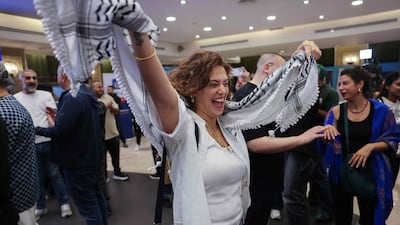
Optimism and unity are rare in Israeli politics today. On Tuesday, it was astonishing, for many, to witness Israel’s once apathetic Palestinian population celebrate at polling stations and coalesce around important causes. It is even more astonishing for others to watch as the same political process seems to be tearing Israeli Jewish society further apart.
Yousef Jabareen, the chairman of the Joint List, said that the Palestinian Israeli party now represents a “large, strong list that cannot be ignored” under any political scenario.
“We said we would be a safety net for our public on the urgent issues facing our community – violence and crime, the demolition of homes and entire villages in the Negev, racism in all areas of life, the lack of housing projects and industrial zones, and physical attacks on young Arab men almost every day,” he added.
“We will represent our public with pride and know how to make responsible, leadership-driven decisions to protect our community.”
Yair Golan is leader of the Democratic Party, the only Zionist party to openly call for working with Palestinian Israeli voters. “The reality must teach us one resounding lesson: We have no future here if we don’t stop being afraid. And if we don’t stop with the racism. We must no longer accept Netanyahu’s racist division between Jewish votes and Arab votes," he wrote on X.
He suggested that a majority now exists, because a coalition with more than 61 seats can be formed. “We have responsibility. And we have an opportunity to form a government of change in partnership with Israel’s Arab citizens. A government that will serve all Israeli citizens. Now we need courage. It takes leadership. It takes stopping the fear and starting to act.”

High turnout could also have implications for the Palestinian cause at large, as so many of the community’s brothers and sisters continue to suffer in Gaza, the occupied West Bank, East Jerusalem and elsewhere, none of whom have any chance of representation.
The community doesn't expect sudden major influence as it remains a marginalised group, shunned by many in the increasingly right-wing Jewish majority. Experts say that mainstream Jewish parties will have to take notice, however, and if Palestinian Arab parties do eventually join a government as they did in 2021, a Palestinian politician within the Israeli state – be it a minister or a Knesset committee chair – would have a rare pocket of insider influence.
Palestinian political analyst Xavier Abu Eid told The National that while Palestinian citizens of Israel have had “awakenings” before, now is “the first time that they truly believe that by voting they can make a difference, even if it’s a moderate one”.
He added that the threat of the far right in Israel was existential for them and “that's the main reason why there's a big vote. If that threat disappears, we don't know if that vote will disappear”.
'Really huge breakthrough'
Indications of a momentous shift emerged even before official turnout data was revealed. In the weeks running up to the elections, some pollsters predicted a big increase in turnout, powered by the aggressive agenda of National Security Minister Itamar Ben-Gvir in particular, who has pursued house demolitions against Palestinians with zeal, gloating about them on social media, and has stood by as a devastating violent crime wave swept through the community, despite being in charge of the police.
The clearest indications that something major was under way came as polls opened. Reports soon came in of busy polling stations, as well as attempts by far-right Israelis to delegitimise and disrupt their vote.
The National witnessed extraordinary turnout at a polling station in a secondary school in the northern city of Nazareth. A stream of cars carrying the sick and elderly arrived throughout the day, with voters using crutches, Zimmer frames or wheelchairs to get inside, alongside families carrying young children or pushing babies in prams.
A 37-year-old woman said she was voting for the first time because after four years of “catastrophe”, the Palestinian-Israeli population was desperate for a new dawn, saying: “We really need change in this country”.
While the majority were motivated by a desire to remove the Netanyahu government from office, other issues were at play, including the unchecked crime that has seen the 2 million Palestinian-Israeli community experience one of the world’s highest murder rates.
They voted despite the intimidating presence of a handful of Jewish settlers who claimed they were deployed as “observers”. They were roundly ignored despite walking around the venue, some with an air of ownership. But observers argued that the settlers' actions motivated Arabs to vote for change in such historic numbers.
There are no guarantees that Tuesday’s momentum will be repeated in future elections, and Israel might be in the midst of yet another quick series of inconclusive votes. However, Palestinian-Israeli leaders now have proof that with large campaigns and high stakes, high turnout in their communities is possible.
Osama Khalid, an 18-year-old voting for the Ra’am party for the first time, said the poll “could be a really huge breakthrough for us” and that he was urging many friends to come out to vote.
Previously, Palestinians with Israeli citizenship “chose not to vote” because they felt their parties had little influence over the far-right’s policies. “We hope we can change the situation for this election. I hope we can give more power to our groups so they can decide for us. Eventually, we want everything to be equal. Most of the people are very optimistic.” said businessman Mohanad Salti, 26.