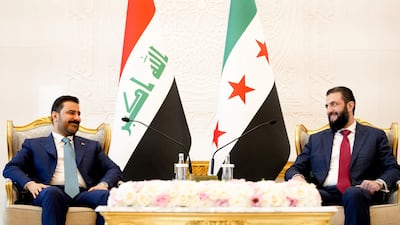

Iraqi Prime Minister Ali Al Zaidi and Syrian President Ahmad Al Shara agreed on Wednesday to push ahead with energy, trade and security co-operation, on the first visit by an Iraqi leader to Damascus since the regime of Bashar Al Assad fell in 2024.
Accompanied by a senior delegation, Mr Al Zaidi was welcomed by Mr Al Shara in Damascus and held talks aimed at turning a decades-long adversarial relationship into a strategic partnership.
Mr Al Zaidi told his hosts during the meeting that Iraqis and Syrians are "one people in two countries", according to a statement from his office.

Both countries also agreed to unify their stances on regional and international issues, and work to achieve peace and stability in the Middle East, the statement said.
One issue discussed was the export of Iraqi oil through the Kirkuk-Baniyas pipeline with an export capacity of up to two million barrels a day, it added. Increasing trade and and developing the agricultural sector were also on the agenda.
The pipeline, built in the 1950s to carry Kirkuk crude to the Mediterranean port of Baniyas, has been out of operation for years. Its revival has become urgent since Iran closed the Strait of Hormuz in late February after the start of the war with the US and Israel, cutting off Iraq's main southern export route.

Mr Al Zaidi visited the Umayyad Mosque in Damascus's Old City and the shrine of Sayyida Zainab on the outskirts of the city, where he was accompanied by Syrian Foreign Minister Asaad Al Shibani. According to Mr Al Zaidi's office, he donated $10 million from his personal account to the two sites.
Earlier on Wednesday, Iraqi government spokesman Haider Al Aboudi said the two leaders were set to discuss "the future of Iraqi-Syrian relations, and regional developments and the repercussions of geopolitical circumstances".
"Economic and trade co-operation will be the priority, stemming from the two countries' need for an economic and investment partnership that transforms the neighbourly ties to mutual interests and opportunities for development and investment," Mr Al Aboudi said.
Although it is Mr Al Zaidi’s first trip to Syria as Prime Minister, he and Mr Al Shara met during the UN General Assembly in New York in September, where they reviewed regional developments.
The Iraq-Syria relationship has shifted in recent months from deep mistrust to pragmatic co-operation, driven by the start of the Iran war in February and US pressure for regional de-escalation.
Iraq, which exported an average of 105 million barrels a month through the Strait of Hormuz before Iran effectively closed the waterway, is seeking alternative trade routes, including through Syria.
Baghdad is already moving limited volumes by lorry across Syria to Baniyas port on the Mediterranean – about 500,000 tonnes of fuel oil a month, according to the Syrian Petroleum Company – and importing petrol through the same route to cover a daily shortfall of 5 million litres.
On July 18, Syria and Iraq signed two agreements to rehabilitate the Kirkuk-Baniyas pipeline, while a separate deal was reached with a consortium that includes Chevron, UCC Holding and TI Capital, to prepare technical and financial studies for a new two million barrel a day line.

The multibillion-dollar project, expected to take four years, would turn Syria into Iraq’s main gateway to the Mediterranean, Mr Al Shara said in an interview with Iraq's Dijlah TV, which was aired late on Tuesday.
Iraq's corridors could link the country's Grand Faw Port on the Gulf to the Mediterranean, while enabling Iraq to connect Syria to Saudi Arabia and other countries in the region, he said.
Since the fall of the Assad regime, Iraq has sought guarantees on the border as ISIS cells remain active, while Syria sees Iran-backed militias on the other side of the frontier as a threat.
Mr Al Shara said that the border was “fully secure” and that no armed group posed a threat to the two countries, and welcomed Mr Al Zaidi’s visit.
The visit also comes as Iraq handles 5,704 ISIS detainees transferred from Syria this year, including 3,000 Syrians, with discussions under way with the Iraqi judiciary over possible repatriation, Mr Al Shara said.
"I believe this is a historic opportunity that has not come to Iraq and Syria, which have suffered for more than 60-70 years from sectarian and internal warfare, coups and conflicts," he said.

