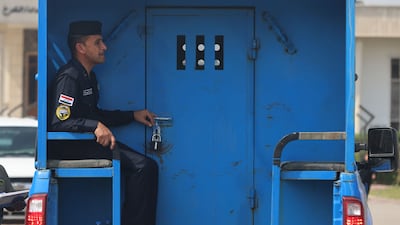

An Iraqi court on Tuesday sentenced seven French ISIS members to prison, in the first verdicts of a trial involving 47 of the country's citizens transferred from Syria, handing down sentences under terrorism laws.
The court sentenced six people to 20 years in prison and one was jailed for 15 years.
Judge Mohammed Salman, of the Karkh Criminal Court, read out the verdicts one after another. "The court found that the evidence is sufficient to convict you,” he told each defendant. “The charge carries the death penalty, but because you are a young man at the beginning of your life, I have decided to give you a chance to reform yourself and change the course of your life."

They joined ISIS during its rule of vast areas of Iraq and Syria. The group held territory from mid-2014 until its defeat in Iraq in 2017 and Syria in 2019. The men were also convicted of participating in terrorist acts threatening public peace and security and endangering people's lives.
The judge said the verdicts could be appealed within 30 days.
Among those convicted was Mehdi Mohammed, 33, a French citizen of Algerian origin. At his hearing on October 5, he admitted joining ISIS, but said he had been lured on social media during Syria's civil war and pleaded for mercy.
Appearing in a yellow prison jumpsuit with his head shaved and hands clasped behind his back, he told the court that as a student in France in 2013 he was troubled by the conflict in Syria. After meeting a man known as Abu Mohammed Al Faransi online, he travelled to Algeria for six months, then in late 2013 flew to Turkey and crossed into Syria with smugglers.
"He convinced me to come to Syria and to join the revolution to support them because they are Muslims," Mohammed told the judge. "It was never my intention to join the Islamic State. I was convinced that we, as Muslims, should help the Syrians. I was deceived."
The judge appointed him a defence lawyer.
The trials began in Baghdad in late September and exposed Europe's unresolved dilemma over what to do with its citizens who joined ISIS. With no international tribunal in place and European countries reluctant to repatriate them, Iraq has become the de facto courtroom for foreign fighters.
In a transfer operation between January and February this year, the US military moved 5,704 suspected ISIS detainees to Iraq by plane and bus. Iraq's Supreme Judicial Council said the detainees comprised 67 nationalities and included 474 Iraqis and 3,497 Syrians. They will also be tried in Baghdad.
ISIS swept across Syria and Iraq in 2014. Iraq, backed by US-led forces, declared victory over the group in 2017, while the Syrian Democratic Forces defeated ISIS two years later.
Iraq has tried thousands of its own citizens accused of joining ISIS. The trials are based on the country's sweeping anti-terrorism law, which carries the death penalty for belonging to a terrorist group.
Foreign citizens have faced the same fate, a policy that rights groups have criticised but that Baghdad defends as a matter of sovereignty and deterrence.
In 2019, several French citizens transferred from Syria were sentenced to death in Baghdad before their sentences were commuted to life in jail.

