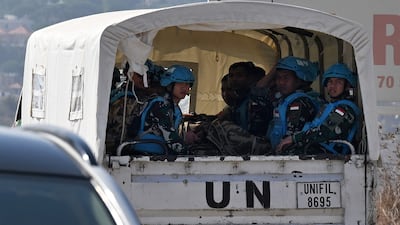
UN peacekeepers have been blocked from arranging journalist visits to Israeli-occupied southern Lebanon for weeks, a spokesman told The National, amid accusations of a media blackout.
Journalists have embedded with the UN Interim Force for Lebanon (Unifil) several times since a June ceasefire between Israel and Hezbollah. Those visits provided one of the few means of accessing the occupied territory, which Israel designates as a buffer zone.
The visits allowed journalists to report on the handful of predominantly Christian villages that remain inhabited, as well as the systematic destruction of largely depopulated Muslim villages.
“At the moment, we cannot conduct media visits south of the so-called yellow line,” said a Unifil spokesman. “This has been the case for the past few weeks.”
He added that Unifil did not know when visits would be permitted to resume.
Elsy Moufarrej, president of the Union of Journalists in Lebanon, told The National that the union had received several complaints from journalists denied access to the zone in recent weeks. She accused Israel of a “media blackout” that prevents independent reporting on “potential crimes and violations”.
“It also deprives these communities of a voice and violates the public's right to know,” she added.
Israel occupied an area extending 10km to 12km into Lebanon during its war with Hezbollah, which reignited in March. The Israeli military launched a ground invasion and forced people to leave the south before establishing its security zone.
Since then, Israel has severely restricted movement in and out of the occupied area, enforcing control through military positions, strikes, forced displacement orders and restrictions on access.
The charity Reporters Without Borders has condemned restrictions on journalists entering the zone, accusing the Israeli military of turning co-ordination mechanisms intended to facilitate safe access into tools of censorship.
“It is unacceptable that Lebanese journalists are denied access or prevented from entering Lebanese territory,” said Jonathan Dagher, head of RSF’s Middle East office. “Ceasefire agreements and military considerations must no longer serve as a pretext to obstruct the right to information and threaten the safety of journalists.”
While some communities such as the Sunni Muslim village of Kfarshouba can still be reached from the Lebanese side, predominantly Christian villages deeper inside the territory are effectively besieged, with movement in and out subject to Israeli permission.
Travelling with Unifil had offered journalists rare opportunities to reach these communities. The media restriction appears to have begun in mid-September, following visits to the occupied zone by journalists from international news organisations.
Téa Ziade, a French-Lebanese freelance journalist, was scheduled to enter the zone with Unifil on September 25 for an assignment with a European news outlet. Her trip was cancelled that morning, just minutes before the convoy was due to depart.
“We had submitted all our papers to Unifil. Everything was in order,” she said. “A Unifil lieutenant told us: ‘It’s the journalists. No journalists are allowed in the convoy.’”
She was given no explanation at the time. She was later told by Unifil that a proper deconfliction process had not taken place.
There have been no Unifil journalist embeds since.
The Israeli military confirmed to The National that it had raised the issue of journalist access with Unifil. “Following incidents in which journalists entered the security zone without prior co-ordination and published footage revealing the locations of troops, the issue was discussed with Unifil,” a military spokesperson said.
But another Israeli military official went further, alleging that journalists had entered the occupied zone concealed within convoys and “shared photographs, which showed the location of our troops, with Hezbollah operatives or people connected to Hezbollah operatives”.
The official did not identify the journalists or news organisations involved, or provide evidence to substantiate the allegation.
When questioned about the accusation, an Israeli military spokesperson appeared to backtrack on the claim that journalists had shared information with people linked to Hezbollah, instead saying that publicly available information about Israeli troop positions could be exploited by the group.
Pictures of Israeli positions inside southern Lebanon are widely available online.

Israel, which has been accused of targeting journalists, has routinely portrayed them as militants. In October, it published a list of 170 people killed in the Gaza war who it said were militants posing as media workers.
Israeli forces have killed at least 16 journalists and media workers in Lebanon since October 2023, according to the Committee to Protect Journalists. Among them was Reuters journalist Issam Abdallah, killed by Israeli tank fire in October 2023 in an attack that wounded six other journalists and which Human Rights Watch described as a war crime.
In April 2026, Al Akhbar journalist Amal Khalil was killed in an Israeli strike while reporting from the security zone during a ceasefire, while her colleague Zeinab Faraj was seriously wounded.
Tighter restrictions
Unifil was not the only means of accessing the occupied territory. Humanitarian and civilian convoys had also offered journalists a route into the occupied zone.
Those routes, too, have become increasingly restricted in recent weeks.
Sources within Unifil and other organisations say access requires “prior deconfliction arrangements, usually through humanitarian convoys”, Ms Moufarrej said.
Deconfliction with the Israeli army usually involves speaking to Unifil or a US and French-led group established to monitor the ceasefire. The process is intended to arrange safe passage through the area.
“However, Israeli forces have reportedly begun preventing these convoys from entering if journalists accompany them,” she added.
A humanitarian worker who regularly travels into the occupied territory told The National that Israeli soldiers have significantly tightened checks at checkpoints, inspecting every vehicle to ensure no journalists were on board. Such checks were not previously routine, the worker said.
“Israeli soldiers now come out of their base and check every person inside the car to make sure their identity matches the approved list.”
An Israeli army spokesperson said the military reviewed journalists’ requests to enter the occupied zone on a “case-by-case basis”, without clarifying what procedures must be followed for approval.
“Areas where military operations are taking place pose genuine security risks, requiring measures to protect the lives of journalists on the ground, as well as the safety of [Israeli] troops,” the Israeli army spokesperson added. “This policy is intended to enable journalistic coverage to the extent possible, without endangering human lives or compromising the safety of troops and their operational activities.”
However, Israeli military operations are an inherent feature of the occupation, meaning any area could be cut off. Ms Ziade rejected the Israeli army’s security justification.
“If we cannot go to the south, how are we supposed to tell the story of the occupation?” she asked. “We lose part of the meaning of this profession, the ability to build trust and intimacy with people. Without journalists on the ground, there is also a question of accountability and impunity.”
Access for journalists has always been challenging. In July, a vetted humanitarian convoy, which included The National, was barred at the last minute by the Israeli army. At the time, Unifil said the decision was probably made because of media presence.
It has now become practically impossible. Since the end of September, no journalists have been allowed inside the security zone.
“What worries me is that this justification could come to be accepted by the international community, and that we, as journalists, will simply be expected to accept it too,” Ms Ziade said. “And that is how, little by little, a territory becomes closed to journalists.”
Collective punishment
The restrictions have also had consequences for civilians living under Israeli occupation.
Israeli forces suspended convoys to Debel and Rmeish for three days after journalists entered the occupied zone, according to a humanitarian worker who regularly travels to the area.
Residents of both villages confirmed they had been prevented from entering or leaving during the three-day closure. They said Israeli military officials had accused journalists of entering the territory without authorisation.
The Israeli military official denied having a policy of punishing civilians or villages for hosting reporters, saying troops had temporarily paused the convoy to investigate the incident.
“It is unacceptable that a civilian area is isolated for three days simply for having hosted journalists,” said Mr Dagher from RSF.
The suspension temporarily cut off a lifeline for the besieged communities, whose residents depend on the convoys for travel and supplies. The closure sparked fears about speaking to the media.
“It was indirect, but the message was received by all the villages: ‘There are a lot of mistakes happening, be careful. If there are more mistakes there won't be any more convoys,'” said a locally elected official from Debel, who requested not to be named to avoid retaliation by Israeli forces.
“People got scared. They need these convoys to access hospitals, doctors and supplies.”

