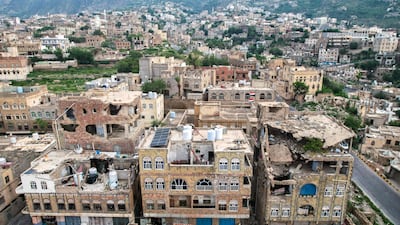

A British charity has warned that dozens of its aid workers are trapped in Taiz, south-west Yemen, which has been under siege by the Iran-backed Houthis since Sunday.
The rebels have cut off the city's supply routes from Aden, weeks after their takeover of the key port city of Mokha on Yemen’s west coast.
Yemeni government forces – backed by Saudi Arabia – said they had recaptured Mokha on Monday. But Taiz remains closed off, with the demining charity Halo Trust raising concerns over an estimated 30 staff members there.


Though some Halo staff fled to Aden, those who remained are now trapped until the roads reopen. “Some fled from Taiz to the south. Some decided to stay, it was an incredibly difficult decision for them,” said Mara van der Kamp, Halo's Yemen director.
Displacement shelters in the city of Lahj, on the road from Taiz to Aden, are packed with civilians. “There has been a lot of movement in the last 24 hours. People moved to Aden and other displacement camps,” she told The National.

There is uncertainty over Taiz’s water reserves, as the city imports it from the capital, Sanaa, because of its own poor networks. Conflict in 2021 severely restricted the supply of drinking water in Taiz.
The renewed fighting on the west coast has forced the charity to abandon its mine and explosive clearance projects in the area. The Halo Trust is not registered to work in Houthi-controlled areas.

Teams have been redeployed to Lahj and Ad Dhale, in southern Yemen, with uncertainty as to when they can resume their work in Taiz.
Yemen has recorded the world’s third-highest number of landmine casualties over the past decade. Ballistic missiles, rockets and mortars are common sights in and around cities.
The most severe danger from unexploded devices in Yemen was around Taiz and Mokha. The toll on children is particularly severe. In 2024, landmines and ordnance killed or injured 260 civilians, including 44 deaths of children. Youngsters frequently encounter lethal hazards during daily activities, such as farming and herding, or by mistaking explosives for toys.

The fighting around Taiz is likely to lead to a “severe” surge in casualties. “We’re hearing of weekly accidents from landmines and explosives,” Ms Van der Kamp said. “Renewed fighting risks creating new contamination on top of an already enormous problem.”
People displaced from Mokha weeks ago had sought refuge in Taiz, mainly in buildings in previously abandoned parts of the city. These areas are closer to the front line, increasing the risk of exposure to unexploded devices.

