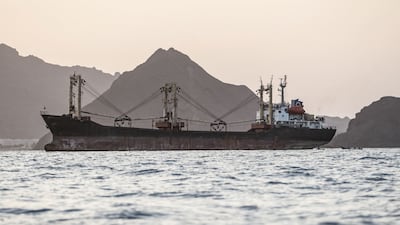

Yemen’s internationally backed coastguard has fled to Djibouti after losing the protection of Gen Tariq Saleh’s military forces on the South-west coast.
The coastguard had received millions of dollars in training from the UK and other western backers to combat piracy and intercept smuggling from the Horn of Africa into the Arabian Peninsula.
It was viewed as a key project to help protect shipping along the Red Sea and help stabilise Yemen’s coastline.

Many of the coastal forces evacuated during the Houthi advance on Mokha last week are now in Djibouti, supporting the tens of thousands of Yemenis who have also fled.
The UK government is understood to be working closely with the remnants of the coastguard and a western diplomat confirmed international backing would continue. But this would now be limited to the Gulf of Aden in areas still controlled by the Yemeni government.
Instead, there are fears that Mr Saleh’s retreat from the Bab Al Mandeb strait could give the Houthis free reign to expand their smuggling networks that stretch deep into the Horn of Africa, with ties to Al Shabab and the Sudanese Armed Forces.

The Houthis claim to have seized advanced coastal surveillance equipment that had been supplied to Gen Saleh's forces over the years.
“It's a significant blow to efforts to cut off supplies of weapons, dual-use components and other materiel to the Houthis, whether supplied by Iran or procured by Houthis networks,” one Yemeni researcher told The National.
“There will be very little to stop the cargo flow now. The National Resistance Forces and the Red Sea district coastguard were the only Yemeni maritime security forces interdicting this materiel with any success.”
The Houthi takeover also shed light on the weakness of international support for Yemen, which critics say was contained to stabilising the coastal borders while civil war bubbled inside. “It (coast guard support) is a good project, but it is not enough. Smuggling will have been undermined, but not removed or defeated,” said Edmund Fitton-Brown, a former British diplomat to Yemen.

Gen Saleh’s flight
The coastguard on the south-west coast was protected by the naval arm of the National Resistance Forces (NRF), led by one of Yemen's most successful – and unpredictable – power brokers.
Gen Saleh, who started receiving Saudi backing in January, has been at the heart of international efforts to secure Yemen’s coastline. He is said to have arrived in Jeddah on Monday after meetings in Riyadh.
In July, they intercepted a shipment of Iranian weapons bound for the Houthis, seizing more than 750 tonnes of munitions and hardware, including hundreds of advanced cruise, anti-ship and anti-aircraft missiles, warheads and seekers, US Central Command said.
“The National Resistance Forces were getting a handle on some of the smuggling. It was heavily reinforced by international support,” said Laura James, Middle East specialist at Oxford Analytica.
The UK pledged $4 million last year to upgrade the Yemeni coastguard’s existing fleets, refurbish its interceptor vessels and purchase new ones, while protecting critical international shipping lanes.
Hamish Falconer, then-minister for the Middle East, made the UK’s first ministerial visit to Yemen in years, where he was pictured inspecting patrol vehicles and a coastguard outpost in the Gulf of Aden. The UK sponsored two patrollers. One of these, the Mayun was initially stationed on Perim island, which was captured by the Houthis this week.
Gen Saleh was in London two years ago drumming up support for his forces to counter the Houthi threat in the Red Sea. The cargo ship RubyMar had been targeted by the Iranian-backed militia, which launched a campaign on international shipping crossing Bab Al Mandab in response to the Israel-Gaza war.
“Saleh was selling the idea that he would protect the sea [to the international community[,” said Farea Al Muslimi, an expert on Yemen and the Gulf at foreign affairs think tank Chatham House.
While this did not translate into material support for the NRF from western donors, it helped drive initiatives to train the civilian coastguard.

Protector of the south-west coast
Casting himself as a protector of the west coast was an important transformation for Gen Saleh – the nephew of former president Ali Abdullah Saleh, the last to preside over a unified Yemen before he was toppled by the Houthis in 2014.
Gen Saleh is among the most powerful figures of north Yemen's political elite who were ousted from Sanaa by the Houthis but continue to seek a unified country.
The Saleh family and their followers have a “nostalgia” for Mokha, despite being from the Northern Highlands of Yemen, according to Mr Al Muslimi. His uncle was a commander in Mokha in the 1970s, which led to the family’s rise to prominence. “There was this nostalgia, a prophecy that Tariq Saleh would rise again in Mokha,” Mr Al Muslimi said.
And though the loss of Bab Al Mandab now finds him disgraced, he is likely to re-emerge, said Nicholas Hopton, a former British ambassador to Yemen. “Ultimately he is a survivor and he will find a new off-route.”
Mr Hopton met Gen Saleh in 2011, when he was accused of opening fire on protesters in Sanaa during anti-government protests.

Houthi smuggling
While this coastguard assistance to Yemen was welcome, for many it was also a fraction of what was needed to reinforce the government and stabilise a country that had just come out of a devastating civil war between pro-government forces and the Houthis.
Instead, more was needed to equip the embattled internationally recognised government in the face of political and security threats from the Iran-backed militia.
The government had been subjected to an “unintended pincer movement” where they faced Houthi attacks from the north and a Saudi-led clamp down on Yemen’s southern secessionist movement, Mr Fitton-Brown said.
“The internationally recognised government is beleaguered in both directions. Civil war is raging again in Yemen. Unless the Saudis get their act together to support the UN-backed government, the Houthis will prevail.”

