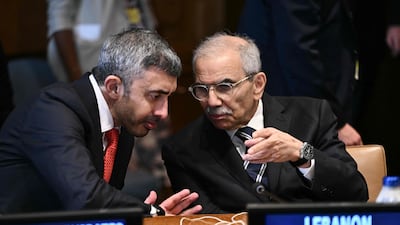
The UAE and Lebanon on Friday launched an initiative to train one million Lebanese in AI, as the two countries moved to deepen co-operation in technology and digital skills.
The “One Million Lebanese AI Experts” initiative was announced during a meeting between Sheikh Abdullah bin Zayed, UAE Deputy Prime Minister and Minister of Foreign Affairs, and Lebanese Prime Minister Nawaf Salam on the sidelines of the UN General Assembly in New York.
The initiative, launched under the UAE’s Government Experience Exchange Programme in co-operation with the Lebanese government, will provide training in generative artificial intelligence and prompt engineering.
It also aims to equip one million people in Lebanon with practical skills to use AI tools in their work and daily lives, including how to formulate instructions and guide applications to produce more accurate and effective results.
The announcement came the same day Mr Salam addressed the General Assembly, where he said the AI revolution is opening unprecedented horizons for progress across every sphere of life.
“Yet it also raises challenges for the future of work and for human rights and fundamental freedoms,” he said, calling for international governance that “places the human being with his or her freedom and privacy at the heart of this transformation”.
He added that Lebanon would not allow itself to become an “arena for the conflicts of others” or a bargaining chip in wider regional disputes.
“No one negotiates on its behalf, except the Lebanese state through its constitutional institutions,” Mr Salam said.
While acknowledging that Lebanon was inevitably affected by developments around it, Mr Salam said that did not mean Beirut would accept decisions about its future being made elsewhere.
“Lebanon's future will not be decided on its behalf, nor may its security and stability become the price of settlements concluded in its absence,” he said.
Mr Salam said his government was committed to extending state authority across all Lebanese territory and carrying out reforms, and called on the international community to uphold Lebanon’s sovereignty and ensure the implementation of international resolutions.
“The Lebanon that stands before you today does not shirk its responsibilities, nor does it ask others to do what it is duty-bound to do itself,” he said.
“We are shouldering our responsibility for reform and for extending the authority of the state over the entirety of our territory.”
The Prime Minister acknowledged criticism that his government had yet to fulfil all its commitments, but said it had inherited weakened state institutions, an ineffective public administration and an economy battered by years of crises.
“We do not claim that the task is complete,” he said, pointing to “paralysed institutions” and a state weakened by “compounding crises and by decades of external interference.”
Mr Salam said those challenges would not be used as justification for abandoning the government’s commitments.
“We have not used the difficulty of our circumstances as a pretext to retreat from our commitments, and we will not retreat,” he said.

