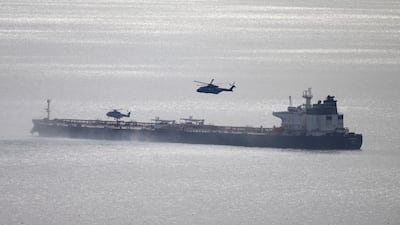

Dozens of shipping and legal documents have tied one of Lebanon's biggest fuel scandals to a prominent Russian-linked shadow maritime network now under western sanctions.
Companies subject to G7 or EU rules generally cannot provide shipping, insurance and financial services for seaborne Russian oil sold to third countries above the applicable price cap. Since 2023, the price cap has been set at $45 a barrel for fuel oil and at $100 a barrel for gas oil and diesel.
The National's previous investigation pieced together how energy-starved Lebanon has imported overpriced Russian fuel since 2023 to operate its ageing power plants. Certificates of origin were allegedly falsified to present the sanctioned fuel as Egyptian or Turkish, which, if established, would have allowed it to be sold at market prices, generating hefty margins at the expense of the Lebanese state.

The new documents, obtained by The National, reveal for the first time the names of companies and vessels involved in the alleged scheme to deliver the oil from suppliers since placed under western sanctions from 2023 to 2025.
The scandal, which arguably cost the energy-strapped country tens of millions of dollars, has now triggered investigations in the country, The National can reveal, further exposing the scale of the case.
A year after The National’s initial investigation exposed parts of the alleged scheme, Lebanese judicial documents and sources confirmed that two additional legal cases have been opened to investigate the companies involved, bringing the total to at least three.
The documents provide an in-depth look at how the oil network allegedly operated, using vessels tied to Russia's alleged shadow fleet and front companies that have since been sanctioned over suspected ties mainly to the 2Rivers Group.

The shadow fleet is a network of ageing vessels that use deceptive shipping practices to evade energy sanctions. It is one “of the world's largest shadow fleet operators and a major trader of Russian crude oil”, a representative for the UK's Foreign, Commonwealth & Development Office told The National.
The UK imposed sanctions on 175 companies linked to the 2Rivers oil group, formerly known as Coral Energy Group, and 48 shadow fleet oil tankers in February 2026 as part of a wider package against Russian interests.
The National found that at least eight companies involved in Lebanon’s fuel supply chain between 2023 and 2025 were subsequently sanctioned for their ties with the 2Rivers oil group as part of the 2026 UK package. It also found that 15 vessels directly involved in Lebanon’s fuel supply chain were later sanctioned.
Joseph Saddi, Lebanon's Energy Minister since February 2025, told The National he was not personally aware of the alleged price-cap violations before the scandal became public. He added that his ministry had “immediately” amended the tender specifications to prevent similar irregularities from happening, while suspected violations from before his tenure had been referred to the judiciary.
“Every time there were suspicions, we asked the judiciary to investigate,” he clarified.
Vessels under sanction
Based on open-source data and shipping documents, The National also found that at least 15 vessels directly involved in Lebanon’s fuel supply chain between 2023 and 2025 were later sanctioned by western governments for transporting Russian oil.
Among the newly sanctioned vessels is the Vietnam-flagged TM Hai Ha 568, which The National previously investigated, tracing its 2025 route to Lebanon via Cyprus and Egypt after ship-to-ship transfers. The National made several attempts to reach the vessel's owner, Ha Trang Petrol Transportation Company Limited, for comment.
The US Treasury's Office of Foreign Assets Control considers ship-to-ship (STS) activity one of the red flags of sanctions evasion, although it can also be conducted for legitimate reasons.
The Lebanese judiciary, which opened an investigation into TM Hai Ha 568 last year, suspected that the ship had not loaded any products in Egypt and had stopped there only to misrepresent the fuel’s origin as Egyptian, according to judicial documents.
The EU, the UK, Canada and Switzerland imposed sanctions on TM Hai Ha 568 in 2026. According to an EU sanctions notice, the vessel is believed to carry sanctioned oil and engage in irregular and high-risk shipping practices.
According to expert David Tannenbaum, director of Washington-based consultancy Blackstone Compliance Services, the EU and the UK have really “stepped up their game” in unravelling clandestine maritime networks in the past year.
The roots of the fuel scandal in Lebanon date back to 2021, when Baghdad began supplying heavy fuel oil to crisis-hit Lebanon on preferential payment terms. Because the Iraqi fuel was incompatible with Lebanon’s power plants, it was swapped on the international market through state tenders. Following the scandal, the swap arrangement with Iraq was terminated in 2025.
Among the main winning companies of the swap tender were BB Energy DMCC, Sahara Energy Resources DMCC, OQ Trading and Iplom International SA.
International shipping documents obtained by The National show that companies sourced fuel ultimately bound for Lebanon between 2023 and 2025 from entities belonging to the 2Rivers Group before the latest UK sanctions. “2Rivers is a prolific user of shell and front companies,” Mr Tannenbaum said.
Shadowy trade
2Rivers Group has been under UK sanctions since 2024. The company, which began a formal dissolution process last year, has previously denied accusations that it violated sanctions. It did not reply to The National's request for comment.

Shipping documents show that BB Energy sourced the fuel delivered aboard the TM Hai Ha 568 from a company called LINXOIL in 2025. LINXOIL is one of the eight 2Rivers-associated companies linked to Lebanon's alleged scheme that the UK later sanctioned. LINXOIL was not itself subject to sanctions at the time of the transaction.
“At the time of the transaction and delivery, compliance screening did not identify any sanctions-related concerns,” a representative for BB Energy said in written responses sent to The National. “Any entity designated under such sanctions becomes prohibited for business dealings,” they added.
Sahara Energy Resources and OQ Trading did not respond to requests for comment.
Standard swap contracts with the Lebanese state, seen by The National, impose obligations on the suppliers to identify the loading port, ensure vessels are tracked by the automatic identification system throughout the voyage and prohibit offshore loading. According to the bidder’s integrity declaration for fuel tenders reviewed by The National, sellers contracting with the Lebanese state must comply with “Lebanese and international laws, especially British ones” and can be held liable for violations.
Speaking generally about the market, Mr Tannenbaum said suppliers are responsible for spotting red flags in certificates of origin, suppliers' reputation and incorporation history. “Traders are expected to do their due diligence … and understand who owns the company that’s selling it before they engage in a multimillion-dollar contract,” said the expert.
While the shadowy world of maritime oil trade is not new, the revelations hit differently in crisis-hit Lebanon, where rampant corruption and mismanagement have long deprived people of affordable electricity.
According to Lebanese judicial documents and sources, the issue has led to fresh investigations, with financial prosecutors filing charges in two separate cases involving Iplom for alleged fraudulent practices and Sahara Energy Resources for alleged corruption resulting in illicit enrichment. No findings have been made against either company. Iplom did not reply to The National's request for comment on the continuing investigation. Both files are currently with the investigative judge, a judicial source told The National last week.

