

Libya has spent years learning how to live with division.
Since the ceasefire that halted the country’s last major round of fighting in 2020, after military commander Field Marshal Khalifa Haftar launched an offensive to capture Tripoli, the absence of nationwide war has created an impression of relative calm.
However, rival authorities have continued to compete for power, armed groups have retained enormous influence and the country's institutions remain divided, even though the political system largely managed to contain those tensions without returning to full-scale conflict.
The events of the past week were a reminder of how precarious that equilibrium is.
A series of drone attacks struck strategic energy infrastructure in Zawiya in western Libya, setting fire to fuel storage facilities and destroying a power substation. The National Oil Corporation warned that continued attacks could force it to declare a force majeure.
A strike on the South Zawiya substation left more than 700 megawatts of generation capacity unavailable, while US company GE withdrew technical personnel because of security concerns.
At almost the same time, Maj Gen Fawzi Al Mansouri, the head of military intelligence in eastern Libya, was killed in a car bombing in Benghazi. No group has claimed responsibility, and there is no evidence that the assassination is connected to the attacks in Zawiya.
Then came another shock on the institutional front. Central bank governor Naji Issa submitted his resignation to Libya's rival legislative bodies. Mr Issa told Al Jazeera that authorities did not accept his resignation.
His appointment in 2024 had been part of an agreement intended to resolve one of the country's most dangerous institutional disputes. Confrontation over control of the bank had contributed to an oil shutdown when eastern authorities halted production and exports.

These developments may ultimately prove to have little or nothing to do with one another. But that is precisely what makes them significant.
“When the political landscape is in flux, as has been the case in Libya in recent months, armed groups tend to mobilise and take actions they believe could strengthen their position, obstruct emerging political shifts or shape their direction,” an analyst with Armed Conflict Location and Event Data (Acled), a US-based global war monitor, told The National on condition of anonymity for security reasons.
Instability in Zawiya
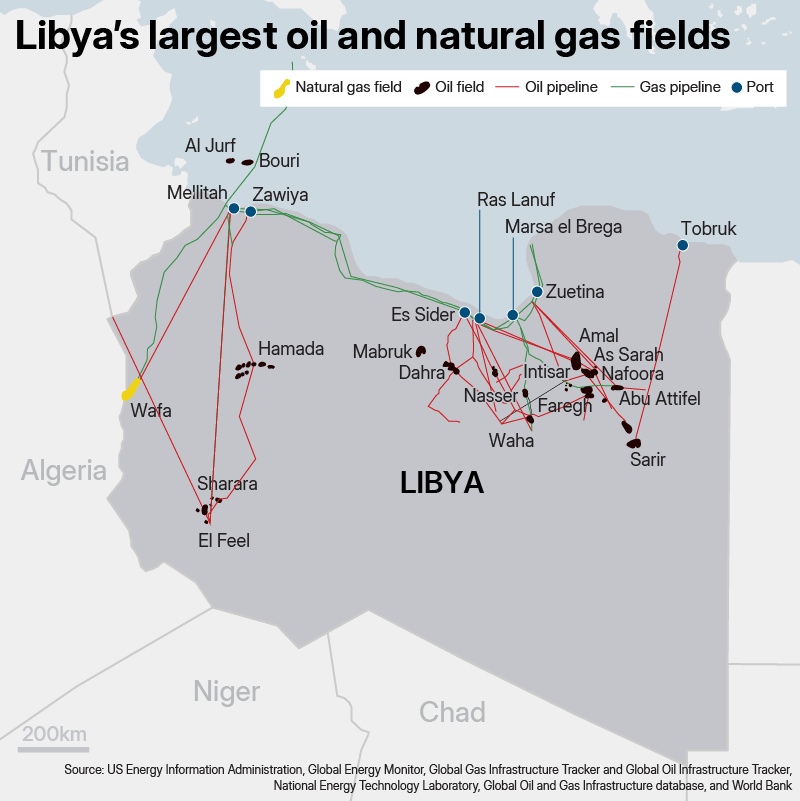
Zawiya contains some of the country’s most important energy infrastructure, including its largest operating refinery and critical electricity facilities. That makes the city’s security inseparable from the country’s economic security. Renewed violence there has disrupted Opec member Libya's oil industry and risks undermining the oil and gas sector's gradual recovery, particularly by eroding foreign investor confidence.
“The issue is that Zawiya is dominated by rival armed groups, and that has been the case for the past 15 years,” said Othman Ben Sassi, a political analyst who was a member of Libya’s now disbanded post-2011 National Transitional Council.
The militias are tied to Libya's western security institutions but operate with considerable autonomy.
Acled has recorded more than 30 armed clashes in Zawiya this year, accounting for nearly 40 per cent of all such incidents in Libya. Most were short-lived and localised, however, making the violence over the past week different in scale.
“Clashes among militias in Zawiya are unique to the city, and there might be a solution for it after the recent developments,” said Mr Ben Sassi.
Meetings between senior security officials and militia leaders from western Libya, including Zawiya, have taken place following the violence and appear to have temporarily eased tensions. Whether that de-escalation can hold is less certain.
“While other cities in Libya are relatively more stable, the overall security situation remains fragile: there are no state institutions, and almost everyone is armed,” added Mr Ben Sassi.
The country had already been grappling with an electricity crisis that sparked unrest in the capital, Tripoli, and demonstrations against Prime Minister Abdul Hamid Dbeibah, who governs western Libya. Last month, protesters cut gas flows to power plants and caused an important field to temporarily halt output, piling further pressure on his administration.
Trump’s unity push tested
The US has been intensifying efforts to advance a long-discussed framework to unify Libya's competing camps. It is the latest attempt to end political fragmentation and rebuild state institutions since the 2011 uprising that toppled long-time ruler Muammar Qaddafi. A deal would also open the door for US economic interests.
The North African nation, which sits on the continent’s largest crude reserves, descended into civil war after Qaddafi's downfall. Field Marshal Haftar gradually consolidated control over much of the country's east, while the Tripoli-based UN-recognised Government of National Unity, led by Mr Dbeibah, remains the dominant authority in the west.
US President Donald Trumps' initiative is being led by his senior adviser for Arab and African affairs, Massad Boulos, who has spearheaded diplomatic engagement with figures across Libya's political spectrum.

“The political manoeuvring initiated by [Mr] Boulos revolved primarily around three tracks: the military, energy and oil and the economy,” the Acled analyst said. They added that last week’s events “complicate the trajectory of all three”.
A US State Department spokesperson told The National that the attacks on Zawiya and the killing of Maj Gen Al Mansouri “underscore the need for unified, professional military and security institutions that are capable of providing security for the Libyan people”.
“US objectives are clear: we seek a unified Libyan executive capable of governing all of Libya’s territory, providing security and economic stability for the Libyan people and creating a credible path to successful national elections,” said the official. “Although the divisions in Libya are long-standing and challenges remain, ongoing efforts have resulted in meaningful progress and closed many gaps between the parties.”
Mr Ben Sassi is sceptical that the latest diplomatic push will produce a breakthrough.
“Libyans are not that interested in external proposals. For us, all efforts, including those from the UN, neighbouring countries and now the US administration, are things that Libyans are used to and no longer find extraordinary. Up until today, all the initiatives have failed,” he said.
Image of stability in Benghazi
Unlike Zawiya, Benghazi is at the centre of the eastern power structure dominated by Field Marshal Haftar’s forces. The east has often been presented as the more secure and tightly controlled half of divided Libya. Yet the assassination of a senior military figure demonstrates that control is not synonymous with immunity.
“The [eastern-based Libyan National Army] LNA will now have to focus on restoring its image of stability in Benghazi, which has been seriously damaged,” said the Acled analyst.
In June, Lt Gen Saddam Haftar, the deputy commander of the LNA and son of Field Marshal Haftar, met US Secretary of State Marco Rubio in Washington.
Under the US proposal, Washington has explored a power-sharing formula that would keep Mr Dbeibah in office while elevating Lt Gen Haftar to a senior national executive role, possibly leading a unified presidential structure.
“Despite these cyclical spikes in violence, the ability of Libya’s elites to contain conflicts and quickly de-escalate should not be underestimated,” said the analyst. “What is far more difficult is moving beyond these temporary and tactical understandings.”

