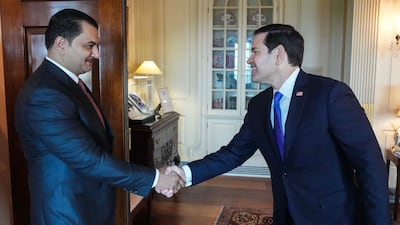

Lt Gen Saddam Haftar, the deputy commander of the eastern-based Libyan National Army, met US Secretary of State Marco Rubio in Washington on Monday.
Mr Rubio was also expected to meet representatives from Libya's eastern government and the Tripoli-based UN-recognised Government of National Unity, led by Prime Minister Abdul Hamid Dbeibah.
"The US will continue working with Libyan leaders and international partners to support a more peaceful, unified and prosperous Libya," Mr Rubio said on X.

Washington is intensifying efforts to advance a long-discussed framework aimed at unifying Libya's rival eastern and western administrations. The initiative is the latest attempt to end years of political fragmentation and rebuild state institutions after the 2011 uprising that toppled longtime ruler Muammar Qaddafi.
Massad Boulos, President Donald Trump's senior adviser for Arab and African affairs, said the meeting with Lt Gen Haftar was "important".
"The United States remains committed to building on the recent momentum toward unified military, economic and political institutions as Libya advances toward lasting peace and national elections," he said on social media.
Libya descended into civil war after Qaddafi's fall, splitting the country in half as military commander Field Marshal Khalifa Haftar – father of Lt Gen Haftar – gradually consolidated control over much of the east.
Lt Gen Haftar was appointed as his father's second-in-command last year, a move described at the time as part of an effort to strengthen the LNA's command structure.
The Boulos deal
The emerging US approach has been associated with Mr Boulos, who has led recent diplomatic engagement with Libyan figures across the political spectrum. The proposal envisions a transitional arrangement that would integrate Libya's divided institutions under a single governing framework.
Under the proposal, Washington has explored a power-sharing formula that would keep Mr Dbeibah in office while elevating Lt Gen Haftar to a senior national executive role, possibly leading a unified presidential structure.
While Mr Boulos has presented the initiative as complementary to UN efforts, it has sparked debate over whether Washington can bridge Libya's long-standing division or whether the proposal will join a series of failed peace initiatives.

Mr Boulos said in an interview with Saudi broadcaster Al Hadath on Saturday that the initiative was “designed to be inclusive, ensuring balanced representation for all stakeholders, regions and cities”.
“Decisions on the details of any unification agreement belong to the Libyans themselves, and the short-term US initiative is designed to be fully complementary to the medium- and long-term road map" of the UN Support Mission in Libya, he wrote on social media.
Mr Boulos also highlighted the role of international partners, including the UAE, Turkey, Egypt, Italy, France, Jordan and Qatar.
On June 21, Abdul Hakim Belhaj, a political figure and former rebel commander who led the Tripoli Military Council, publicly endorsed the US initiative. His endorsement came after Field Marshal Haftar's forces and more than 100 members of the eastern-based House of Representatives expressed support for the US proposal.
In April, for the first time on Libyan soil, forces from the country's rival camps conducted joint military training under US supervision.

Diplomatic frenzy
Diplomatic activity surrounding Libya has accelerated this month.
Last week, Giovanni Caravelli, head of Italy's foreign intelligence service, travelled to Tripoli, where he discussed the US unification proposal with Mr Dbeibah, according to Italian media.
Mr Dbeibah also hosted Egypt's intelligence chief, Hassan Rashad, marking the first visit by a senior Egyptian official to Tripoli since 2021. Relations have remained strained, with Cairo largely favouring engagement with Field Marshal Haftar.
In Benghazi, Turkish intelligence chief Ibrahim Kalin met Lt Gen Haftar to discuss efforts to unify Libya's institutions and strengthen stability.
The foreign ministers of Egypt, Saudi Arabia and Turkey also met Mr Boulos in Cairo to discuss Libya.
Saddam Haftar's rise
Lt Gen Haftar has assumed an increasingly prominent diplomatic and military role within the eastern camp and is widely viewed as a key figure in any future succession in the Haftar command structure. His growing engagement with foreign governments reflects the eastern authorities' efforts to secure international recognition and strengthen their position in negotiations over Libya's future.
The US has maintained contacts with Libya's eastern leadership and the GNU, pursuing incremental steps to reduce divisions in key sectors, including security and energy. Previous US-backed initiatives have led to limited co-operation between the administrations, but political reconciliation has remained elusive.
The two competing administrations are each backed by different armed groups and foreign allies. This month, the country's top governing bodies agreed on a road map to hold long-awaited presidential and parliamentary elections within eight months.

One potential reward for a successful settlement is Libya's vast energy sector. The country holds Africa's largest proven oil reserves, and the US says a more stable political environment could unlock significant American investment and boost global crude supplies.
Mr Boulos said he had encouraged American oil companies to invest in Libya. He noted that ConocoPhillips and Chevron had signed agreements this year, while ExxonMobil was exploring a return to the country.
Libyan oil production could double to three million barrels per day by the end of the decade, he told the Financial Times this month.