

Libya, which holds Africa’s largest proven oil reserves, needs investment of up to $40 billion as it aims to boost production and become a reliable global supplier.
Libya’s National Oil Corporation (NOC) chairman Masoud Suleman told the Financial Times: “We have a lot of untapped resources. We need significant funds, between $30 billion and $40 billion. More than 60 oil and gasfields have been discovered off the Libyan coast but have yet to be developed."
Libya has been beset with problems, such as political instability and violence, following the overthrow of former leader Muammar Qaddafi in 2011. Much of its oil production has since remained offline as unrest grips the country.

The divided North African nation is run by two governments, in Tripoli and Benghazi, with the presence of numerous armed groups wielding influence and discouraging investors to pump finances into the country.
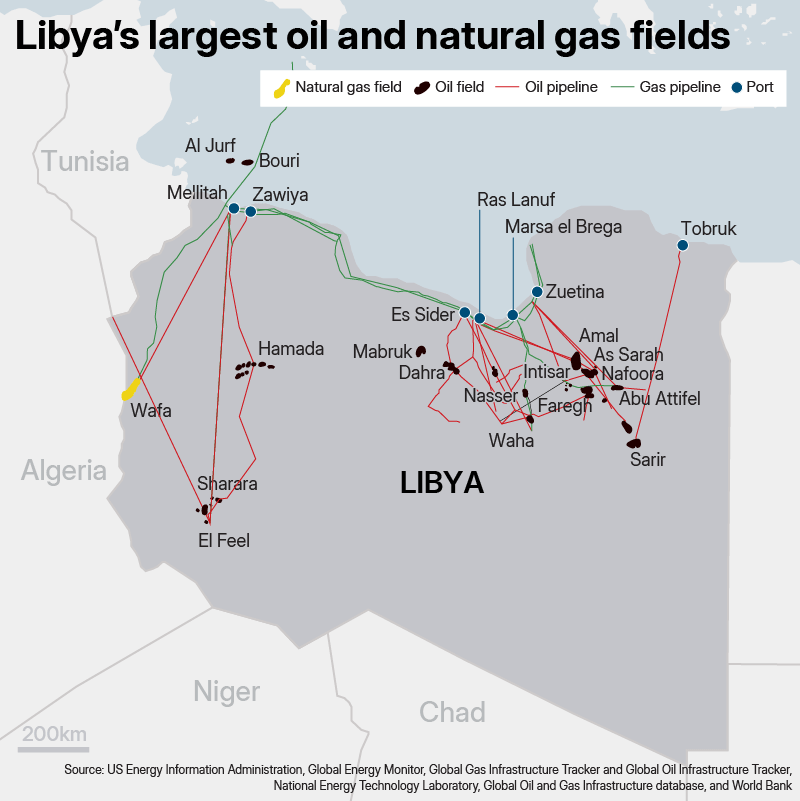
Most of Libya's largest oilfields and export terminals lie in areas controlled by military commander and politician Khalifa Haftar, the strongman who dominates the east, the FT report said on Tuesday, adding that Mr Haftar and his armed faction have periodically blockaded oilfields and ports. In the West, the UN-recognised Government of National Unity in Tripoli is backed by a patchwork of armed groups.
Last week, the Zawiya Refinery complex was attacked with explosive drones causing fires in several fuel storage tanks and disrupting operations. One tank containing about 4.5 million litres of petrol collapsed after catching fire, resulting in no casualties.
The security concerns have also spread beyond the oil complex, with South Zawiya power substation also coming under attack causing a major power cut in areas around Zawiya city. US company GE suspended work at the nearby power plant and withdrew technical teams over security concerns.
Mr Suleman said the attacks were confined to a “limited geographical area … caused by a small number of outlaws” that the state was working to “neutralise”, the FT reported. He said all oil and gas investment sites were “located well beyond areas of tension and under robust security”.
Reviving hydrocarbon sector
In an attempt to revive its hydrocarbons sector, Libya has awarded oil and gas exploration blocks to foreign energy companies, such as Chevron, Eni, QatarEnergy and Repsol. It is looking to increase production to 2 million barrels per day by the end of the decade, from 1.4 million bpd currently.
State-owned NOC in February named the winners of its first bidding round since 2007, allocating concessions across the onshore Sirte and Murzuq basins, as well as offshore gasfields in the Mediterranean.
Under Libya’s production-sharing agreements, the oil company is required to finance its share of development costs, leaving projects vulnerable when government funding is delayed.
Mr Suleman said the NOC was therefore considering a return to concession-style agreements under which investors would shoulder more of the upfront costs.
“We are thinking [of changing] the business model between NOC and our international partners,” he told FT. “We are suffering from [a] lack of funds and this is delaying our development projects dramatically.”

The NOC was also studying “whether we go back to concession agreement” or improve the current production-sharing terms to allow investors to provide more funding, he added.
In an early example of the potential shift, NOC last month signed an agreement for a block named Area 47 with Qatar-based UCC Holding, led by the Syrian-Qatari billionaire Al-Khayyat brothers, without holding a competitive licensing round.
“There was no bidding process, it was a direct negotiation,” Mr Suleman told the FT. He added that the UCC and its partners would finance the project, with NOC’s share of production increasing after 10 years.

