

Repeated drone strikes on Libya's Zawiya refinery complex have put the country on high alert given its dependence on the centre for energy security and its push to raise crude production and attract foreign investment.
The state-owned National Oil Corporation warned that continued attacks could force it to declare force majeure and suspend operations. A prolonged shutdown could increase the country's dependence on imported fuel and potentially disrupt crude flows through one of Libya's most important oil plants.
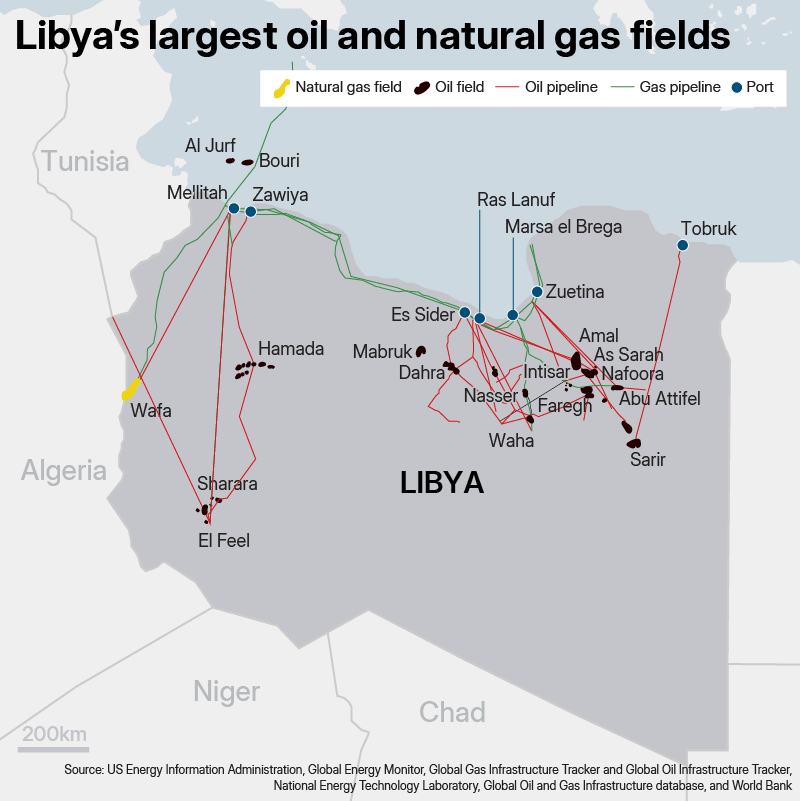
The complex is also important for the country’s upstream operations as it is connected to Sharara, one of Libya’s largest fields, through a pipeline that transports crude for domestic supply and for export in global markets.

“Zawiya sits at the intersection of Libya’s upstream production, crude evacuation infrastructure and domestic fuel-supply system,” Fiza Jan, a senior analyst from Rystad Energy, told The National. “That makes it a potential transmission point through which a localised security incident can become a national oil-supply problem.”
The site was attacked several times with explosive-laden drones causing fires fire at several fuel storage tanks and disrupting operations. One tank containing about 4.5 million litres of petrol collapsed after catching fire. No casualties were reported.
The corporation said emergency teams had brought all the fires under control earlier than expected and that the refinery itself had not been damaged, although production was briefly disrupted. Libya's overall fuel supply has so far remained stable, supported by petrol stocks at the Tripoli oil depot and additional cargoes being loaded by tankers.
Zawiya dependence
The easing of the immediate crisis, however, has done little to remove the threat to the complex.
The security concerns have also spread beyond the oil complex. A drone attack on the South Zawiya power substation caused a major electricity outage in areas around the city, while US company GE suspended work at the nearby power plant and withdrew technical teams because of security concerns. More than 700 megawatts of the plant's 1,300MW generating capacity became unavailable.
Zawiya is Libya’s largest operating refinery, with a refining capacity of 120,000 barrels per day. It produces petrol, diesel, jet fuel, LPG, fuel oil and naphtha for domestic consumption. The wider site also includes a centre for the production of asphalt and lubricants.
Despite having the Zawiya refinery, Libya remains heavily dependent on imports of refined products for local consumption, and the shutdown of the refinery would further increase its import requirements and put pressure on its economy.
That dependence means a prolonged disruption would have consequences beyond the refinery itself. Reduced domestic production of petrol and diesel would have to be compensated for with additional imports, increasing Libya's foreign-exchange requirements and import bill at a time when the economy remains heavily dependent on hydrocarbons revenue.
“If [the] company moves to force majeure and shuts the refinery for an extended period, we would expect higher Libyan product import requirements, particularly gasoline and middle distillates, while crude that would otherwise be processed domestically could become available for export or require alternative disposition,” said Sumit Ritolia, a senior manager of Kpler.
Heightened threat
Zawiya has been vulnerable to security disruptions, with the refinery being shut during fighting in May and suffering storage-tank fires during clashes in December 2024.
The latest incidents are particularly significant because they come only three months after heavy fighting around Zawiya forced the refinery into a complete shutdown and prompted the evacuation of tankers from its port. Operations resumed two days later.
Unlike previous episodes in which energy infrastructure was disrupted by fighting between armed groups, the latest incidents involve repeated drone attacks directly targeting strategically important infrastructure, potentially marking a more troubling evolution in the security risks facing Libya's oil industry.
The country remains politically divided between the UN-recognised Government of National Unity in Tripoli and a rival administration in the east, while numerous armed groups continue to wield influence across the country.
The complex is also important from an upstream operations perspective. It is connected to the Sharara oilfield, which accounts for about a quarter of Libya’s production of 1.4 million bpd.
Production at Sharaha is expected to be affected if the site is closed that could compound problems for the country, which is heavily dependent on oil revenue to run its economy.
“Direct and repeated drone attacks against energy infrastructure represent a more troubling evolution because they demonstrate that strategically important assets can themselves become targets,” Ms Jan said. “That increases the security premium attached not only to current production but also to maintenance, brownfield investment and future capacity expansion.”
Libya, which holds Africa’s largest proven oil reserves, estimated at 48 billion barrels, is focusing on reviving its hydrocarbons sector and attracting more foreign investment.
Earlier this year, it awarded oil and gas exploration blocks to companies, including Chevron, Eni, QatarEnergy and Repsol in its first licensing round in nearly two decades.
Tripoli is aiming for a crude output of 1.6 million bpd by the end of 2026, with new investments in the oil sector.
The country produces some of North Africa’s cheapest, largely sweet oil, much of which has remained offline since the 2011 civil war that followed the overthrow of former leader Muammar Qaddafi.

