
Libya has reached its highest oil production in more than a decade, approved its first unified budget in 13 years and secured one of the few growth upgrades in the IMF's latest regional outlook, making it a rare bright spot as the Iran war forces steep downgrades on economies across the Middle East.
The Opec member, which holds Africa’s largest proven oil reserves and remains divided between rival governments in the east and west, has increased output to 1.43 million barrels per day this month. It also agreed on a unified budget of 190 billion Libyan dinars ($29.95 billion) on April 11, its first consolidated spending plan since 2013.
While the Iran war is expected to slow growth in Gulf economies, the IMF raised Libya’s growth forecast for this year by 2.5 percentage points to 6.7 per cent – one of the few upwards revisions in its regional outlook.

The budget allocates 12 billion dinars to the state oil company National Oil Corporation (NOC), which is central to efforts to boost production, according to a Reuters report.
“Libya’s unified budget likely aims to reduce unchecked spending and set in place a framework for government expenditure that would support Libya’s economic needs,” senior analysts at S&P Global Market Intelligence Samer Talhouk and Jessica Leyland told The National.

Allocation to the NOC would support hydrocarbon production, investment and likely purchase of refined fuel.
Due to a lack of refining capacity, Libya imports refined fuel, including gasoline and diesel, to meet domestic demand.
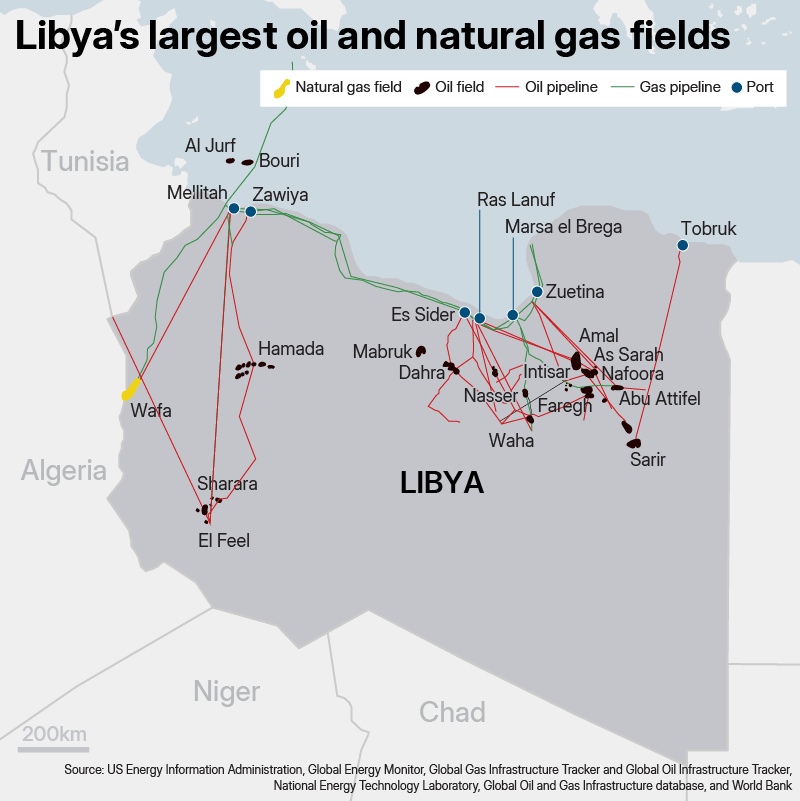
With the Strait of Hormuz effectively closed since early last month, Libyan production is proving invaluable to European refiners who favour light-sweet crude. Its export terminals sit on the Mediterranean coast, completely outside the crisis zone, and it is connected to European markets through the Greenstream gas pipeline running from Western Libya to Sicily in Italy.
“That geographic separation, which was historically just a structural footnote, has now become a strategic advantage transforming into a genuine premium differentiator overnight,” said Fiza Jan, a Rystad Energy senior analyst.
Libya exports about 1 million barrels per day, with Europe as the primary market, positioning the country as “a valuable non-Hormuz supplier of light-sweet crude (low sulphur content) during Gulf disruptions,” said Hazel Seftor, senior research analyst of global oil supply at Wood Mackenzie.
“One more structural advantage worth noting is that Libya operates within Opec under a long-standing quota exemption, originally granted because of its post-conflict recovery status. That exemption now gives Libya the freedom to increase output without a production ceiling,” Ms Jan added.
The Libyan dinar, which has been devalued twice in the past year amid higher public spending and lower oil prices, also reacted positively, strengthening to under 7 dinar per US dollar from a decade low of 9 per dollar. “This should contain Libya's inflation, improve purchasing power, and support domestic economic activity,” S&P analysts said.
A joint statement issued by the UAE, the US, Egypt, France, Germany, Italy, Qatar, Saudi Arabia, Turkey and the UK also praised the budget as “a critical step to increase economic co-ordination between western and eastern Libyan leaders,” adding it has “the potential to foster increased unity, stability, and prosperity for Libya.”
It is also expected to help roll out development projects and international investment across Libya, and strengthen its institutions, including the Central Bank of Libya, NOC, and Libyan Audit Bureau.
Record output
Libya also set a target to reach 2 million bpd by 2030 as it opens up its energy sector and awards new licences to global oil and gas companies. “For a country that has been prone to outages, hitting 1.43 million represents a domestic production revival story, something many volatile countries can draw lessons from,” Ms Jan said.
Libya has some of the cheapest, largely sweet oil in northern Africa, but much of it has remained offline since a civil war erupted after the downfall of Muammar Qaddafi in 2011. Shutdown of oilfields due to protests and technical difficulties has continued to hamper production.
Last month, Libya's El Feel oilfield was shut down after its pipeline was used to transport crude from the Sharara field following fire damage. The country is nonetheless pushing to revive its hydrocarbons sector, awarding exploration blocks to Chevron, Eni, QatarEnergy and Repsol in February – the first such exercise since 2007.

In January, it signed a 25-year agreement worth more than $20 billion with TotalEnergies and ConocoPhillips to extend the Waha concessions to 2050, with plans to add 100,000 barrels of oil equivalent per day to the current output of 370,000 bpd. TotalEnergies also restarted production at the Mabruk oilfield after more than a decade.
However, infrastructure remains the key caveat. Ageing pipelines and vulnerability to disruptions require sustained investment across the value chain. Libya's economy relies heavily on hydrocarbons, with oil and gas accounting for nearly 95 per cent of exports and government revenue.

