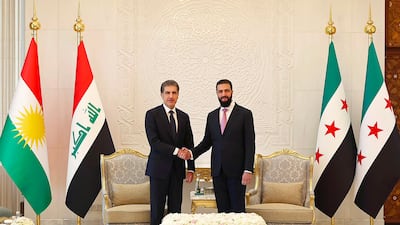
Syrian President Ahmad Al Shara on Monday rolled out the red carpet for the President of the Kurdistan region of Iraq, Nechirvan Barzani, for the first high-level visit by a Kurdish official since the downfall of Bashar Al Assad's regime in late 2024.
For the Kurdistan region, a semi-autonomous area in northern Iraq, the engagement is strategic and protective. A stable, inclusive Syria reduces the risk of ISIS resurgence and of refugee flows into the Kurdish region. It also gives Erbil influence with Baghdad and Ankara by positioning itself as a bridge between the Damascus government and Syrian Kurds.
For Syrian Kurds, Mr Barzani’s visit provides political cover at a delicate moment as they negotiate with Damascus to secure a formal place in Syria's post-conflict political process.

In a statement after the meeting, Mr Barzani said he was “pleased to have visited Damascus” and noted the significance of the engagement after years of conflict in Syria.
He expressed optimism about Syria’s prospects, saying the country “now has a historic opportunity to recover, rebuild, and prosper”. He voiced confidence in Mr Al Shara’s vision, saying that “under his leadership, Syria can advance toward greater stability, prosperity and a brighter future for all its people”.
The Kurdistan region's President reaffirmed his support for “a stable and united Syria, where the rights of all ethnic and religious communities are protected”.
The two leaders also discussed the importance of Syria playing “a constructive role in advancing regional peace and security”, according to the statement.
“As neighbours, Syria, Iraq and the Kurdistan region share many common interests, and there is significant potential to expand economic co-operation for the benefit of all our peoples,” Mr Barzani said.
Syrian Kurds, who make up an estimated 10 per cent of Syria’s population, control much of the north-east through the Autonomous Administration of North and East Syria, led politically by the Democratic Union Party, PYD, and militarily by the Syrian Democratic Forces, SDF.
Since 2014, the SDF, with support from the US-led coalition, played the main ground role in defeating ISIS in Syria. In return, the US maintained a presence in Hasakah, Deir Ezzor and Raqqa to support counter-ISIS operations and guard detention facilities holding the militants.
However, what Syrian Kurds have obtained so far since the establishment of a transitional administration led by Mr Al Shara is limited.
In March 2025, the Autonomous Administration signed a preliminary agreement with the transitional government that recognised Kurdish as an official language in Kurdish-majority areas and called for the integration of SDF units into the Syrian Ministry of Defence. However, implementation has stalled over disputes about decentralisation, oil revenue and the fate of foreign fighters.

Kurdish officials have said no final political status has been granted. Schools in Kurdish areas now teach in Kurdish, and some local councils have been recognised, but Damascus has not agreed to a federal or decentralised system similar to Iraq’s Kurdistan Region.
The visit by President Barzani is likely to push that process forwards.
The Kurdistan Region shares a 1,100km border with Syria and hosts tens of thousands of Syrian Kurdish refugees. Erbil has also mediated in the past between the SDF and Turkey, which views the PYD as linked to the militant Kurdistan Workers’ Party, the PKK.
A Syrian Kurdish political source briefed on the trip said that although it had been planned for months, regional changes sparked by the Iran war have strengthened the position of Syria and raised concerns about possible effects on Kurds in Syria and Iraq.
Kurdish statesman Massoud Barzani, the uncle of Mr Barzani, played a major role in a US-sponsored agreement in January under which the SDF kept some of its gains from the Syrian civil war, retaining de facto control over Kurdish population centres in the north-east, near the border with Iraq and Turkey.
The Barzanis do not want to see the SDF “trampled upon” by Mr Al Shara's forces if “all hell breaks loose” on the border, the source said.
Mr Barzani, the source said, had expressed the support of Iraqi Kurdistan's regional government for the ultimate dissolution of the SDF while preserving as much as possible of a de facto autonomy for the Kurds in the north-east and authority for Kurdish commanders in SDF units that are supposed to become part of the country's new military. “There is no doubt in anyone's mind that the SDF will dissolve sooner or later,” the source said.

