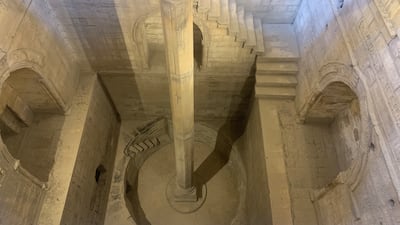

It is housed in a pointed structure that looks deceptively like the mausoleum of a member of royalty or the nobility.
But once visitors are through its wooden gate, what is revealed is an architectural wonder: a large and elaborate stone device that for centuries reliably informed Egyptians whether they would have enough to eat for the next year.
Cairo's Nilometer was built in the 9th century, and had long continued to gauge the river's water level during the annual flood season. The completion some 50 years ago of the Soviet-built High Dam on the Nile in southern Egypt has rendered it obsolete. The water level is now measured in Lake Nasser, the world's largest artificial lake that is behind the dam.
But the bitter, years-long quarrel between Egypt and Ethiopia over the former's share of the Nile's water has quietly given symbolic significance to the Nilometer, turning it into a monument to the enduring bond between the river and the livelihood of Egyptians.
Sitting on the southernmost tip of Roda, a residential Nile island in Egypt's capital, the Nilometer has for years languished in obscurity. It is rarely visited by locals and it is off the itinerary of tours curated for the millions of foreign tourists who come to Cairo every year.

But that takes nothing away from its historical and aesthetic value.
“Whenever Egyptians had to identify a spot to build a Nilometer, they chose a place where the current is not too strong and the river is deep,” said Abbas Sharaky, Egypt's leading Nile expert and a professor at Cairo University's Faculty of African Postgraduate Studies.
“Roda island meets these requirements and the Niometer is very well looked after, but it's not getting the public attention it deserves.”
A variety of Nilometers have been used by Egyptians for thousands of years to measure the river's annual flood, which peaks in August. That allowed them to predict agricultural productivity and avoid destructive flooding.
However, the one on Roda island has wider significance. It is one of the oldest surviving Islamic monuments in Egypt, a fact that raises questions about its relative obscurity in its home city and beyond.
It is housed in a brown and silver cone-like wooden structure, perched on a building the size of a volleyball court.
Technologically sophisticated by medieval standards – it was commissioned in 861 AD by the Abbasid Caliph Al Mutawakkil, on the site of an older water gauge – the Nilometer is built of limestone blocks and is based on a concept in physics called the principle of communicating vessels.
It consists of a deep, stone-lined well with a measuring column standing in the middle. A 45-step staircase spirals to the bottom of the well, allowing maintenance and manual inspection.
Three tunnels at different heights connect the well to the river, allowing the Nile's water to enter in a controlled fashion.

A “perfect flood” would see the water level reach the 16-cubit level on the octagonal column. The reading allowed authorities to predict whether the next harvest would be plentiful, and determine how much tax farmers had to pay.
“Sometimes, past authorities hid the fact that the water level was low so they can still collect high taxes from crop growers,” said Mr Sharaky.
Significantly, the walls inside the Roda Nilometer are adorned with engraved Quranic verses that are among the oldest surviving examples of architectural Arabic Calligraphy, or Kufi style, in Egypt.
The verses deal with themes relevant to the function of the Nilometer, such as water, rain, vegetation and divine providence. In their entirety, they paint a picture of a people entirely beholden to the Nile for their livelihood.
The location of the Nilometer on Roda island also offers a majestic view of the river at its widest point in the Egyptian capital.

Water supply fears
Egypt, the most populous Arab nation with 109 million people, is gripped by fear that a Nile dam built by upstream Ethiopia would reduce its share of the water.
It claims that any reduction of its share of the Nile's water would wipe out millions of agricultural jobs and disrupt its delicate and politically sensitive food balance.
Egyptian President Abdel Fattah El Sisi says the threat from the Grand Ethiopian Renaissance Dam is existential and tells visiting dignitaries without fail that his country will not sit idly by and watch its “water security” taken away.
“Egypt will not be lenient when it comes to its existential water interests,” Mr El Sisi told Massad Boulos, US President Donald Trump's senior adviser on Arab and African affairs, in April in Cairo.
More than a decade of negotiations between Ethiopia on the one hand and Egypt and fellow downstream Sudan on the other has failed to produce a legally binding deal wanted by Cairo and Khartoum on the dam's operation.
Ethiopia maintains that the dam is a sovereign matter and repeatedly seeks to reassure Cairo and Khartoum that they have nothing to fear from it.
However, experts in Egypt maintain that while the effects of the dam on Egypt have to date been minimal – thanks to consistently plentiful rain on the Ethiopian highlands in the past few years – Cairo is rightly worried about how much water Ethiopia would allow through when there is a persistent drought.
Egypt has been seeking to pressure Ethiopia into showing flexibility in the dispute, by cosying up to neighbours of the Horn of Africa nation with military pacts, arms deals and securing naval facilities on the Red Sea.
Significantly, it has deployed up to 15,000 troops in Somalia, its largest military deployment outside the country since the Kuwait liberation war in 1991. The troops are there as part of an African Union peacekeeping force and a training and counter-terrorism mission.
Egypt has also been trying to stymie efforts by landlocked Ethiopia to gain a foothold on the Red Sea, vociferously opposing its attempt to secure an outlet on the strategic waterway in the breakaway region of Somaliland.