

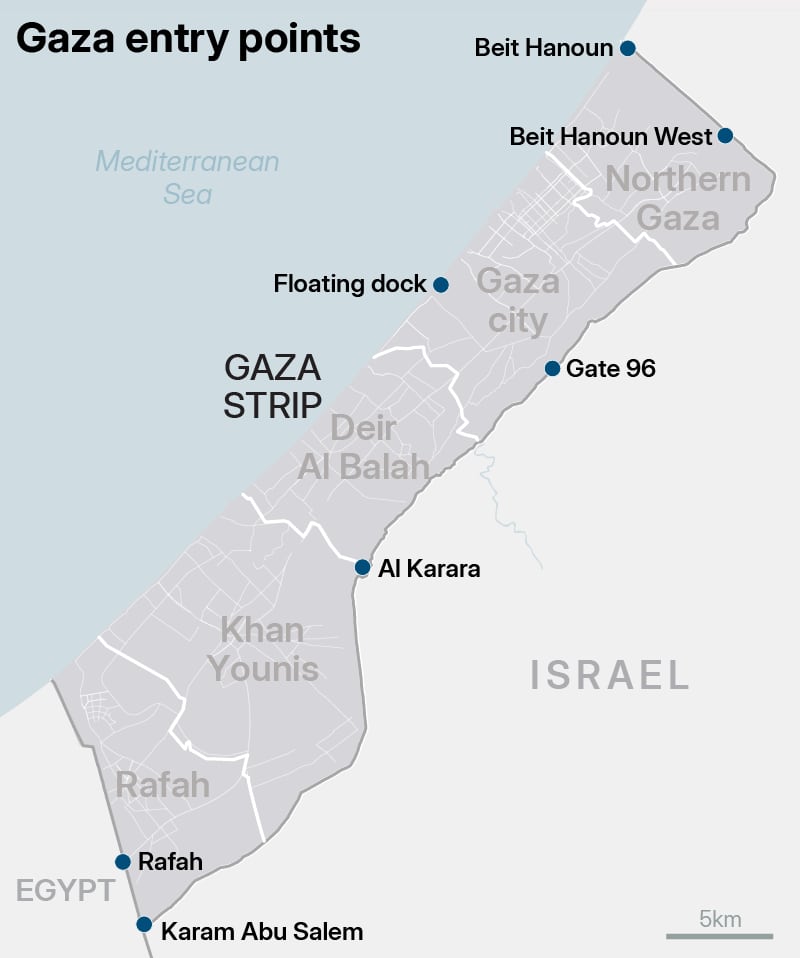
The head of Gaza’s interim government has raised hopes that the Rafah border crossing with Egypt could open within days − boosting peace and recovery efforts after Israel’s destructive war.
Ali Shaath, who leads the new Palestinian committee taking charge of Gaza’s affairs, said the crossing would open “in both directions” next week without specifying a day. In an ideal but less likely scenario, that could allow more aid to enter Gaza, and Palestinians to leave the strip if they wish.
A cabinet meeting is expected to be held in Israel on Sunday to discuss the crossing's opening and what shape that would take, Israeli media reported, citing officials.


Israel has kept Rafah shut since an October ceasefire. US President Donald Trump’s peace plan had called for the crossing to open and aid to enter “without interference”, and its closure is regarded as a key unfulfilled element of the deal.
After Mr Shaath’s surprise announcement on Thursday at the World Economic Forum in Davos, another member of Mr Trump’s Board of Peace said an agreement had been reached “regarding the preparation for reopening of the Rafah crossing”.
“We are currently co-ordinating logistics on implementing this agreement,” said Nickolay Mladenov, who is described by the White House as the “on-the-ground link” between Mr Trump’s board and Mr Shaath’s committee.
There was no immediate comment from Egypt, which has long called for the crossing to open, or Israel, which tightly controls entry and exit from Gaza.
Israel has linked hold-ups in Mr Trump’s peace plan to the return of all its hostages. All 20 survivors have returned to Israel, along with the remains of 27 of 28 dead Israelis. But the body of police officer Ran Gvili has yet to be found and returned.
Mr Mladenov said the board was “working with Israel and the National Committee for the Administration of Gaza to expedite the search for the remaining Israeli hostage”, suggesting Israel is still applying pressure on that front.

The crossing lies at Gaza’s southern tip. The city of Rafah has been largely destroyed by Israel’s attacks, which it described as a war against Hamas but were viewed by many countries and experts as a campaign of genocide against Palestinians.
It is also a lifeline for Gazans who, even before October 7, 2023, depended on at least 600 lorries of aid a day. This number has dwindled significantly during the two-year war, and despite the ceasefire mandating that aid returns to prewar figures, only an average of 144 lorries a day entered in November and 158 in December.
Vital items like biscuits, frozen meat, tents and jackets were rejected by Israel between July and October. Israel claims that some of the items have a “dual use” nature, allowing them to be repurposed for military use.
Images of aid lorries queuing at the Rafah crossing have become a symbol of the humanitarian crisis inside Gaza. Some Palestinians were allowed to cross into Egypt for medical treatment during a previous ceasefire in 2025.
In December, Israel suggested the Rafah crossing would open in one direction only, allowing Gazans to leave for Egypt. But Egypt and several other Arab countries rejected that, fearing a plan to push Palestinians off their land for good.
Egypt has also rejected Israeli attempts to share the blame for Rafah’s closure, saying last month that “the obstruction is on the Israeli side”.

