
The discovery of seven naturally mummified remains of cheetahs, alongside the skeletons of 54 others, in caves in northern Saudi Arabia has raised hope that the species could be reintroduced to the region.
Cheetahs, once common across most of Africa and southern Asia, have experienced a steep population decline, disappearing from 91 per cent of their historical range, including Saudi Arabia and the rest of the Arabian Peninsula.
There were sightings in the peninsula in the 19th century, but the animals have been thought to be locally extinct since the 1970s. The last known sighting was in 1977, when an adult female was shot by a local hunter in Oman.
They are thought to have died out through a combination of habitat loss, prey depletion, human-wildlife contact and hunting.
There are five subspecies of cheetah, including the Asiatic type that is thought to have lived in Saudi Arabia. Asiatic cheetahs are critically endangered, with only about 50 to 70 left in the wild, comprising a single, small population in Iran.
-

One of the mummified cheetahs preserved in a laboratory. Photo: Ahmed Boug et al / Communications Earth & Environment -
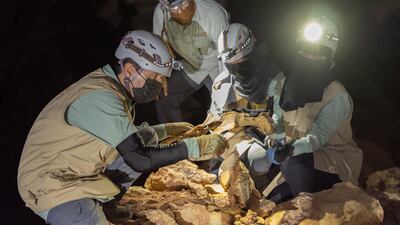
Researchers collecting one of the mummified cheetahs from its place of discovery. Photo: David Chancellor / Ahmed Boug et al / Communications Earth & Environment -

This one was found in situ in a cave in northern Saudi Arabia. Photo: National Centre for Wildlife - Saudi Arabia -

One of the caves in which a mummified cheetah was found. Photo: National Centre for Wildlife - Saudi Arabia -

The entrance to one of the caves that contained a mummified cheetah. Photo: David Chancellor / Ahmed Boug et al / Communications Earth & Environment -

A researcher with one of the mummified cheetahs in the lab. Photo: National Centre for Wildlife - Saudi Arabia -

Researchers examining of the mummified cheetahs. Photo: Ahmed Boug et al / Communications Earth & Environment


Researchers believe the caves, near the city of Arar in northern Saudi Arabia, were used as a den by cheetahs for thousands of years. Tests showed the oldest skeleton was up to 4,000 years old and the mummified remains ranged between 170 and 2,000 years old. While some were found relatively close to the entrance others were more than a kilometre into the cave network.
A video shows researchers clambering through the deep cave network, with the roof covered by bats, documenting the moment they came across the mummified bodies. One team member holds a cheetah's remains aloft as they are removed.
Tests found that most were Asiatic cheetahs, but there were also others more closely related to African cheetahs.
The researchers, led by Ahmed Boug of Saudi Arabia’s National Centre for Wildlife, scoured 134 underground caves in 2022 and 2023, and were able to extract complete genome sequences from three of the seven sampled specimens – the first time this has been done in naturally mummified big cats.
The findings, reported in the journal Communications Earth and Environment, may open new possibilities for the reintroduction of cheetahs to the peninsula.
Mr Boug told The National it was a "critically important discovery" as it was the first physical evidence that cheetahs had inhabited Arabia over the course of the last four millennia and highlights the potentially critical role of caves in preserving genetic and biological evidence of historical species.
He said it also provides insights for the planning of rewilding efforts in the Middle East such as how an increased available genetic pool makes rewilding more feasible.
The team also suggest that their method shows that ancient DNA records from similar specimens could be used to inform future reintroduction plans for other species.
Natural mummies are created in environments that enable dehydration and are most common in arid soil caves that sustain hot, dry microclimates where bacteria is inhibited.

In recent decades, Saudi Arabia has launched wildlife programmes to reintroduce animals into their former habitats. The kingdom has reintroduced species such as oryx and gazelle, and authorities believe that apex carnivores are required so that the ecosystems function successfully.
“This material opens a window to the past that provides most useful data to inform rewilding efforts,” the authors wrote.
“The arid cave environments of Saudi Arabia and elsewhere may yet hold further important highlights that can inform ecological histories, evolutionary insight and actionable intelligence for rewilding and conservation.”

