

Farouq Hosny relishes telling the unlikely story of how the Grand Egyptian Museum was conceived more than three decades ago.
As he tells it, the idea came to him when a prominent Italian publisher and graphic designer, Franco Maria Ricci, provoked him by calling the 123-year-old Museum of Egyptian Antiquities in central Cairo a “storage warehouse” during a conversation in Paris.
“To my own surprise, the anger I felt prompted me to tell him that we plan to build the world's largest museum in Egypt,” Mr Hosny, Egypt's culture minister between 1987 and 2011, tells The National.


“That was in 1992, and we certainly were not building or even thinking of building anything at the time. But I made that up because I was so angry. He then asked where will the museum be, and I said it will be near the pyramids.”
And that, says the 87-year-old Mr Hosny, is the genesis of the $1.2 billion Grand Egyptian Museum that is scheduled to formally open on Saturday with what promises to be a dazzling and extravagant celebration attended by scores of world leaders.
But Mr Hosny's off-the-cuff response to Mr Ricci's remark may not have come out of nowhere. The former minister and renowned abstract painter had been thinking for years before that about what could be done to give the treasures of ancient Egypt a better and larger display space.
“I always felt that something was missing. The old Egyptian museum in Tahrir Square is a gorgeous building that contains beautiful artefacts, but every time I visited I came out with a headache and negative energy.
“It was a sad feeling that our culture and civilisation are not getting the display they deserve,” he says of the colonial-era museum that boasts more than 100,000 artefacts. “But I did not know what to do. As it turned out, what I needed perhaps was the fit of anger I felt because of an offensive remark by someone I had just met for the first time.”

Mr Hosny's fictional plan for a new museum in the desert was taken seriously by Mr Ricci, who flew to Cairo the following week to discuss the matter further. “I did not know what to do with him when he came to Cairo,” Mr Hosny recalled.
The pair went to the desert on the western fringes of Cairo and identified a suitable spot, but it later transpired that it would be difficult to appropriate the land for the museum because the air force kept a guesthouse there.
Later, Mr Hosny returned to the area with Field Marshal Hussein Tantawi, Egypt's late defence minister. They identified an elevated spot that had a panoramic view of the Giza Pyramids. And that is where the majestic Grand Egyptian Museum stands today.
Fortunately, Mr Ricci, who died in 2020, was a close of friend of Giulio Andreotti, Italy's prime minister at the time, and was able to convince him to grant Egypt $5 million to conduct a feasibility study for the project.
Four years later, the study, all eight volumes of it, was ready, complete with an assessment of the possible impact of wind, earthquakes, rain and sun on the proposed structure.
“To realise your dreams is like a crown to wear,” says Mr Hosny, speaking at his yet-to-open art museum that will feature his work and his private collection of paintings and sculptures by his European contemporaries.
-
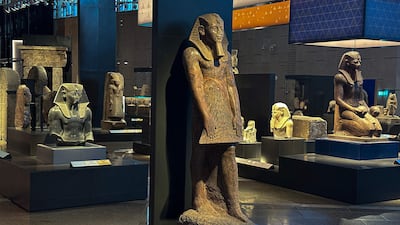
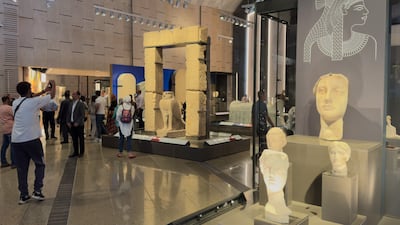
The Grand Egyptian Museum in Giza, during a trial partial opening on October 15. EPA -
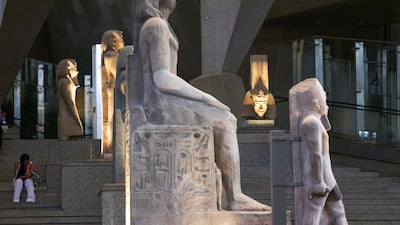
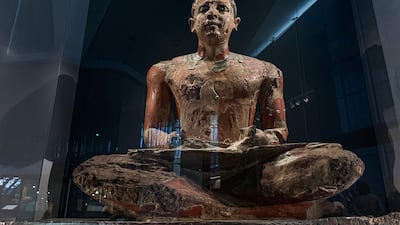
A tourist sits beside pharaonic statues. Reuters -
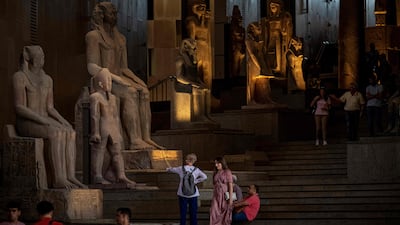
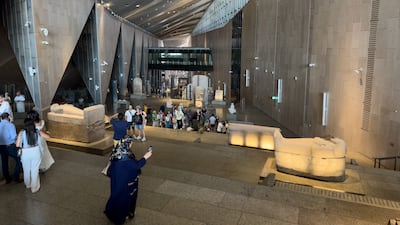
The Grand Staircase is lined with hundreds of pieces, including statues, coffins and reliefs. AFP -
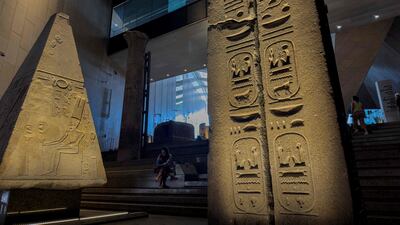
More statues along the Grand Staircase of the museum. AFP -
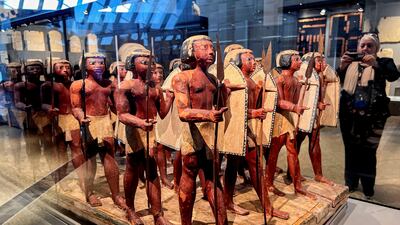
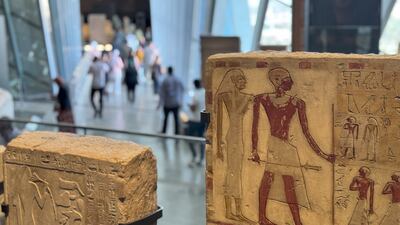
The galleries are divided into four rows, each one covering a different historical period. Reuters -
The grand opening of the museum, which has been delayed several times, is still pending an official announcement. AFP -
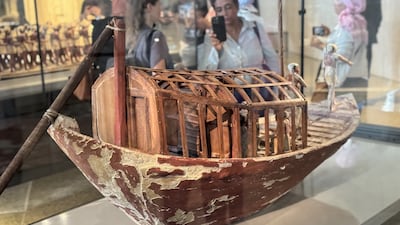
Two halls remain closed, one dedicate to the collection of King Tut, and another with two ships, believed to have belonged to King Khufu. AFP -
Egypt has invested $1 billion in the project. EPA -
Tickets are 200 Egyptian pounds for Egyptians and 1,000 pounds for foreigners. EPA -
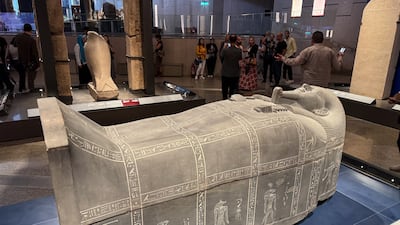
Notable pieces include a colossal statue of the god Ptah statues of the cat-headed Sekhmet, the goddess of war. EPA -
Visitors can see stone tools and grinding stones from the Neolithic and Paleolithic periods. EPA -
There is also a collection from the Green Sahara period, when the desert was reportedly covered in lush vegetation. EPA


With a full head of silver hair and sporting his hallmark scarf around his neck and handkerchief in his jacket pocket, Mr Hosny, a native of Alexandria, cuts a figure that conveys a love of art undiminished by age or life's tribulations and challenges.
In his 24 years as culture minister under the late president Hosni Mubarak, Mr Hosny, a native of Alexandria, showed love and admiration for the treasures of ancient Egypt. But he never allowed his ministerial duties to distract him from his lifelong passion: painting. “Art is not a secondary component of my soul,” Mr Hosny declared.
What captivated him most about ancient Egyptian artefacts was their artistic value. “As an artist I always felt that pharaonic artefacts constituted a compass that moves my feelings,” he explains. “Every time I visited the pharaonic treasures in Luxor, I returned to Cairo filled with energy. They move something inside me that is both glorious and large.
“Every time I stand before them, I am astonished again, like I had not seen them before.”
Mr Hosny confides that his pride in being the man behind the Grand Egyptian Museum does not overshadow his satisfaction over the creation of small and medium-sized museums across the country during his ministerial tenure.
He lists a few: the Museum of Civilisations in Cairo; the Mosaics Museum in Alexandria; the Textiles Museum in the capital; and the Embalmment Museum in the southern city of Luxor.
“It was never a question of big and small,” he declares. “This museum is small but it's full of energy and vision,” he says of his own museum, in the upscale Cairo district of Zamalek.
He insists it should be known by the name he chose for it: The Small Museum.

