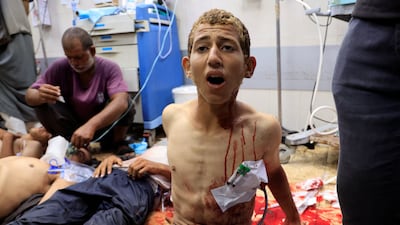
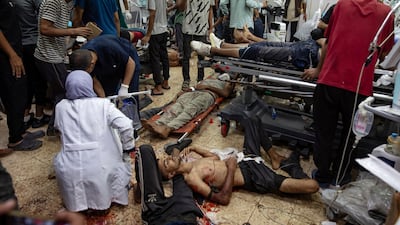
• Palestinians wounded while seeking aid in Gaza are treated at Nasser Hospital, in Khan Younis. Reuters
    Palestinians wounded while seeking aid in Gaza are treated at Nasser Hospital, in Khan Younis. Reuters
  • In addition to the wounded, Nasser Hospital said it received bodies from Morag and others killed near an aid site in southern Gaza run by the Gaza Humanitarian Foundation. EPA
    In addition to the wounded, Nasser Hospital said it received bodies from Morag and others killed near an aid site in southern Gaza run by the Gaza Humanitarian Foundation. EPA
  • Dozens were killed or wounded as desperate crowds headed towards food distribution points, aid lorries and air-dropped parcels in the enclave. Reuters
    Dozens were killed or wounded as desperate crowds headed towards food distribution points, aid lorries and air-dropped parcels in the enclave. Reuters
  • Witnesses and health officials said Israeli forces fired towards crowds near aid sites. Reuters
    Witnesses and health officials said Israeli forces fired towards crowds near aid sites. Reuters
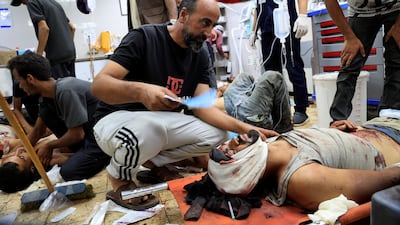
  • Medics attend to wounded Palestinians at Nasser Hospital. Reuters
    Medics attend to wounded Palestinians at Nasser Hospital. Reuters
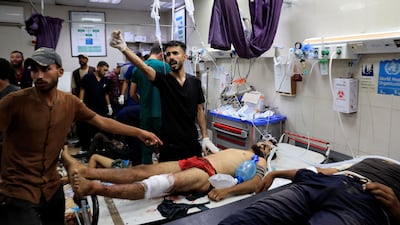
  • People wounded while trying to reach aid lorries entering Gaza through the Morag corridor receive treatment at Nasser Hospital. AP
    People wounded while trying to reach aid lorries entering Gaza through the Morag corridor receive treatment at Nasser Hospital. AP
  • Palestinians wounded while trying to reach aid lorries entering Gaza through the Morag corridor receive treatment at Nasser Hospital. AP
    Palestinians wounded while trying to reach aid lorries entering Gaza through the Morag corridor receive treatment at Nasser Hospital. AP
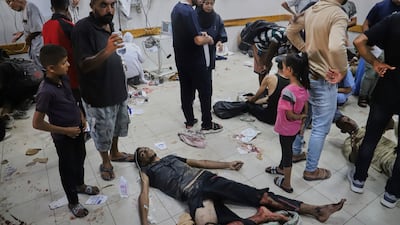
  • Wounded Palestinians are treated at Nasser Hospital. EPA
    Wounded Palestinians are treated at Nasser Hospital. EPA

Startling new details reveal how Gazans are lured to their deaths in aid queues


  • English
  • Arabic

The National can reveal new details of the systematic killing of Palestinians by the Israeli army and private contractors while attempting to collect aid in Gaza.

Striking testimony from Gazans who have escaped the crossfire of the Israeli army during distribution at the Gaza Humanitarian Foundation's aid sites suggests a strategy that legitimises force being used by the military, luring desperate civilians into waves of live fire that can be justified by occupying forces.

Survivors told The National the pattern is that after waiting all night, crowds are shot at early in the morning before the arrival of tanks, which causes panic among aid-seekers. Fleeing the tanks, they are then shot at by Israeli soldiers for moving in "unauthorised directions".
More than 1,300 Palestinians have been killed while waiting to receive aid – at least 850 of them in the vicinity of aid distribution sites, mostly by Israel's army – since the inception of the US-Israeli backed GHF in May, the UN said last week.

The question is: why? The National spoke to witnesses, experts, survivors and others to uncover the circumstances under which starving Gazans are dying by bullets.

The investigation revealed humiliating tactics used by the Israeli army to control crowds waiting for aid, often under inhumane conditions at sites that can only be described as death traps.

Members of a private US security company, contracted by the GHF, direct Palestinians at an aid point in central Gaza, as smoke bombs are fired by Israeli troops. AFP

It showed how soldiers have effectively been given licence to shoot and eliminate anyone they suspect might pose a threat, frequently killing men and women who are simply trying to feed their families.

But first: what is the GHF?

The Gaza Humanitarian Foundation for the distribution of aid was announced in February as an alternative to the UN in Gaza, as Israeli authorities did not trust the internationally recognised institution, even though it has been operating in the enclave successfully for decades.

Israel's pretext for creating the GHF was based on its accusations against Hamas of stealing aid, although Israeli military officials, the US Agency for International Development (USAID) and the UN have said that is simply not the case.

There are only four GHF distribution sites in Gaza, where nine out of 10 people have been displaced numerous times during the war. Three of these sites are in Rafah, in the south, where Israel had said it would create camps to "concentrate Palestinians" and prevent them from leaving.

Palestinians gather at an aid distribution point set up by GHF, near the Nuseirat refugee camp, central Gaza. AFP

The Rafah sites are metres from each other, in militarised zones once declared unsafe by Israel's standards, as the army had been operating there. The fourth site, Wadi Gaza, is in a buffer zone along the recently created Netzarim corridor.

The UN's refusal to work with the GHF is based on the organisation's lack of adherence to humanitarian principles.

Trekking for food

By design, the GHF is set up in a way that encourages displacement, because it forces people to trek through lawless, dangerous and difficult terrain with no guarantee they will be receiving aid, a crime under international humanitarian law – by forcing people to move closer to the few aid sites.

In contrast, the UN operates hundreds of distribution sites across Gaza and delivers aid to those in need, whether in schools that have become shelters, hospitals, tents or homes.

On average, the distribution sites give out anywhere between 3,000 and 9,000 boxes a day – according to posts on their Facebook page – barely enough for a population of 2.2 million, all of them in need.

What began on May 27 with fenced queues, intense screenings and segregated entry and exit lanes, seems to have devolved into near total disorder in which crowds surge from every direction.

There have been reports of live fire and tank fire at crowds almost every day since the sites have been up and running.

Recent high-resolution satellite images confirm that the compounds were built with two main corridors to separate arrivals and departures. Other social media footage shows watchtowers overlooking each site, while makeshift utility poles carry floodlights around sand berms designed to contain crowds.

Ultimately, Israel, which controls every land entry and exit point in Gaza, as well as its sea and sky, is responsible for the security of the sites in co-ordination with the GHF. Some GHF staff are armed private contractors – that is, people with a military background.

People, such as retired Lt Col Anthony Aguilar, have been whistleblowers on the GHF's activities. Since the beginning of its operation, the system has been rigged and key components of its work were left unclear, he said.

"There were no clear indicators, no established rules of engagement or standard operating procedures for engaging with civilians," he said on Tuesday.

Mr Aguilar also highlighted the fact that some of the sites are in areas that had once been declared military zones by Israel; areas that Israel had told civilians to flee "for their own safety".

"This is a violation of international law," Mr Aguilar claimed.

Unpacking the process

To better understand the circumstances, it is essential to explain the process and what unfolds each day at aid distribution sites across the famine-stricken Palestinian territory.

According to witnesses and people with knowledge of the process, hungry civilians gather overnight in areas near distribution sites. The key is for people to arrive before the chaos starts, and for those who are even slightly late, death might be closer than assistance.

In the case of the Wadi Gaza distribution site, which is in an "evacuation zone" – an area the Israelis have told Palestinians is too dangerous to live in – people spend the night under the Wadi Gaza bridge.

Others, like 35-year-old Abu Al Majd, choose to depart just after fajr (dawn) prayers.

From his tent in Nuseirat, it's a 3km walk, which almost guarantees him a spot closer to the aid site, even though there is no specific time for when the distribution, which lasts for around 10 minutes at a time, begins and ends.

Then, throngs of people begin arriving, pushing those in front of them as they clamour for aid. That is when the gunshots begin, under the guise of "crowd control"; and when it does, it's impossible to know where and who the bullets are coming from.

People take cover as shots are fired near a GHF aid point. Reuters

"They begin their warm-up by firing at the crowds at 6am before the tanks arrive around an hour later," Mr Al Majd told The National.

Once that happens and panic sets in, people begin running in all directions, trying to avoid the fire. The Israeli army fires again because people start moving in "unauthorised directions".

This happens again. And again.

Once more, when people arrive to find that all the boxes have been taken, they sit and sift through the sand for grains of rice and pasta that their predecessors left. And another time, when there is nothing left, and the armed men tell people who had walked for 12km or so, starving and thirsty, to come back tomorrow.

"They say 'we’re staying here till you get us something' – and that’s when the Israeli army starts firing again. The fourth massacre of the day," said an expert on aid distribution with knowledge of the process.

Everyone a target

The body of evidence backing deaths and injuries at or near the aid distribution points is solid. Testimonies, video footage and official statements all back up the claim that not enough is being done to prevent the sites from turning into crime scenes.

Speaking to The National, a father Palestinian who had been attempting to go to a GHF site, described what he saw.

"They killed a little boy, 10 metres from where I was," he told The National. "His mother and father looked on. With one bullet, both he and his uncle were shot dead. I will never forget that scene."

Among the hundreds of victims was Ehab, a father of three, who left for one of the aid sites in Rafah early on June 10 and never returned.

His family's calls to him went unanswered and they learnt of his fate later that day when his cousin Omar spotted Ehab in photos of unidentified victims of a shooting at aid sites who had been brought to Al Nasser Hospital in Khan Younis.

"He was shot in the head," Omar told The National.

The bullets are not only aimed at aid seekers but also at those who help the wounded.

In a testimony to Doctors Without Borders (MSF), Mohammad Daghmeh, 24, said he was shot at 3.10am and was left bleeding until 5am. "There were many other men with me. One of them tried to get me out. He was shot in the head and died on my chest," he said.

Others, such as Mahmoud Assaf, a researcher in his 40s, were terrified of what they saw on the one occasion they went to an aid site.

He had left at 10am and came back at 7pm empty-handed. People, he said, were fighting like dogs over meat. When shots are fired, everybody ducks or tries to take cover. Chaos ensues.

In a vicious cycle, Mr Assaf's health is exacerbated by hunger – the very hunger that is driving him to try to fetch food for his children. "They offered to go in my stead, but I couldn't bear the thought of something happening to them."

The shooting, he said, seems to be at random. If they escape the bullets, pepper spray and stun grenades, aid seekers still run the risk of being trampled.

The dangers are too numerous, he said. Mr Assaf, luckier than others, said he instead opted to buy aid being sold on the black market, albeit at exorbitant prices, with the cost of 1kg of flour ranging anywhere between $300 and $800, depending on the prospects of a ceasefire and the amount of aid entering the Strip.

Israeli testimonies

Shots fired at civilians rushing for boxes of aid containing their only source of food are being labelled as "crowd control" measures.

But evidence of the carnage taking place at and around the distribution sites is widely documented in videos, testimonies and statements by members of the GHF who blew the whistle anonymously or openly.

Speaking to Israeli newspaper Haaretz, several Israeli soldiers who worked at GHF distribution sites acknowledged the use of firepower, through heavy machine guns, grenade launchers and mortars, either as warning shots or to disperse crowds.

"Our form of communication is gunfire," one said.

Palestinians gathering near a distribution site affiliated with the GHF in Khan Younis, top, and again at the same site the following day. Photo: Planet Labs / AFP

"We open fire early in the morning if someone tries to get in line from a few hundred metres away and sometimes we just charge at them from close range. But there's no danger to the forces."

Mr Aguilar claimed that using machineguns and military quadcopters to disperse hungry and desperate people in famine-stricken Gaza results in widespread panic and an increase in the lack of safety for them and others.

He recounted numerous missteps, from bringing armed contractors like him on a tourist visa to witnessing war crimes in the form of live ammunition being used against unarmed civilians.

The GHF has repeatedly rejected Mr Aguilar's claims, calling them "categorically false" and made by a "disgruntled former contractor who was terminated for misconduct".

Claims of shootings are not limited to witnesses, former GHF officials and soldiers, however.

The International Committee of the Red Cross, which operates a field hospital in Rafah, has been running "beyond maximum capacity almost daily" since the GHF began operations, treating more patients in that time than it did in the entire preceding year, it said.

"Its staff are racing to treat an unrelenting tide of injuries, the vast majority caused by gunfire," it said. These include toddlers, teenagers, the elderly, mothers, and men and boys, who are known to frequent GHF sites.

Last week, the UN released a video showing shots being fired towards people waiting for food in humiliating conditions, many of them children, as an aid convoy approaches. The shots are fired into the ground in front of a crowd of people, who begin rushing towards the UN vehicles as they draw near.

Olga Cherevko, spokeswoman for the UN Office for Co-ordination of Humanitarian Affairs, said the UN team faced “several constraints” when they went to pick up food supplies from the border crossing.

Palestinians struggle to get food and humanitarian aid from the back of a lorry near Rafah, southern Gaza. AP

“One of the constraints that we faced was waiting about two and a half hours at an Israeli forces checkpoint, which by the time we were allowed to pass, we were met on the road by tens of thousands of hungry and desperate people who directly offloaded everything from the backs of our lorries.”

Israel had not given the UN enough time to secure the aid on the lorries, Ms Cherevko said, making it easier for the packages to fall off.

Blame game

After months of denials and deflecting responsibility for its role in the reported deaths, Israel acknowledged some of the reality on the ground.

"Following incidents in which harm to civilians who arrived at distribution facilities was reported, thorough examinations were conducted in the Southern Command and instructions were issued to forces in the field following lessons learnt," the Israeli army told The National, without clarifying what the new instructions were. A "review" of the "incidents" was being conducted, it said.

Since Israel stopped all aid from entering Gaza in March, dozens of people, including 24 children under five, have died of malnutrition, the World Health Organisation (WHO) said.

  • Palestinians wounded while seeking aid in Gaza are treated at Nasser Hospital, in Khan Younis. Reuters
    Palestinians wounded while seeking aid in Gaza are treated at Nasser Hospital, in Khan Younis. Reuters
  • In addition to the wounded, Nasser Hospital said it received bodies from Morag and others killed near an aid site in southern Gaza run by the Gaza Humanitarian Foundation. EPA
    In addition to the wounded, Nasser Hospital said it received bodies from Morag and others killed near an aid site in southern Gaza run by the Gaza Humanitarian Foundation. EPA
  • Dozens were killed or wounded as desperate crowds headed towards food distribution points, aid lorries and air-dropped parcels in the enclave. Reuters
    Dozens were killed or wounded as desperate crowds headed towards food distribution points, aid lorries and air-dropped parcels in the enclave. Reuters
  • Witnesses and health officials said Israeli forces fired towards crowds near aid sites. Reuters
    Witnesses and health officials said Israeli forces fired towards crowds near aid sites. Reuters
  • Medics attend to wounded Palestinians at Nasser Hospital. Reuters
    Medics attend to wounded Palestinians at Nasser Hospital. Reuters
  • People wounded while trying to reach aid lorries entering Gaza through the Morag corridor receive treatment at Nasser Hospital. AP
    People wounded while trying to reach aid lorries entering Gaza through the Morag corridor receive treatment at Nasser Hospital. AP
  • Palestinians wounded while trying to reach aid lorries entering Gaza through the Morag corridor receive treatment at Nasser Hospital. AP
    Palestinians wounded while trying to reach aid lorries entering Gaza through the Morag corridor receive treatment at Nasser Hospital. AP
  • Wounded Palestinians are treated at Nasser Hospital. EPA
    Wounded Palestinians are treated at Nasser Hospital. EPA

The army also clarified it is not running the GHF centres, although it "allows the American civil organisation [GHF] to distribute aid". Security of those zones is handled by the organisation," Israel's military added.

But the GHF has taken a different position. Referring to a video with which the Associated Press confronted it during an investigation into its conduct, the organisation said the shots heard were not coming from them, but from Israeli forces.

Israel has created an atmosphere in Gaza that has pushed people to starvation, caused prices to rise sharply to hundreds of dollars for basic necessities like flour and sugar, all the while making roads dangerous, medical assistance a rare privilege and safety almost non-existent.

With almost the entire population of Gaza displaced, more than 40,000 people are crammed into a 1 square km space.

To wonder why the Israeli army, or the armed guards working under its watch, are firing at hungry Gazans is to ask why the GHF has been created.


GAC GS8 Specs

Engine: 2.0-litre 4cyl turbo

Power: 248hp at 5,200rpm

Torque: 400Nm at 1,750-4,000rpm

Transmission: 8-speed auto

Fuel consumption: 9.1L/100km

On sale: Now

Price: From Dh149,900

Disclaimer

Director: Alfonso Cuaron 

Stars: Cate Blanchett, Kevin Kline, Lesley Manville 

Rating: 4/5

TECH%20SPECS%3A%20APPLE%20WATCH%20SERIES%208
%3Cp%3E%3Cstrong%3EDisplay%3A%3C%2Fstrong%3E%2041mm%2C%20352%20x%20430%3B%2045mm%2C%20396%20x%20484%3B%20Retina%20LTPO%20OLED%2C%20up%20to%201000%20nits%2C%20always-on%3B%20Ion-X%20glass%3C%2Fp%3E%0A%3Cp%3E%3Cstrong%3EProcessor%3A%3C%2Fstrong%3E%20Apple%20S8%2C%20W3%20wireless%2C%20U1%20ultra-wideband%3C%2Fp%3E%0A%3Cp%3E%3Cstrong%3ECapacity%3A%3C%2Fstrong%3E%2032GB%3C%2Fp%3E%0A%3Cp%3E%3Cstrong%3EMemory%3A%3C%2Fstrong%3E%201GB%3C%2Fp%3E%0A%3Cp%3E%3Cstrong%3EPlatform%3A%3C%2Fstrong%3E%20watchOS%209%3C%2Fp%3E%0A%3Cp%3E%3Cstrong%3EHealth%20metrics%3A%3C%2Fstrong%3E%203rd-gen%20heart%20rate%20sensor%2C%20temperature%20sensing%2C%20ECG%2C%20blood%20oxygen%2C%20workouts%2C%20fall%2Fcrash%20detection%3B%20emergency%20SOS%2C%20international%20emergency%20calling%3C%2Fp%3E%0A%3Cp%3E%3Cstrong%3EConnectivity%3A%3C%2Fstrong%3E%20GPS%2FGPS%20%2B%20cellular%3B%20Wi-Fi%2C%20LTE%2C%20Bluetooth%205.3%2C%20NFC%20(Apple%20Pay)%3C%2Fp%3E%0A%3Cp%3E%3Cstrong%3EDurability%3A%3C%2Fstrong%3E%20IP6X%2C%20water%20resistant%20up%20to%2050m%2C%20dust%20resistant%3C%2Fp%3E%0A%3Cp%3E%3Cstrong%3EBattery%3A%3C%2Fstrong%3E%20308mAh%20Li-ion%2C%20up%20to%2018h%2C%20wireless%20charging%3C%2Fp%3E%0A%3Cp%3E%3Cstrong%3ECards%3A%3C%2Fstrong%3E%20eSIM%3C%2Fp%3E%0A%3Cp%3E%3Cstrong%3EFinishes%3A%3C%2Fstrong%3E%20Aluminium%20%E2%80%93%20midnight%2C%20Product%20Red%2C%20silver%2C%20starlight%3B%20stainless%20steel%20%E2%80%93%20gold%2C%20graphite%2C%20silver%3C%2Fp%3E%0A%3Cp%3E%3Cstrong%3EIn%20the%20box%3A%3C%2Fstrong%3E%20Watch%20Series%208%2C%20magnetic-to-USB-C%20charging%20cable%2C%20band%2Floop%3C%2Fp%3E%0A%3Cp%3E%3Cstrong%3EPrice%3A%3C%2Fstrong%3E%20Starts%20at%20Dh1%2C599%20(41mm)%20%2F%20Dh1%2C999%20(45mm)%3C%2Fp%3E%0A
Essentials

The flights
Whether you trek after mountain gorillas in Rwanda, Uganda or the Congo, the most convenient international airport is in Rwanda’s capital city, Kigali. There are direct flights from Dubai a couple of days a week with RwandAir. Otherwise, an indirect route is available via Nairobi with Kenya Airways. Flydubai flies to Kinshasa in the Democratic Republic of Congo, via Entebbe in Uganda. Expect to pay from US$350 (Dh1,286) return, including taxes.
The tours
Superb ape-watching tours that take in all three gorilla countries mentioned above are run by Natural World Safaris. In September, the company will be operating a unique Ugandan ape safari guided by well-known primatologist Ben Garrod.
In the Democratic Republic of Congo, local operator Kivu Travel can organise pretty much any kind of safari throughout the Virunga National Park and elsewhere in eastern Congo.

UAE currency: the story behind the money in your pockets
bundesliga results

Mainz 0 Augsburg 1 (Niederlechner 1')

Schalke 1 (Caligiuri pen 51') Bayer Leverkusen 1 (Miranda og 81')

Directed by Sam Mendes

Starring Dean-Charles Chapman, George MacKay, Daniel Mays

4.5/5

Company%20profile
%3Cp%3E%3Cstrong%3ECompany%20name%3A%20%3C%2Fstrong%3EHakbah%0D%3Cbr%3E%3Cstrong%3EStarted%3A%20%3C%2Fstrong%3E2018%0D%3Cbr%3E%3Cstrong%3EFounder%3A%20%3C%2Fstrong%3ENaif%20AbuSaida%0D%3Cbr%3E%3Cstrong%3EBased%3A%20%3C%2Fstrong%3ESaudi%20Arabia%0D%3Cbr%3E%3Cstrong%3ESector%3A%20%3C%2Fstrong%3EFinTech%0D%3Cbr%3E%3Cstrong%3ECurrent%20number%20of%20staff%3A%20%3C%2Fstrong%3E22%20%0D%3Cbr%3E%3Cstrong%3EInitial%20investment%3A%20%3C%2Fstrong%3E%24200%2C000%0D%3Cbr%3E%3Cstrong%3EInvestment%20stage%3A%20%3C%2Fstrong%3Epre-Series%20A%0D%3Cbr%3E%3Cstrong%3EInvestors%3A%20%3C%2Fstrong%3EGlobal%20Ventures%20and%20Aditum%20Investment%20Management%0D%3Cbr%3E%3Cbr%3E%3C%2Fp%3E%0A
SPEC%20SHEET
%3Cp%3E%3Cstrong%3EProcessor%3A%3C%2Fstrong%3E%20Apple%20M2%2C%208-core%20CPU%2C%20up%20to%2010-core%20CPU%2C%2016-core%20Neural%20Engine%3C%2Fp%3E%0A%3Cp%3E%3Cstrong%3EDisplay%3A%3C%2Fstrong%3E%2013.6-inch%20Liquid%20Retina%2C%202560%20x%201664%2C%20224ppi%2C%20500%20nits%2C%20True%20Tone%2C%20wide%20colour%3C%2Fp%3E%0A%3Cp%3E%3Cstrong%3EMemory%3A%3C%2Fstrong%3E%208%2F16%2F24GB%3C%2Fp%3E%0A%3Cp%3E%3Cstrong%3EStorage%3A%3C%2Fstrong%3E%20256%2F512GB%20%2F%201%2F2TB%3C%2Fp%3E%0A%3Cp%3E%3Cstrong%3EI%2FO%3A%3C%2Fstrong%3E%20Thunderbolt%203%20(2)%2C%203.5mm%20audio%2C%20Touch%20ID%3C%2Fp%3E%0A%3Cp%3E%3Cstrong%3EConnectivity%3A%3C%2Fstrong%3E%20Wi-Fi%206%2C%20Bluetooth%205.0%3C%2Fp%3E%0A%3Cp%3E%3Cstrong%3EBattery%3A%3C%2Fstrong%3E%2052.6Wh%20lithium-polymer%2C%20up%20to%2018%20hours%2C%20MagSafe%20charging%3C%2Fp%3E%0A%3Cp%3E%3Cstrong%3ECamera%3A%3C%2Fstrong%3E%201080p%20FaceTime%20HD%3C%2Fp%3E%0A%3Cp%3E%3Cstrong%3EVideo%3A%3C%2Fstrong%3E%20Support%20for%20Apple%20ProRes%2C%20HDR%20with%20Dolby%20Vision%2C%20HDR10%3C%2Fp%3E%0A%3Cp%3E%3Cstrong%3EAudio%3A%3C%2Fstrong%3E%204-speaker%20system%2C%20wide%20stereo%2C%20support%20for%20Dolby%20Atmos%2C%20Spatial%20Audio%20and%20dynamic%20head%20tracking%20(with%20AirPods)%3C%2Fp%3E%0A%3Cp%3E%3Cstrong%3EColours%3A%3C%2Fstrong%3E%20Silver%2C%20space%20grey%2C%20starlight%2C%20midnight%3C%2Fp%3E%0A%3Cp%3E%3Cstrong%3EIn%20the%20box%3A%3C%2Fstrong%3E%20MacBook%20Air%2C%2030W%20or%2035W%20dual-port%20power%20adapter%2C%20USB-C-to-MagSafe%20cable%3C%2Fp%3E%0A%3Cp%3E%3Cstrong%3EPrice%3A%3C%2Fstrong%3E%20From%20Dh4%2C999%3C%2Fp%3E%0A
Timeline

2012-2015

The company offers payments/bribes to win key contracts in the Middle East

May 2017

The UK SFO officially opens investigation into Petrofac’s use of agents, corruption, and potential bribery to secure contracts

September 2021

Petrofac pleads guilty to seven counts of failing to prevent bribery under the UK Bribery Act

October 2021

Court fines Petrofac £77 million for bribery. Former executive receives a two-year suspended sentence 

December 2024

Petrofac enters into comprehensive restructuring to strengthen the financial position of the group

May 2025

The High Court of England and Wales approves the company’s restructuring plan

July 2025

The Court of Appeal issues a judgment challenging parts of the restructuring plan

August 2025

Petrofac issues a business update to execute the restructuring and confirms it will appeal the Court of Appeal decision

October 2025

Petrofac loses a major TenneT offshore wind contract worth €13 billion. Holding company files for administration in the UK. Petrofac delisted from the London Stock Exchange

November 2025

180 Petrofac employees laid off in the UAE

Mercer, the investment consulting arm of US services company Marsh & McLennan, expects its wealth division to at least double its assets under management (AUM) in the Middle East as wealth in the region continues to grow despite economic headwinds, a company official said.

Mercer Wealth, which globally has $160 billion in AUM, plans to boost its AUM in the region to $2-$3bn in the next 2-3 years from the present $1bn, said Yasir AbuShaban, a Dubai-based principal with Mercer Wealth.

Within the next two to three years, we are looking at reaching $2 to $3 billion as a conservative estimate and we do see an opportunity to do so,” said Mr AbuShaban.

Mercer does not directly make investments, but allocates clients’ money they have discretion to, to professional asset managers. They also provide advice to clients.

“We have buying power. We can negotiate on their (client’s) behalf with asset managers to provide them lower fees than they otherwise would have to get on their own,” he added.

Mercer Wealth’s clients include sovereign wealth funds, family offices, and insurance companies among others.

From its office in Dubai, Mercer also looks after Africa, India and Turkey, where they also see opportunity for growth.

Wealth creation in Middle East and Africa (MEA) grew 8.5 per cent to $8.1 trillion last year from $7.5tn in 2015, higher than last year’s global average of 6 per cent and the second-highest growth in a region after Asia-Pacific which grew 9.9 per cent, according to consultancy Boston Consulting Group (BCG). In the region, where wealth grew just 1.9 per cent in 2015 compared with 2014, a pickup in oil prices has helped in wealth generation.

BCG is forecasting MEA wealth will rise to $12tn by 2021, growing at an annual average of 8 per cent.

Drivers of wealth generation in the region will be split evenly between new wealth creation and growth of performance of existing assets, according to BCG.

Another general trend in the region is clients’ looking for a comprehensive approach to investing, according to Mr AbuShaban.

“Institutional investors or some of the families are seeing a slowdown in the available capital they have to invest and in that sense they are looking at optimizing the way they manage their portfolios and making sure they are not investing haphazardly and different parts of their investment are working together,” said Mr AbuShaban.

Some clients also have a higher appetite for risk, given the low interest-rate environment that does not provide enough yield for some institutional investors. These clients are keen to invest in illiquid assets, such as private equity and infrastructure.

“What we have seen is a desire for higher returns in what has been a low-return environment specifically in various fixed income or bonds,” he said.

“In this environment, we have seen a de facto increase in the risk that clients are taking in things like illiquid investments, private equity investments, infrastructure and private debt, those kind of investments were higher illiquidity results in incrementally higher returns.”

The Abu Dhabi Investment Authority, one of the largest sovereign wealth funds, said in its 2016 report that has gradually increased its exposure in direct private equity and private credit transactions, mainly in Asian markets and especially in China and India. The authority’s private equity department focused on structured equities owing to “their defensive characteristics.”

How to help

Call the hotline on 0502955999 or send "thenational" to the following numbers:

2289 - Dh10

2252 - Dh50

6025 - Dh20

6027 - Dh100

6026 - Dh200

The specs

Engine: 0.8-litre four cylinder

Power: 70bhp

Torque: 66Nm

Transmission: four-speed manual

Price: $1,075 new in 1967, now valued at $40,000

On sale: Models from 1966 to 1970

French business

France has organised a delegation of leading businesses to travel to Syria. The group was led by French shipping giant CMA CGM, which struck a 30-year contract in May with the Syrian government to develop and run Latakia port. Also present were water and waste management company Suez, defence multinational Thales, and Ellipse Group, which is currently looking into rehabilitating Syrian hospitals.

England Test squad

Ben Stokes (captain), Joe Root, James Anderson, Jonny Bairstow, Stuart Broad, Harry Brook, Zak Crawley, Ben Foakes, Jack Leach, Alex Lees, Craig Overton, Ollie Pope, Matthew Potts


Price, base / as tested From Dh173,775 (base model)
Engine 2.0-litre 4cyl turbo, AWD
Power 249hp at 5,500rpm
Torque 365Nm at 1,300-4,500rpm
Gearbox Nine-speed auto
Fuel economy, combined 7.9L/100km

The specs

Engine: 1.5-litre turbo

Power: 181hp

Torque: 230Nm

Transmission: 6-speed automatic

Starting price: Dh79,000

On sale: Now

ASIAN%20RUGBY%20CHAMPIONSHIP%202024
%3Cp%3E%3Cstrong%3EResults%3C%2Fstrong%3E%3Cbr%3EHong%20Kong%2052-5%20UAE%3Cbr%3ESouth%20Korea%2055-5%20Malaysia%3Cbr%3EMalaysia%206-70%20Hong%20Kong%3Cbr%3EUAE%2036-32%20South%20Korea%3Cbr%3E%3Cbr%3E%3Cstrong%3EFixtures%3C%2Fstrong%3E%3Cbr%3EFriday%2C%20June%2021%2C%207.30pm%20kick-off%3A%20UAE%20v%20Malaysia%3Cbr%3EAt%20The%20Sevens%2C%20Dubai%20(admission%20is%20free).%3Cbr%3ESaturday%3A%20Hong%20Kong%20v%20South%20Korea%3Cbr%3E%3C%2Fp%3E%0A

Director: Shady Ali
Cast: Boumi Fouad , Mohamed Tharout and Hisham Ismael
Rating: 3/5

Updated: August 06, 2025, 11:46 AM