

Gazans have been reduced to “walking corpses” as food shortages push the territory towards starvation, the head of the UN agency for Palestinian refugees said on Thursday, after two more people died from malnutrition.
The latest deaths brought the toll from starvation to 113 since the war began in October 2023, according to Gaza's Health Ministry.
Conditions inside the enclave have deteriorated sharply amid widespread acute hunger that has shocked the world. More than two million people are facing severe food shortages, with more than 100 NGOs warning that “mass starvation” is spreading.
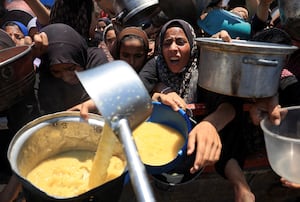
Israel has been accused of restricting the flow of aid but says Hamas is looting supplies and blocking distribution.
“One in every five children is malnourished in Gaza city, as cases increase every day,” UNRWA commissioner general Philippe Lazzarini said, citing the agency's figures.
He quoted a staff member working inside Gaza when he described Palestinians as “neither dead nor alive, they are walking corpses”.
Most children that UNRWA teams encountered were emaciated, weak and at high risk of dying if they do not receive treatment urgently, he added. Parents were too hungry to care for their children and “families are no longer coping, they are breaking down, unable to survive”.
He called for unrestricted and uninterrupted humanitarian assistance, saying UNRWA has “the equivalent of 6,000 loaded trucks of food and medical supplies in Jordan and Egypt” waiting to go.
The International Rescue Committee global aid NGO said it was “horrified” by the reports of starvation, calling for “full, unfettered humanitarian access”.
“Lives are hanging by a thread … This is a man-made hunger crisis driven by severe restrictions and a near-total blockade on aid and goods. It is preventable and it must end,” said Scott Lea, the IRC's acting country director in the Palestinian territories.
There was no sign of a breakthrough in ceasefire talks on Thursday, as Israel recalled its negotiating team from Qatar. Prime Minister Benjamin Netanyahu's office said that “in light of the response Hamas provided this morning, it has been decided to return the negotiating team to continue consultations in Israel”.
The European Commission, the executive arm of the EU, said all options remained on the table if Israel does not deliver on an agreement made with the bloc this month to improve conditions.

International pressure on Israel to alleviate “unbearable” suffering in Gaza is set to increase at an upcoming conference in New York in support of a Palestinian state, the EU commissioner for the Mediterranean Dubravka Suica has told The National.
The EU deal includes a substantial increase in daily aid lorries entering Gaza, the opening of several more crossing points in both the north and south, and the reopening of Jordanian and Egyptian aid routes.
Dr Tedros Adhanom Ghebreyesus, Director General of the World Health Organisation, has said Gaza is “witnessing a deadly surge” in malnutrition and related diseases, and that a “large proportion” of its roughly two million people are starving.
But Israel has denied it is blocking humanitarian aid, claiming that 700 truckloads were on the Gaza side of the border waiting for international organisations to collect and distribute the supplies.

Israel also said it has allowed around 4,500 aid trucks into Gaza since lifting a complete blockade in May.
The UN responded on Thursday by saying it did not know how many truckloads were awaiting distribution inside the Gaza border because Israel has not granted it access.
“Despite our repeated requests, Israel has not allowed the UN to be present at the crossings, which are militarised areas,” said Jens Laerke, spokesman for the UN humanitarian agency OCHA.
“We, therefore, cannot verify the amount of supplies currently at the crossing,” he added.
Mr Laerke said the UN needed multiple authorisations from Israeli authorities: firstly to get aid across the border from Israel into Gaza, where it is dropped off, then a second permit for those trucks to return to Israel. A third approval was needed to drive more trucks from inside Gaza to the border areas to pick up the aid that was brought in.

“It is very important to stress that it is not just about denials of requests to pick up the cargo,” he said.
“They must provide the green light for trucks without unnecessary delays, allow teams to use multiple, safer routes, order troops to stay away from the convoys, and never shoot at civilians along the allocated routes – or anywhere else,” Mr Laerke added.
Palestinian President Mahmoud Abbas said the Palestinian people are facing the “greatest humanitarian catastrophe of our time”, accusing Israel of a war crime.
“How can the world abandon its humanity?” he asked.
International news agencies AP, Reuters and AFP, as well as the BBC, said their reporters in the enclave were “increasingly unable to feed themselves and their families”.
They called on Israel to allow journalists freedom of movement in and out of Gaza.
With the enclave sealed off, many media groups around the world depend on Palestinian reporters based in Gaza who are working for international news agencies.
Media watchdog Reporters Without Borders said this month that more than 200 journalists had been killed in the territory since the war began.
Meanwhile, in Israel, the military said eight soldiers were wounded on Thursday when a driver deliberately rammed his car into a bus stop in what police called a “terror attack”.
The army said two soldiers were “moderately injured” and six “lightly injured” in the attack at the Beit Lid junction near Kfar Yona, in central Israel.
Police said they located the suspect’s vehicle but were still searching for the perpetrator, who abandoned his car in the area.
There has been a spate of violence in Israel and the occupied West Bank since the start of the Gaza war in October 7, 2023.
On that date, Hamas led an attack on southern Israeli communities, killing 1,200 people and abducting 240. Israel's subsequent strikes and ground offensive have killed close to 60,000 Palestinians, according to Gaza's Health Ministry.
Most of Gaza's residents have been displaced by the war, more than once in many cases, and swathes of built-up areas reduced to rubble.

