Smoke and flames erupt from an Israeli air strike in Gaza city on Monday, July 21, 2025. AP

Aid pressure mounts on Israel as nations warn Gaza's suffering has 'reached new depths'


  • English
  • Arabic

The suffering of Gaza's people has “reached new depths”, more than two dozen countries said on Monday, as pressure on Israel to stop its “drip-feeding of aid” to the strip increased.

Britain and France were among 25 countries to say Israel's aid policy is “dangerous, fuels instability and deprives Gazans of human dignity”, in some of their strongest language yet. Israel dismissed their criticism as “disconnected from reality”.

Sources told The National that the US and several Arab allies were in talks to organise airdrops into Gaza to ease a worsening hunger crisis in the strip, whose land borders are tightly controlled by Israel.
The talks began on Sunday in Cairo and Doha between representatives of Israel and those of the US, Egypt, Qatar and Jordan. Several countries carried out airdrops in 2023 and last year.

A UAE aid ship carrying more than 7,000 tonnes of supplies, meanwhile, left Khalifa Port in Abu Dhabi on Monday to deliver supplies for Gaza. The largest aid vessel to be sent by the Emirates so far, it is carrying food, shelter materials and medical and health supplies, state news agency Wam reported.

UAE sends largest aid ship yet to Gaza

The ship, expected to arrive in the next two weeks, is also carrying a fully equipped field hospital that can accommodate 400 patients and 16 ambulances, Hamoud Al Efari, the UAE Aid mission’s co-ordinator, told The National.

The UAE is sending an aid ship to Gaza carrying food, shelter equipment and medical supplies. Victor Besa / The National

Adding to the pressure for more aid, Pope Leo XIV spoke of the “urgent need to provide assistance” in his first call since taking office with Palestinian President Mahmoud Abbas, the Vatican said. Their conversation came days after three people were killed when an Israeli strike hit Gaza's only Catholic church.

Israel has allowed only sporadic aid deliveries into Gaza since ending a two-month ceasefire in March. In one incident on Sunday, Gaza officials said 93 people were killed after hungry civilians surrounded a World Food Programme convoy carrying flour.

Israel was accused on Monday of firing at civilians with their hands raised near the aid convoy, in the bloodiest incident yet involving aid delivery. “Gunfire erupted from all directions,” recalled one witness, Musab Abu Omer.

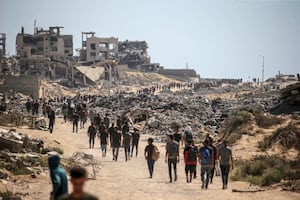
Five more people were reported killed while waiting for aid in Gaza on Monday, as Israel expanded its offensive into the city of Deir Al Balah, which had been spared major ground assaults in the previous 21 months of war. Aid workers have warned of a risk of famine in the enclave.

The secretary general of the Gulf Co-operation Council, Jassim Al Budaiwi, called on the international community to “to take immediate and serious action to end this brutal siege”. He said the Gulf states condemned the “continued unjust, inhumane and illegal blockade” by Israeli forces.

Displaced Gazans flee Deir Al Balah again after Israeli eviction order

The joint statement by 25 mainly European countries, which also include Australia, Canada and Japan, called it “horrifying” that more than 800 Palestinians have been killed while seeking aid.

“The suffering of civilians in Gaza has reached new depths. The Israeli government’s aid delivery model is dangerous, fuels instability and deprives Gazans of human dignity,” they said.

“We condemn the drip feeding of aid and the inhumane killing of civilians, including children, seeking to meet their most basic needs of water and food.”

Israel retorted that Hamas was to blame for starting the war and failing to release Israeli hostages, as talks approach a dead end on a ceasefire proposal by the US, Qatar and Egypt. The Israeli Foreign Ministry said the 25-country statement was “disconnected from reality”.

“Hamas is the sole party responsible for the continuation of the war and the suffering on both sides,” it said. “At these sensitive moments in the ongoing negotiations, it is better to avoid statements of this kind.”

The Israeli army has reportedly proposed seizing yet more of Gaza, where it already claims control of about 75 per cent of the strip's territory, to put pressure on Hamas in the ceasefire talks between both sides falter. Israeli outlet Channel 12 said its sources described the plan as one for “taking over Gaza”.


King Philippe of Belgium calls Gaza crisis ‘disgrace to humanity’

Mercer, the investment consulting arm of US services company Marsh & McLennan, expects its wealth division to at least double its assets under management (AUM) in the Middle East as wealth in the region continues to grow despite economic headwinds, a company official said.

Mercer Wealth, which globally has $160 billion in AUM, plans to boost its AUM in the region to $2-$3bn in the next 2-3 years from the present $1bn, said Yasir AbuShaban, a Dubai-based principal with Mercer Wealth.

Within the next two to three years, we are looking at reaching $2 to $3 billion as a conservative estimate and we do see an opportunity to do so,” said Mr AbuShaban.

Mercer does not directly make investments, but allocates clients’ money they have discretion to, to professional asset managers. They also provide advice to clients.

“We have buying power. We can negotiate on their (client’s) behalf with asset managers to provide them lower fees than they otherwise would have to get on their own,” he added.

Mercer Wealth’s clients include sovereign wealth funds, family offices, and insurance companies among others.

From its office in Dubai, Mercer also looks after Africa, India and Turkey, where they also see opportunity for growth.

Wealth creation in Middle East and Africa (MEA) grew 8.5 per cent to $8.1 trillion last year from $7.5tn in 2015, higher than last year’s global average of 6 per cent and the second-highest growth in a region after Asia-Pacific which grew 9.9 per cent, according to consultancy Boston Consulting Group (BCG). In the region, where wealth grew just 1.9 per cent in 2015 compared with 2014, a pickup in oil prices has helped in wealth generation.

BCG is forecasting MEA wealth will rise to $12tn by 2021, growing at an annual average of 8 per cent.

Drivers of wealth generation in the region will be split evenly between new wealth creation and growth of performance of existing assets, according to BCG.

Another general trend in the region is clients’ looking for a comprehensive approach to investing, according to Mr AbuShaban.

“Institutional investors or some of the families are seeing a slowdown in the available capital they have to invest and in that sense they are looking at optimizing the way they manage their portfolios and making sure they are not investing haphazardly and different parts of their investment are working together,” said Mr AbuShaban.

Some clients also have a higher appetite for risk, given the low interest-rate environment that does not provide enough yield for some institutional investors. These clients are keen to invest in illiquid assets, such as private equity and infrastructure.

“What we have seen is a desire for higher returns in what has been a low-return environment specifically in various fixed income or bonds,” he said.

“In this environment, we have seen a de facto increase in the risk that clients are taking in things like illiquid investments, private equity investments, infrastructure and private debt, those kind of investments were higher illiquidity results in incrementally higher returns.”

The Abu Dhabi Investment Authority, one of the largest sovereign wealth funds, said in its 2016 report that has gradually increased its exposure in direct private equity and private credit transactions, mainly in Asian markets and especially in China and India. The authority’s private equity department focused on structured equities owing to “their defensive characteristics.”

How it works

Each player begins with one of the great empires of history, from Julius Caesar's Rome to Ramses of Egypt, spread over Europe and the Middle East.

Round by round, the player expands their empire. The more land they have, the more money they can take from their coffers for each go.

As unruled land and soldiers are acquired, players must feed them. When a player comes up against land held by another army, they can choose to battle for supremacy.

A dice-based battle system is used and players can get the edge on their enemy with by deploying a renowned hero on the battlefield.

Players that lose battles and land will find their coffers dwindle and troops go hungry. The end goal? Global domination of course.

Red flags
  • Promises of high, fixed or 'guaranteed' returns.
  • Unregulated structured products or complex investments often used to bypass traditional safeguards.
  • Lack of clear information, vague language, no access to audited financials.
  • Overseas companies targeting investors in other jurisdictions - this can make legal recovery difficult.
  • Hard-selling tactics - creating urgency, offering 'exclusive' deals.

Courtesy: Carol Glynn, founder of Conscious Finance Coaching

The specs

Engine: 2-litre 4-cylinder and 3.6-litre 6-cylinder

Power: 220 and 280 horsepower

Torque: 350 and 360Nm

Transmission: eight-speed automatic

Price: from Dh136,521 VAT and Dh166,464 VAT 

On sale: now

Updated: July 23, 2025, 9:45 AM