

An Israeli minister has called for Syria's President Ahmad Al Shara to be "eliminated", after a ceasefire failed to put an end to three days of violence in southern Syria against the country's Druze minority.
Dozens of Druze were reportedly killed in new clashes with pro-government forces in Sweida. Israel, meanwhile, struck military vehicles belonging to the Syrian government in what the country says is a campaign to defend the Druze.
"Anyone who thinks Ahmad Al Shara is a legitimate leader is gravely mistaken. This is a terrorist, a barbaric murderer who should be eliminated now,” Israeli Diaspora Affairs Minister Amichai Chikli said on social media. There was no immediate reaction from Damascus.


He accused European leaders of failing to condemn the "horrific massacre" of Syrian Alawites during sectarian violence earlier this year and said "we now see the acts of slaughter and humiliation against the Druze".
Sources in Jordan said Israeli drones flew over Sweida amid strikes against army and police convoys to the west, as well as inside Sweida city, the provincial capital. Israel renewed attacks on the region after deadly clashes between Druze groups and pro-government forces, who have besieged the city.
The Israeli intervention could undermine a military and diplomatic campaign by Mr Al Shara to consolidate his control over the country, buoyed by the establishment of ties with Washington. Mr Al Shara leads Hayat Tahrir Al Sham, a splinter group from Al Qaeda that ended Assad family rule in December.
Suhail Thebian, a prominent civil figure in Sweida, accused the new authorities of using more violence in the area than the former regime. In former president Bashar Al Assad last three years in office, the Druze mounted civil disobedience movements demanding his removal.
"Who gave Al Shara and his militants the legitimacy to do this? Was he even elected?" Mr Thebian said. He said Sweida would accept the presence of official security forces if they were drawn from the province, not from HTS and other militant groups that underpin the current government.
"We saw what they did on the coast," Mr Thebian said, referring to the killing of 1,300 Alawites on the coast during a government campaign against the area over two days in March.
Israel said the Syrian government has breached demilitarisation arrangements in the south of the country. Prime Minister Benjamin Netanyahu and Defence Minister Israel Katz have ordered troops “to immediately strike regime forces and weapons introduced into the Sweida area in the Druze Mountain in Syria for regime activity against the Druze”.
A senior source in Jordan said at least 50 Druze fighters and civilians were killed on Tuesday in Sweida city in clashes with thousands of pro-government troops. The source said thousands of civilians had fled to the Jordanian border, without entering the kingdom. The Syrian Interior Ministry said 18 security personnel were killed during a government advance on Sweida on Monday.
Syrian troops and auxiliaries entered Sweida city from the west and north on Tuesday after the Druze spiritual leadership, led by Hikmat Al Hijri, announced that the province “should be spared” further bloodshed, and that security forces should be let into the provincial capital to restore security and stability.
In a report on the violence, the UN cited accounts by Sweida residents of "killings, abductions, burning of properties and looting, as well as an increase in incitement and hate speech online and in person". The report, however, did not identify the perpetrators.
Syrian Defence Minister Murhaf Abu Qasra said the government had agreed on a ceasefire with "notables" from the city and that the security forces would only respond if they came under fire. Mr Abu Qasra said only Interior Ministry forces would remain in Sweida after the army finished ”combing“ the city.
But Suwayda 24, a network of citizen journalists, said clashes were continuing in the area. Looting has occurred in neighbourhoods taken by government forces and many residents have fled, it said.
Mr Abu Qasra was a commander of HTS when it was an Al Qaeda splinter group in north-western Syria. HTS took power after leading the assault that overthrew former president Bashar Al Assad in December.
A resident of Sweida, who was contacted by phone and did not want to be identified, said foreign fighters were among the loyalist forces who entered Sweida on Tuesday, but that fighting was continuing into the evening.
"People have started resisting," he said. Even young people have taken up arms to defend their neighbourhoods, in addition to Druze militias, he added.
Security forces, he said, stormed a building next to his looking for Druze fighters amid shelling on the city, levelling insults at residents.
Despite Mr Al Hijri instructing Sweida residents to allow government forces into the city, he later appeared in a video saying the provincial capital continued to come under random shelling and that its people should “make a stand for dignity”.
Mr Al Hijri has described the HTS government as “extremists” who are not interested in building a civil and pluralistic state following Mr Al Assad's downfall.

A Druze political figure close to Mr Al Hijri said Syria's authorities had received a “green light” from Thomas Barrack, the US envoy to Syria, to enter Sweida.
“This is Barrack's doing. We are being attacked by than 100,000 regime forces,” he said.
Elsewhere, Mr Barrack has been pushing for an extension of government control over parts of east Syria which are under Kurdish-led forces.
Mr Abu Qasra was a commander of Hayat Tahrir Al Sham when it was an Al Qaeda splinter group in north-western Syria. HTS took power after leading the assault that overthrew former president Bashar Al Assad in December.
Sweida is home to most of Syria's registered 800,000 Druze. But many have emigrated, particularly during the country's 13-year civil war, with an estimated 270,000 Druze remaining in the city. The Druze, who follow an offshoot of Islam, are also present in Jordan, Israel and Lebanon.
-
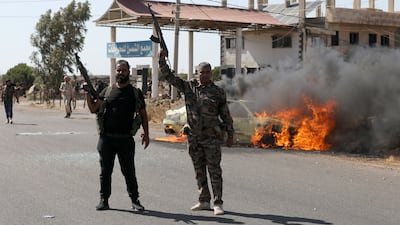
Armed men in front of a burning car near the site of clashes between Druze fighters and Bedouin tribesmen in Sweida, southern Syria. Getty Images -
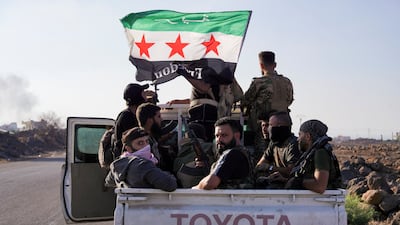
Members of Syria's security forces sit together in the back of a truck, amid fighting in Sweida. Reuters -
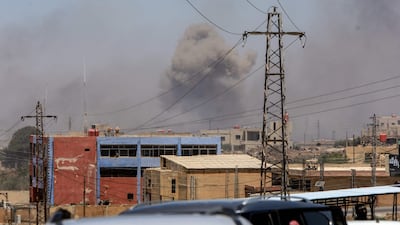
Smoke billows on the horizon during Israeli strikes near the city of Sweida. AFP -
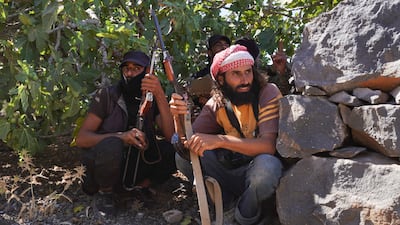
Armed men sit in wait in Sweida. Reuters -
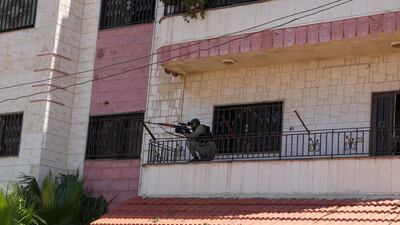
A member of Syria's security forces takes position in Sweida. AFP -
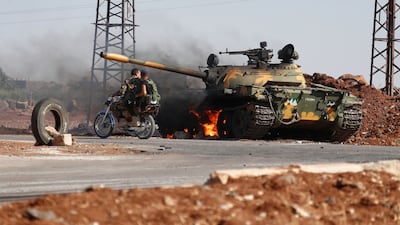
Syrian government soldiers pass a burning tank on the outskirts of Sweida city. Dozens of people were reported killed in the fighting. AP -
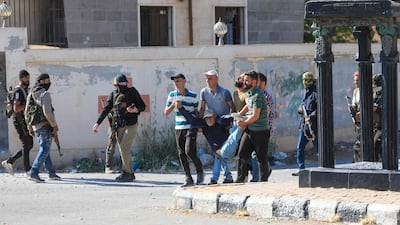
An injured man is carried away during clashes in an area between the villages of Mazraa and Walga, near the predominantly Druze city of Sweida. AFP -
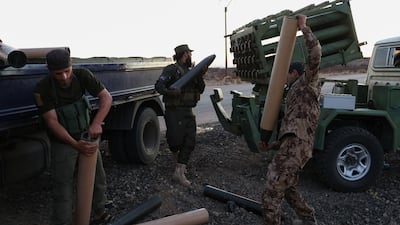
Syrian government forces prepare to fire a rocket launcher near Sweida. Getty images -
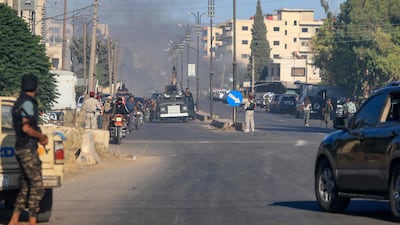
Members of Syria's security forces look on as smoke billows from clashes between Bedouin tribes and Druze fighters, between Mazraa and Walga. AFP -
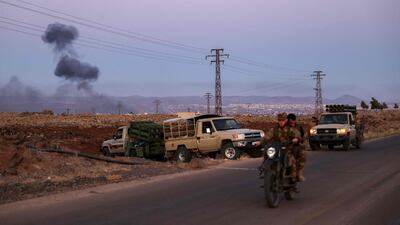
Smoke billows from Israeli air strikes in an area between Mazraa and Walga. Israel said it was acting in defence of the Druze minority. AFP -
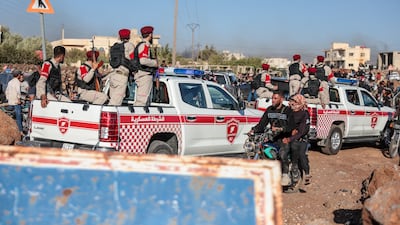
Syrian military police sent to the area. Government troops and auxiliary forces were among those killed in the fighting, said officials. EPA -
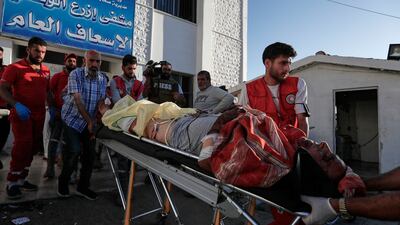
Syrian Red Crescent volunteers bring an injured man to Ezra Hospital, in southern Syria. AP


Druze sources said pro-Syrian government militias on Sunday launched attacks on Sweida from Sunni areas to its west as the province came under siege by government forces. A war monitor put the total death toll at 89 on Monday.
On Sunday, at least one Druze town was seized by militias from neighbouring Deraa, in the worst violence against the Druze community since clashes in April, sources said.
Sweida and parts of eastern Syria, where the mostly Kurdish Syrian Democratic Forces are in control, are the only areas where the government does not fully exert control.
The latest clashes in Sweida started last week after Fadlalah Duwara, a vegetable seller and member of the Druze community, was abducted while driving his lorry on the main road from Sweida to Damascus, which is under government control. His tribe responded by abducting a man in a Sunni neighbourhood of Sweida.
The area is inhabited by members of Bedouin tribes who moved to the city decades ago from a rugged region on the outskirts.

