
A police trooper holds a machine gun mounted on a patrol vehicle at the site of a rally held by protesters in Sanaa. Reuters

Houthis’ tactical upgrade in Red Sea attacks and what it means


  • English
  • Arabic

In only 48 hours, Yemen’s Houthi rebels have pulled off two sophisticated attacks on commercial ships in the Red Sea, combining armed boats, drones, rockets and missiles.

This marks a tactical shift from their earlier, simpler use of missiles and drones, stepping up into co-ordinated air-and-sea assaults meant to overwhelm basic defences on board the ships.

Here, The National looks at the attacks and what the tactical upgrade means:
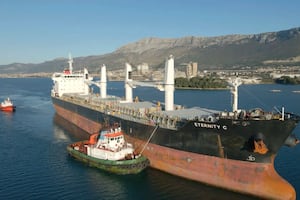
Magic Seas

Houthi fighters attacked the Liberian-flagged bulk carrier Magic Seas using fast, small boats equipped with rocket-propelled grenades and automatic weapons. At the same time, explosive-laden drone boats slammed into the hull.

Eternity C

A day later, the cargo vessel Eternity C was struck in nearly the same area of the Red Sea: armed skiffs unleashed bursts of gunfire, while explosive drones detonated around the deck. Missiles and small rockets were also used. Both ships sank.

Why it matters

  • Previously, the Houthis relied on missiles, single-use drones or occasionally boat-launched rockets. Now, they have wired these elements into a multipronged “swarm” approach, with surface boats, aerial drones, missiles, and firearms all converging on a single target
  • The simultaneous use of airborne and surface threats forces defenders to split focus, making interception more difficult
  • Captain Marvin Scott of the USS Dwight D Eisenhower told Janes magazine that the Houthis have “evolved from basic drone surveillance to co-ordinated, multi-domain assaults”. He explained they started off with simple unmanned aerial vehicles (UAVs) for intelligence, surveillance and reconnaissance, one-way attacks, and then anti-ship ballistic cruise and land-attack missiles. "They try now to co-ordinate and attack using multidomain and multiaccess," he added
  • There seem to be complaints of no naval backup in the area when the ships were attacked. In the absence of military assets in the Red Sea, private security guards stand between the Houthis and seafarers, said Joshua Hutchinson, managing director of intelligence and risk at maritime security firm Ambrey.

Wider context

This intensifying Houthi approach mirrors how Israel and others have engaged them.

Israel, for example, used about 20 aircraft to strike Houthi-controlled ports, power stations and even a captured ship after the Magic Seas attack, dropping more than 50 munitions in quick succession. According to a Yemeni source in Sanaa, these maritime strikes are not a deviation; they are part of a steady campaign aimed at Israel-linked ships.

Houthi supporters gather for a rally in solidarity with Iran and Palestinians, in Sanaa, Yemen's capital. AFP

The Houthis see themselves as part of an “Axis of Resistance” aligned with Iran, Hezbollah and Hamas, and they have vowed to continue pressing on with the fight, despite Israeli and US-UK strikes.

Their campaign resumed after a temporary pause. In May, President Donald Trump announced a truce and said the US would stop targeting Houthi positions after the group agreed to halt attacks. But the following month, after US strikes on Iran, the Houthis declared their intention to resume operations. The attack on the Magic Seas was their first major statement of return.

What it means for shipping

  • The Red Sea corridor, which normally handles 12 per cent of global trade and connects Europe to Asia, is once again a conflict zone
  • Dozens of major shipping companies have already diverted vessels, adding 10 to 14 days to journeys and up to $1 million in additional fuel per trip
  • Early last year, when the number of similar Houthi attacks surged, container traffic through the Suez Canal dropped by more than 50 per cent. The resulting delays and rerouting contributed to rising global shipping costs, insurance premiums and commodity prices, from crude oil to wheat
  • Naval coalitions, including the EU’s Operation Aspides and the US-led Prosperity Guardian, have stepped up patrols. But western officials acknowledge that defending against hybrid swarms is far more difficult than intercepting lone missiles.

In two days, the Houthis have shifted to a potent hybrid doctrine, pairing surface and air assaults in near-perfect synchronicity, experts say. They have adapted, elevating the dangers in the Red Sea and potentially forcing a recalibration of naval defence strategies.


Four reasons global stock markets are falling right now

There are many factors worrying investors right now and triggering a rush out of stock markets. Here are four of the biggest:

1. Rising US interest rates

The US Federal Reserve has increased interest rates three times this year in a bid to prevent its buoyant economy from overheating. They now stand at between 2 and 2.25 per cent and markets are pencilling in three more rises next year.

Kim Catechis, manager of the Legg Mason Martin Currie Global Emerging Markets Fund, says US inflation is rising and the Fed will continue to raise rates in 2019. “With inflationary pressures growing, an increasing number of corporates are guiding profitability expectations downwards for 2018 and 2019, citing the negative impact of rising costs.”

At the same time as rates are rising, central bankers in the US and Europe have been ending quantitative easing, bringing the era of cheap money to an end.

2. Stronger dollar

High US rates have driven up the value of the dollar and bond yields, and this is putting pressure on emerging market countries that took advantage of low interest rates to run up trillions in dollar-denominated debt. They have also suffered capital outflows as international investors have switched to the US, driving markets lower. Omar Negyal, portfolio manager of the JP Morgan Global Emerging Markets Income Trust, says this looks like a buying opportunity. “Despite short-term volatility we remain positive about long-term prospects and profitability for emerging markets.” 

3. Global trade war

Ritu Vohora, investment director at fund manager M&G, says markets fear that US President Donald Trump’s spat with China will escalate into a full-blown global trade war, with both sides suffering. “The US economy is robust enough to absorb higher input costs now, but this may not be the case as tariffs escalate. However, with a host of factors hitting investor sentiment, this is becoming a stock picker’s market.”

4. Eurozone uncertainty

Europe faces two challenges right now in the shape of Brexit and the new populist government in eurozone member Italy.

Chris Beauchamp, chief market analyst at IG, which has offices in Dubai, says the stand-off between between Rome and Brussels threatens to become much more serious. "As with Brexit, neither side appears willing to step back from the edge, threatening more trouble down the line.”

The European economy may also be slowing, Mr Beauchamp warns. “A four-year low in eurozone manufacturing confidence highlights the fact that producers see a bumpy road ahead, with US-EU trade talks remaining a major question-mark for exporters.”

Temple numbers

Expected completion: 2022

Height: 24 meters

Ground floor banquet hall: 370 square metres to accommodate about 750 people

Ground floor multipurpose hall: 92 square metres for up to 200 people

First floor main Prayer Hall: 465 square metres to hold 1,500 people at a time

First floor terrace areas: 2,30 square metres  

Temple will be spread over 6,900 square metres

Structure includes two basements, ground and first floor 

Vidaamuyarchi

Director: Magizh Thirumeni

Stars: Ajith Kumar, Arjun Sarja, Trisha Krishnan, Regina Cassandra

Rating: 4/5


Results
%3Cp%3E%0D%3Cstrong%3EElite%20men%3C%2Fstrong%3E%0D%3Cbr%3E1.%20Amare%20Hailemichael%20Samson%20(ERI)%202%3A07%3A10%0D%3Cbr%3E2.%20Leornard%20Barsoton%20(KEN)%202%3A09%3A37%0D%3Cbr%3E3.%20Ilham%20Ozbilan%20(TUR)%202%3A10%3A16%0D%3Cbr%3E4.%20Gideon%20Chepkonga%20(KEN)%202%3A11%3A17%0D%3Cbr%3E5.%20Isaac%20Timoi%20(KEN)%202%3A11%3A34%0D%3Cbr%3E%3Cstrong%3EElite%20women%3C%2Fstrong%3E%0D%3Cbr%3E1.%20Brigid%20Kosgei%20(KEN)%202%3A19%3A15%0D%3Cbr%3E2.%20Hawi%20Feysa%20Gejia%20(ETH)%202%3A24%3A03%0D%3Cbr%3E3.%20Sintayehu%20Dessi%20(ETH)%202%3A25%3A36%0D%3Cbr%3E4.%20Aurelia%20Kiptui%20(KEN)%202%3A28%3A59%0D%3Cbr%3E5.%20Emily%20Kipchumba%20(KEN)%202%3A29%3A52%3C%2Fp%3E%0A
Why are asylum seekers being housed in hotels?

The number of asylum applications in the UK has reached a new record high, driven by those illegally entering the country in small boats crossing the English Channel.

A total of 111,084 people applied for asylum in the UK in the year to June 2025, the highest number for any 12-month period since current records began in 2001.

Asylum seekers and their families can be housed in temporary accommodation while their claim is assessed.

The Home Office provides the accommodation, meaning asylum seekers cannot choose where they live.

When there is not enough housing, the Home Office can move people to hotels or large sites like former military bases.

SPECS
%3Cp%3E%3Cstrong%3EEngine%3A%20%3C%2Fstrong%3E4-litre%20flat-six%0D%3Cbr%3E%3Cstrong%3EPower%3A%20%3C%2Fstrong%3E525hp%20(GT3)%2C%20500hp%20(GT4)%0D%3Cbr%3E%3Cstrong%3ETorque%3A%20%3C%2Fstrong%3E465Nm%20(GT3)%2C%20450Nm%20(GT4)%0D%3Cbr%3E%3Cstrong%3ETransmission%3A%20%3C%2Fstrong%3ESeven-speed%20automatic%0D%3Cbr%3E%3Cstrong%3EPrice%3A%20%3C%2Fstrong%3EFrom%20Dh944%2C000%20(GT3)%2C%20Dh581%2C700%20(GT4)%0D%3Cbr%3E%3Cstrong%3EOn%20sale%3A%20%3C%2Fstrong%3ENow%0D%3Cbr%3E%3C%2Fp%3E%0A
Farage on Muslim Brotherhood

Nigel Farage told Reform's annual conference that the party will proscribe the Muslim Brotherhood if he becomes Prime Minister.
"We will stop dangerous organisations with links to terrorism operating in our country," he said. "Quite why we've been so gutless about this – both Labour and Conservative – I don't know.
“All across the Middle East, countries have banned and proscribed the Muslim Brotherhood as a dangerous organisation. We will do the very same.”
It is 10 years since a ground-breaking report into the Muslim Brotherhood by Sir John Jenkins.
Among the former diplomat's findings was an assessment that “the use of extreme violence in the pursuit of the perfect Islamic society” has “never been institutionally disowned” by the movement.
The prime minister at the time, David Cameron, who commissioned the report, said membership or association with the Muslim Brotherhood was a "possible indicator of extremism" but it would not be banned.

Skoda Superb Specs

Engine: 2-litre TSI petrol

Power: 190hp

Torque: 320Nm

Price: From Dh147,000

Available: Now

UAE currency: the story behind the money in your pockets
Brief scoreline:

Liverpool 2

Mane 51', Salah 53'

Chelsea 0

Man of the Match: Mohamed Salah (Liverpool)

Brief scores:

Arsenal 4

Xhaka 25', Lacazette 55', Ramsey 79', Aubameyang 83'

Fulham 1

Kamara 69'

The distance learning plan

Spring break will be from March 8 - 19

Public school pupils will undergo distance learning from March 22 - April 2. School hours will be 8.30am to 1.30pm

Staff will be trained in distance learning programmes from March 15 - 19

Teaching hours will be 8am to 2pm during distance learning

Pupils will return to school for normal lessons from April 5

Updated: July 10, 2025, 1:31 PM