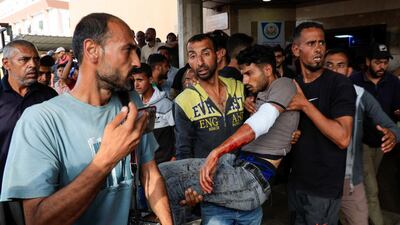
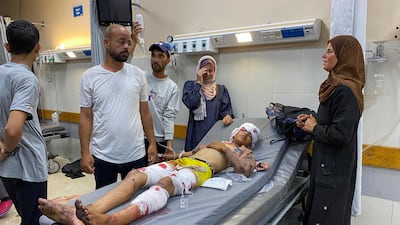
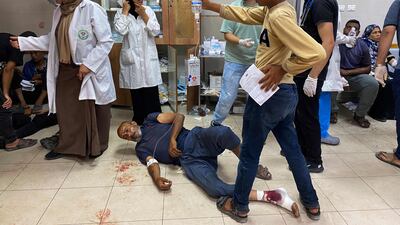
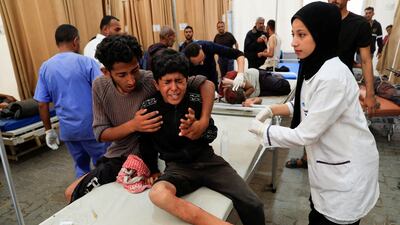
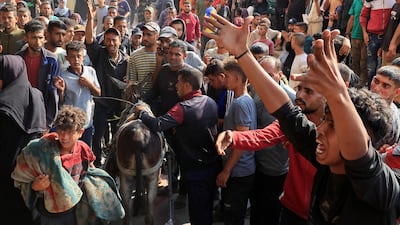
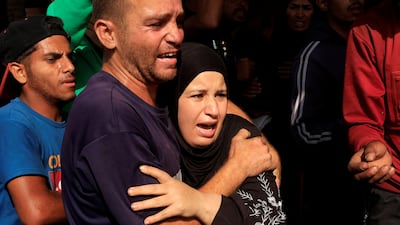
Fifty-nine Palestinians were killed in southern Gaza on Tuesday when Israeli tanks and drones fired on people waiting for aid lorries carrying food to arrive, authorities and witnesses said.
More were feared dead, while another 200 people were critically injured by the attack at Al Tahliya roundabout in the city of Khan Younis, the Gaza Health Ministry said.
Israeli warplanes bombed a home in the area before ground forces opened fire on a crowd of people waiting on food and other supplies, witnesses said.
“We’ve received around 60 martyrs already,” spokesman Dr Mohammed Saqr told The National. “The number is rising every moment. Many of the bodies are in pieces – that tells you what kind of weapons were used.”
There was no immediate comment from the Israeli army.
The shooting took place shortly after dawn as hundreds of displaced Palestinians gathered near an American aid distribution point by a desalination plant in hopes of a sack of flour or a few cans of food, witnesses said. Israeli tanks shelled the area, followed by heavy gunfire from drones, they told The National.
“Suddenly, the tanks started firing. People fell instantly. The place was chaos – blood everywhere, bodies lying on the ground,” said Mahmoud Wadi, 34.
He said he had been standing in a line for aid with his brother and three children when the killing started.
Ambulances could not reach the scene, so survivors used donkey carts and bicycles to evacuate the injured and dead, he added. “We carried our neighbours’ corpses in whatever we could find.”
At the hospital, floors were soaked with blood, while people wandered the hallways looking for relatives. Dr Saqr said staff struggled to treat dozens of patients with injuries they could not tend to properly because of inadequate equipment.
The hospital is one of the last functioning in southern Gaza and is stretched daily. Fuel shortages and the collapse of the health system have left doctors unable to perform life-saving surgery or provide basic care.
“If help doesn’t arrive immediately, more will die, not from wounds, but from the neglect forced upon us,” Dr Saqr said. “We are not asking for much. Just the chance to save lives.”
Yahya Barbakh, a former schoolteacher and father of six who has been sheltering in a tent in Gaza's Al Mawasi displacement zone, said his cousin and four neighbours were killed.
“I went to get food for my children. That’s all. I had no weapon. None of us did,” he told The National, his wounded leg bandaged. “The occupation starves us, sends us to these aid points, and then kills us in cold blood, while the whole world watches.”
Before the war broke out in October 2023, Mr Barbakh was a teacher in Khan Younis, a job that enabled him to provide for his family. “We lived with dignity once. Now, we die for aid,” he said.
Tuesday's crowd, he said, had been large but peaceful, waiting hours before the aid point opened. “They (Israeli troops) didn’t care. They just opened fire. It was slaughter.”
Gaza authorities and witnesses say Israeli troops have repeatedly opened fire in recent weeks on crowds trying to reach food distribution points run by a US and Israel-backed aid group, the Gaza Humanitarian Foundation, since its aid centres opened last month.
Local health officials say hundreds have been killed and thousands wounded over the past weeks. The Israeli army has said it fired warning shots at people approaching its troops in a “suspicious manner” during incidents.
On Monday, the Gaza Health Ministry said another 38 people were killed by Israeli fire while they were trying to collect food from GHF centres.
Israel allowed the GHF to start operations in late May after imposing a nearly three-month blockade on all aid into Gaza. It claims the new system, which has been condemned by the UN and international aid groups, is designed to stop supplies falling into the hands of Hamas.
UN agencies and major aid groups deny that there is widespread theft of aid by Hamas and have rejected the new system. They say supply cannot meet the population's demands and turns food into a weapon for Israel to carry out its military goals, including by moving Gaza's more than two million Palestinians into a “sterile” area in the south of the territory.
The limited amounts of aid being distributed at GHF's four sites have done little to alleviate hunger. More than 2,700 children under five face acute malnutrition, the UN's Palestinian relief agency UNRWA said on Monday. People have been fainting on the streets from hunger.
“The whole world knows this system is humiliating,” Mr Wadi told The National. “And every day, people die because of it. Yet it continues.”

Mercer, the investment consulting arm of US services company Marsh & McLennan, expects its wealth division to at least double its assets under management (AUM) in the Middle East as wealth in the region continues to grow despite economic headwinds, a company official said.
Mercer Wealth, which globally has $160 billion in AUM, plans to boost its AUM in the region to $2-$3bn in the next 2-3 years from the present $1bn, said Yasir AbuShaban, a Dubai-based principal with Mercer Wealth.
“Within the next two to three years, we are looking at reaching $2 to $3 billion as a conservative estimate and we do see an opportunity to do so,” said Mr AbuShaban.
Mercer does not directly make investments, but allocates clients’ money they have discretion to, to professional asset managers. They also provide advice to clients.
“We have buying power. We can negotiate on their (client’s) behalf with asset managers to provide them lower fees than they otherwise would have to get on their own,” he added.
Mercer Wealth’s clients include sovereign wealth funds, family offices, and insurance companies among others.
From its office in Dubai, Mercer also looks after Africa, India and Turkey, where they also see opportunity for growth.
Wealth creation in Middle East and Africa (MEA) grew 8.5 per cent to $8.1 trillion last year from $7.5tn in 2015, higher than last year’s global average of 6 per cent and the second-highest growth in a region after Asia-Pacific which grew 9.9 per cent, according to consultancy Boston Consulting Group (BCG). In the region, where wealth grew just 1.9 per cent in 2015 compared with 2014, a pickup in oil prices has helped in wealth generation.
BCG is forecasting MEA wealth will rise to $12tn by 2021, growing at an annual average of 8 per cent.
Drivers of wealth generation in the region will be split evenly between new wealth creation and growth of performance of existing assets, according to BCG.
Another general trend in the region is clients’ looking for a comprehensive approach to investing, according to Mr AbuShaban.
“Institutional investors or some of the families are seeing a slowdown in the available capital they have to invest and in that sense they are looking at optimizing the way they manage their portfolios and making sure they are not investing haphazardly and different parts of their investment are working together,” said Mr AbuShaban.
Some clients also have a higher appetite for risk, given the low interest-rate environment that does not provide enough yield for some institutional investors. These clients are keen to invest in illiquid assets, such as private equity and infrastructure.
“What we have seen is a desire for higher returns in what has been a low-return environment specifically in various fixed income or bonds,” he said.
“In this environment, we have seen a de facto increase in the risk that clients are taking in things like illiquid investments, private equity investments, infrastructure and private debt, those kind of investments were higher illiquidity results in incrementally higher returns.”
The Abu Dhabi Investment Authority, one of the largest sovereign wealth funds, said in its 2016 report that has gradually increased its exposure in direct private equity and private credit transactions, mainly in Asian markets and especially in China and India. The authority’s private equity department focused on structured equities owing to “their defensive characteristics.”
How to wear a kandura
Dos
- Wear the right fabric for the right season and occasion
- Always ask for the dress code if you don’t know
- Wear a white kandura, white ghutra / shemagh (headwear) and black shoes for work
- Wear 100 per cent cotton under the kandura as most fabrics are polyester
Don’ts
- Wear hamdania for work, always wear a ghutra and agal
- Buy a kandura only based on how it feels; ask questions about the fabric and understand what you are buying
'Top Gun: Maverick'
Rating: 4/5
Directed by: Joseph Kosinski
Starring: Tom Cruise, Val Kilmer, Jennifer Connelly, Jon Hamm, Miles Teller, Glen Powell, Ed Harris
The language of diplomacy in 1853
Treaty of Peace in Perpetuity Agreed Upon by the Chiefs of the Arabian Coast on Behalf of Themselves, Their Heirs and Successors Under the Mediation of the Resident of the Persian Gulf, 1853
(This treaty gave the region the name “Trucial States”.)
We, whose seals are hereunto affixed, Sheikh Sultan bin Suggar, Chief of Rassool-Kheimah, Sheikh Saeed bin Tahnoon, Chief of Aboo Dhebbee, Sheikh Saeed bin Buyte, Chief of Debay, Sheikh Hamid bin Rashed, Chief of Ejman, Sheikh Abdoola bin Rashed, Chief of Umm-ool-Keiweyn, having experienced for a series of years the benefits and advantages resulting from a maritime truce contracted amongst ourselves under the mediation of the Resident in the Persian Gulf and renewed from time to time up to the present period, and being fully impressed, therefore, with a sense of evil consequence formerly arising, from the prosecution of our feuds at sea, whereby our subjects and dependants were prevented from carrying on the pearl fishery in security, and were exposed to interruption and molestation when passing on their lawful occasions, accordingly, we, as aforesaid have determined, for ourselves, our heirs and successors, to conclude together a lasting and inviolable peace from this time forth in perpetuity.
Taken from Britain and Saudi Arabia, 1925-1939: the Imperial Oasis, by Clive Leatherdale
The burning issue
The internal combustion engine is facing a watershed moment – major manufacturer Volvo is to stop producing petroleum-powered vehicles by 2021 and countries in Europe, including the UK, have vowed to ban their sale before 2040. The National takes a look at the story of one of the most successful technologies of the last 100 years and how it has impacted life in the UAE.
Read part four: an affection for classic cars lives on
Read part three: the age of the electric vehicle begins
Read part one: how cars came to the UAE
UAE currency: the story behind the money in your pockets
Tips on buying property during a pandemic
Islay Robinson, group chief executive of mortgage broker Enness Global, offers his advice on buying property in today's market.
While many have been quick to call a market collapse, this simply isn’t what we’re seeing on the ground. Many pockets of the global property market, including London and the UAE, continue to be compelling locations to invest in real estate.
While an air of uncertainty remains, the outlook is far better than anyone could have predicted. However, it is still important to consider the wider threat posed by Covid-19 when buying bricks and mortar.
Anything with outside space, gardens and private entrances is a must and these property features will see your investment keep its value should the pandemic drag on. In contrast, flats and particularly high-rise developments are falling in popularity and investors should avoid them at all costs.
Attractive investment property can be hard to find amid strong demand and heightened buyer activity. When you do find one, be prepared to move hard and fast to secure it. If you have your finances in order, this shouldn’t be an issue.
Lenders continue to lend and rates remain at an all-time low, so utilise this. There is no point in tying up cash when you can keep this liquidity to maximise other opportunities.
Keep your head and, as always when investing, take the long-term view. External factors such as coronavirus or Brexit will present challenges in the short-term, but the long-term outlook remains strong.
Finally, keep an eye on your currency. Whenever currency fluctuations favour foreign buyers, you can bet that demand will increase, as they act to secure what is essentially a discounted property.
Our Time Has Come
Alyssa Ayres, Oxford University Press
Company profile
Name: One Good Thing
Founders: Bridgett Lau and Micheal Cooke
Based in: Dubai
Sector: e-commerce
Size: 5 employees
Stage: Looking for seed funding
Investors: Self-funded and seeking external investors
In-demand jobs and monthly salaries
- Technology expert in robotics and automation: Dh20,000 to Dh40,000
- Energy engineer: Dh25,000 to Dh30,000
- Production engineer: Dh30,000 to Dh40,000
- Data-driven supply chain management professional: Dh30,000 to Dh50,000
- HR leader: Dh40,000 to Dh60,000
- Engineering leader: Dh30,000 to Dh55,000
- Project manager: Dh55,000 to Dh65,000
- Senior reservoir engineer: Dh40,000 to Dh55,000
- Senior drilling engineer: Dh38,000 to Dh46,000
- Senior process engineer: Dh28,000 to Dh38,000
- Senior maintenance engineer: Dh22,000 to Dh34,000
- Field engineer: Dh6,500 to Dh7,500
- Field supervisor: Dh9,000 to Dh12,000
- Field operator: Dh5,000 to Dh7,000
Silent Hill f
Publisher: Konami
Platforms: PlayStation 5, Xbox Series X/S, PC
Rating: 4.5/5
COMPANY PROFILE
Name: Almnssa
Started: August 2020
Founder: Areej Selmi
Based: Gaza
Sectors: Internet, e-commerce
Investments: Grants/private funding
Farasan Boat: 128km Away from Anchorage
Director: Mowaffaq Alobaid
Stars: Abdulaziz Almadhi, Mohammed Al Akkasi, Ali Al Suhaibani
Rating: 4/5
UAE currency: the story behind the money in your pockets