Iranians drive past an anti-Israel poster in Tehran's Enghlab Square on June 14, 2025. AFP

'We were negotiating': Why Israel's attack caught Iran off guard


Lizzie Porter
  • English
  • Arabic

Less than a month ago in Tehran, senior Iranian diplomats engaged foreign journalists and analysts with a clear message: Iran sought dialogue, not confrontation. It wanted better relations with its Middle Eastern neighbours, they said, and, under the right conditions, with western nations with which it had long been at odds.

There was some optimism – albeit very cautious – about the prospects of reaching an agreement with the US for limitations on its nuclear programme in exchange for much-needed sanctions relief.

Senior officials past and present stressed that Iran and its neighbours needed to look at what was possible, rather than be constantly on the look out for perils.
“One of my criticisms of my own country is that we have to depart from a threat-based perspective,” one former senior official said in a background briefing. “We want an opportunity-based outlook, not a threat-based outlook.”

In a glossy cobalt blue book of essays that accompanied the Tehran Dialogue Forum, a conference held by an Iranian Foreign Ministry-affiliated think tank, former Foreign Minister Ali Akbar Salehi argued that US President Donald Trump was hesitant to drag the US into more wars. Saber-rattling would keep Iran on its toes and strengthen Washington’s negotiating position “without actually unleashing a ruinous conflict”, Mr Salehi wrote.

Iran's President Masoud Pezeshkian at the Tehran Dialogue Forum on May 18. AFP

Iranian officials attempted to emphasise diplomacy, knowing well that Israel favoured military options, and the US had threatened action should nuclear talks collapse. In the following weeks, Iranian officials and observers made clear that they believed Israel wanted to strike, and that any attack could not take place without US knowledge and backing.

“We will immediately respond to the Zionist regime's possible attack on the country's nuclear facilities,” Iran’s Supreme National Security Council said in a statement last week, before the Israeli strikes began.

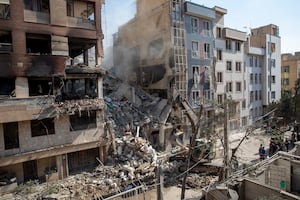
A man rides his motorcycle in Tehran past a poster displaying the portraits of Iranian military generals and nuclear scientists killed in Israel's attack on June 13. AFP

Iranian officials and analysts did not expect an attack to happen while there were active plans for more negotiations. US and Iranian officials have been planning to meet for a sixth round of discussions in the Omani capital Muscat on Sunday.

“We were in a limited negotiation process and did not expect military [action],” a senior Iranian government foreign policy researcher told The National on Friday. “In fact, the Israeli regime sabotaged the diplomacy entirely with military action.”

Hassan Ahmadian, assistant professor of West Asian Studies at the University of Tehran, said that “Israeli warmongering against Iran was obvious and so the attack was never ruled out at any point”.

“Yet many in Iran believed that now the US had chosen dialogue with Tehran, it wouldn’t unleash the Israelis against it,” he told The National.

That moment came quicker than expected, though. For many in Iran, diplomatic talks have not yet failed, although they were facing significant headwinds over differing stances in Tehran’s rights to uranium enrichment. President Trump appeared to justify Israel’s attacks, which he later said took place with Washington’s knowledge, by noting that a 60-day deadline he had imposed for nuclear talks to succeed had ended on Thursday.

The point is that we were in a diplomatic process and we expected the other side to respect this joint diplomatic effort.
Iranian government foreign policy researcher

Some observers argue that Iran miscalculated the time it had available for negotiations, and Israel’s willingness to really go through with an attack.

In Tehran, however, many believe Israel miscalculated too, encouraged by what they see as international inertia over its bombing campaigns in Palestine, Lebanon and Syria. And because of the perception of US complicity, Washington is being held responsible as well.

“It's not about underestimating [Israel],” the government foreign policy researcher said. “The point is that we were in a diplomatic process and we expected the other side to respect this joint diplomatic effort.”

The US president was swayed from diplomacy to not saying no to military action, Iranian officials believe.

Influence of, "Zionist lobbies" on the US government and "extremists" in US decision-making frameworks "should be considered the reason for this change in approach and finally, Israel carried out this attack," a second senior Iranian government official told The National.

Israel’s multipronged attack on Iran’s nuclear and defence infrastructure has dramatically changed the playing field.

As it pledged, Iran has responded, and there is room for further escalation if the exchange of strikes and counterstrikes continues. It has named its continuing strikes against Israel as “Operation True Promise 3”, linking it to previous operations of the same name on the country.

Unlike past responses, which carefully balanced force with restraint to avoid spiraling escalation, such caution may now be less of a priority.

Buildings hit during a ballistic missile attack by Iran in Rishon Lezion, Israel, on Saturday, June 14. Bloomberg

Iran’s response cannot be similar to what happened in October or April 2024,” a regional source close to Iranian thinking and military circles, told The National. “The proportionate retaliation must be strong enough to deter further Israeli aggression.”

The escalation has endangered both the possibility of nuclear talks continuing and the likelihood of them succeeding, even if they resume. Iran’s position on attending the negotiations scheduled for Sunday is unclear, its Foreign Ministry spokesman said on Saturday. The framework of thinking in Iran is shifting from diplomacy to war, observers believe.

“I suspect it’s [Iran’s] preferred diplomatic approach not to go ahead in parallel with the continuing military confrontation with Israel,” said Mr Ahmadian. “And so, it’s war now – diplomacy can only come afterwards.”


If you go

Flight connections to Ulaanbaatar are available through a variety of hubs, including Seoul and Beijing, with airlines including Mongolian Airlines and Korean Air. While some nationalities, such as Americans, don’t need a tourist visa for Mongolia, others, including UAE citizens, can obtain a visa on arrival, while others including UK citizens, need to obtain a visa in advance. Contact the Mongolian Embassy in the UAE for more information.

Nomadic Road offers expedition-style trips to Mongolia in January and August, and other destinations during most other months. Its nine-day August 2020 Mongolia trip will cost from $5,250 per person based on two sharing, including airport transfers, two nights’ hotel accommodation in Ulaanbaatar, vehicle rental, fuel, third party vehicle liability insurance, the services of a guide and support team, accommodation, food and entrance fees; nomadicroad.com

A fully guided three-day, two-night itinerary at Three Camel Lodge costs from $2,420 per person based on two sharing, including airport transfers, accommodation, meals and excursions including the Yol Valley and Flaming Cliffs. A return internal flight from Ulaanbaatar to Dalanzadgad costs $300 per person and the flight takes 90 minutes each way; threecamellodge.com

Starring: Jamie Foxx, Angela Bassett, Tina Fey

Directed by: Pete Doctor

Rating: 4 stars

The biog

Favourite food: Tabbouleh, greek salad and sushi

Favourite TV show: That 70s Show

Favourite animal: Ferrets, they are smart, sensitive, playful and loving

Favourite holiday destination: Seychelles, my resolution for 2020 is to visit as many spiritual retreats and animal shelters across the world as I can

Name of first pet: Eddy, a Persian cat that showed up at our home

Favourite dog breed: I love them all - if I had to pick Yorkshire terrier for small dogs and St Bernard's for big

Who's who in Yemen conflict

Houthis: Iran-backed rebels who occupy Sanaa and run unrecognised government

Yemeni government: Exiled government in Aden led by eight-member Presidential Leadership Council

Southern Transitional Council: Faction in Yemeni government that seeks autonomy for the south

Habrish 'rebels': Tribal-backed forces feuding with STC over control of oil in government territory

The candidates

Dr Ayham Ammora, scientist and business executive

Ali Azeem, business leader

Tony Booth, professor of education

Lord Browne, former BP chief executive

Dr Mohamed El-Erian, economist

Professor Wyn Evans, astrophysicist

Dr Mark Mann, scientist

Gina MIller, anti-Brexit campaigner

Lord Smith, former Cabinet minister

Sandi Toksvig, broadcaster


UAE v Zimbabwe A, 50 over series

Fixtures
Thursday, Nov 9 - 9.30am, ICC Academy, Dubai
Saturday, Nov 11 – 9.30am, ICC Academy, Dubai
Monday, Nov 13 – 2pm, Dubai International Stadium
Thursday, Nov 16 – 2pm, ICC Academy, Dubai
Saturday, Nov 18 – 9.30am, ICC Academy, Dubai

Abu Dhabi GP schedule

Friday: First practice - 1pm; Second practice - 5pm

Saturday: Final practice - 2pm; Qualifying - 5pm

Sunday: Etihad Airways Abu Dhabi Grand Prix (55 laps) - 5.10pm

Mercer, the investment consulting arm of US services company Marsh & McLennan, expects its wealth division to at least double its assets under management (AUM) in the Middle East as wealth in the region continues to grow despite economic headwinds, a company official said.

Mercer Wealth, which globally has $160 billion in AUM, plans to boost its AUM in the region to $2-$3bn in the next 2-3 years from the present $1bn, said Yasir AbuShaban, a Dubai-based principal with Mercer Wealth.

Within the next two to three years, we are looking at reaching $2 to $3 billion as a conservative estimate and we do see an opportunity to do so,” said Mr AbuShaban.

Mercer does not directly make investments, but allocates clients’ money they have discretion to, to professional asset managers. They also provide advice to clients.

“We have buying power. We can negotiate on their (client’s) behalf with asset managers to provide them lower fees than they otherwise would have to get on their own,” he added.

Mercer Wealth’s clients include sovereign wealth funds, family offices, and insurance companies among others.

From its office in Dubai, Mercer also looks after Africa, India and Turkey, where they also see opportunity for growth.

Wealth creation in Middle East and Africa (MEA) grew 8.5 per cent to $8.1 trillion last year from $7.5tn in 2015, higher than last year’s global average of 6 per cent and the second-highest growth in a region after Asia-Pacific which grew 9.9 per cent, according to consultancy Boston Consulting Group (BCG). In the region, where wealth grew just 1.9 per cent in 2015 compared with 2014, a pickup in oil prices has helped in wealth generation.

BCG is forecasting MEA wealth will rise to $12tn by 2021, growing at an annual average of 8 per cent.

Drivers of wealth generation in the region will be split evenly between new wealth creation and growth of performance of existing assets, according to BCG.

Another general trend in the region is clients’ looking for a comprehensive approach to investing, according to Mr AbuShaban.

“Institutional investors or some of the families are seeing a slowdown in the available capital they have to invest and in that sense they are looking at optimizing the way they manage their portfolios and making sure they are not investing haphazardly and different parts of their investment are working together,” said Mr AbuShaban.

Some clients also have a higher appetite for risk, given the low interest-rate environment that does not provide enough yield for some institutional investors. These clients are keen to invest in illiquid assets, such as private equity and infrastructure.

“What we have seen is a desire for higher returns in what has been a low-return environment specifically in various fixed income or bonds,” he said.

“In this environment, we have seen a de facto increase in the risk that clients are taking in things like illiquid investments, private equity investments, infrastructure and private debt, those kind of investments were higher illiquidity results in incrementally higher returns.”

The Abu Dhabi Investment Authority, one of the largest sovereign wealth funds, said in its 2016 report that has gradually increased its exposure in direct private equity and private credit transactions, mainly in Asian markets and especially in China and India. The authority’s private equity department focused on structured equities owing to “their defensive characteristics.”

Updated: June 18, 2025, 11:42 AM