

Live updates: Follow the latest on Israel-Gaza
Israel freed 183 more Palestinian detainees after Hamas handed over three more Israeli hostages on Saturday in the fifth hostage-prisoner swap to take place under the terms of the Gaza ceasefire deal.
The Israeli hostages were released in Deir Al Balah in central Gaza, where they were handed over to Red Cross officials amid a strong presence of fighters from Hamas's armed wing, Al Qassam Brigades.
The hostages, Ohad Ben Ami, 56, Eli Sharabi, 52, and Or Levy, 34, were delivered by Al Qassam Brigades' Shadow Unit, taken onto a stage and asked to speak before being led to three vehicles for transfer to Israel.
"I tell the families of the hostages to continue until the deal is implemented. I want them to go home and the only way for this return is by the completion of the deal," said one of the hostages.
"And for the continuation of the second and third phase of the deal, I tell Israel to go [forward with] the deal - and for both nations to live in peace. We are being released now - and I request that the second and third phase of the deal is continued," he added.
"I thank Al Qassam [Brigades] for giving us food and water and keeping us safe."
Unlike the hostages released earlier, all three men appeared frail and emaciated.
Mr Sharabi was kidnapped from Kibbutz Be’eri in southern Israel during the October 7, 2023 Hamas-led attacks that sparked the war. His wife and children were killed in their home and he was taken captive along with his brother, Yossi, who has since been confirmed dead by Hamas.
Mr Ben Ami was taken from the same kibbutz along with his wife, who was released during a week-long ceasefire in November 2023.
-
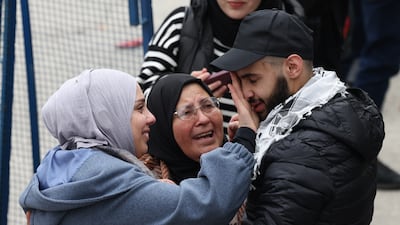
A Palestinian released from Israeli detention is welcomed on arrival in Ramallah, in the occupied West Bank. EPA -
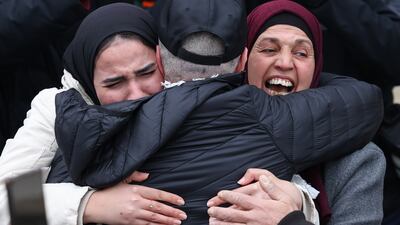
A Palestinian embraces loved ones in Ramallah after being released from an Israeli jail. EPA -
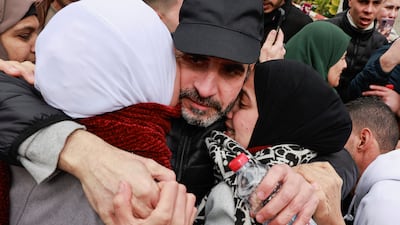
Families reunite as dozens of Palestinians arrive in Ramallah, after being released from Israeli prisons. Reuters -

Palestinian prisoners are greeted by their loved ones. AP Photo -
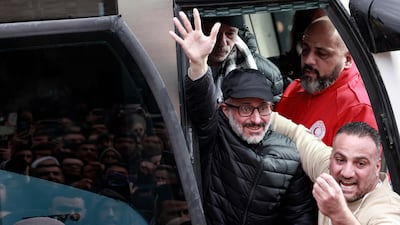
A former Palestinian prisoner released by Israel waves to a cheering crowd. AFP -
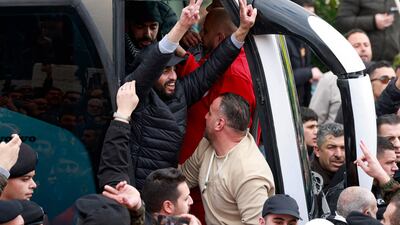
A former Palestinian prisoner released by Israel flashes the victory sign. AFP -
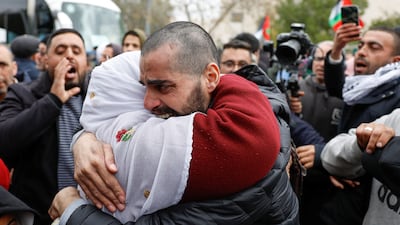
A freed Palestinian prisoner is greeted by a loved one. Reuters -
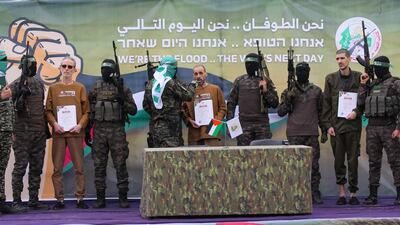
Left to right, Ohad Ben Ami, Or Levy and Eli Sharabi are the latest hostages to be released. AFP -

Mr Ami was held in Gaza since the deadly October 7, 2023 attack. Reuters -

Mr Sharabi is released by Hamas militants. Reuters -

Michal Cohen, front left, the mother of Ohad Ben Ami, joins other relatives to celebrate Ohad's release from captivity. Getty Images -

Families and supporters celebrate the release of Ohad Ben Ami and Eli Sharabi, who were taken from Kibbutz Be'eri and held in Gaza since the October 7, 2023 attack. Reuters -

Relatives of Israeli hostage Eli Sharabi watch on television preparations for his release. AFP -

The Red Cross team arrives ahead of the release of hostages. Reuters -
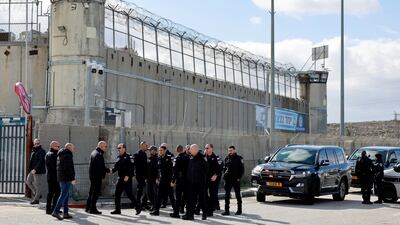
Members of Israeli forces gather outside the Israeli military prison, Ofer. Reuters -

In Tel Aviv, people wait to watch a livestream on a big screen reporting on the release of Israeli hostages Eli Sharabi, Or Levy and Ohad Ben Ami, to be transferred from Hamas to the Red Cross. EPA -
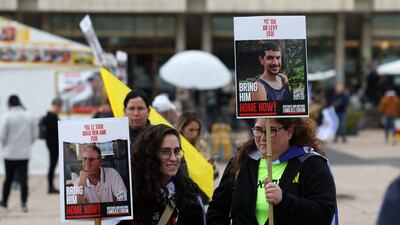
Supporters in Tel Aviv hold posters bearing a pictures of Ohad Ben Ami, left, and Or Levy, two of three Israeli hostages to be released by Hamas. AFP -
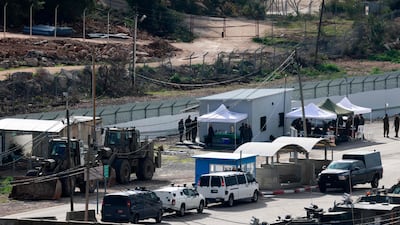
Israeli troops and vehicles inside Ofer military prison, between Ramallah and Beituniya in the occupied West Bank, awaiting the release of Palestinian detainees as part of an exchange on February 8. AFP


Mr Levy was taken from a music festival near Kibbutz Re’im. His wife was killed during the attack.
Israeli President Isaac Herzog said the condition of the three hostages was “a crime against humanity” and showed the urgency of completing the ceasefire deal to ensure the return of all those being held in Gaza.
“This is what a crime against humanity looks like!” Mr Herzog wrote in a post on X.
“We take solace in the fact that they are being returned alive to the arms of their loved ones,” he said, and added that completing the hostage deal “is a humanitarian, moral and Jewish duty”.
Israeli Prime Minister Benjamin Netanyahu's office issued a statement warning of a response to the "harsh conditions" of the hostages.
Gaza suffered severe food shortages during the 15 months of war as Israel placed restrictions on the flow of aid into the small Palestinian enclave. Several children starved to death, the UN said last month.
Hours after the hostages were released, buses carrying the 183 Palestinian detainees left Israel's Ofer prison. Eight were to be sent into exile, a condition Israel applied to some of the most high-profile prisoners, while 111 were returned to Gaza and released at the European Hospital in Khan Younis. The rest were freed in the West Bank city of Ramallah.
Israel earlier raided homes in the occupied West Bank of the prisoners being released and warned their families against public celebrations, according to the Palestinian Detainees Media Office, which posted a video of one of the raids online.
The health of at least seven Palestinian detainees released in Ramallah was so poor that authorities transferred them to hospital for immediate attention, the Palestine Red Crescent said.
Hamas accused Israel of adopting a policy of "slow killing" of Palestinians inside its jails.
"The fact that seven prisoners were transferred to hospitals immediately after their release... reflects the systematic assaults and mistreatment of our prisoners by the Israeli prison authorities," Hamas said.
Hamas and the allied Palestinian Islamic Jihad group have now released 16 of the 33 Israel hostages to be freed during the six-week initial stage of the ceasefire, which began on January 19. Another 73 are believed to remain in captivity, but the Israeli military says 34 of them have died.
Talks on the second stage of the ceasefire and a permanent end to the fighting were supposed to start this week but have been overshadowed by US President Donald Trump's suggestion that America take over and redevelop Gaza after resettling its population to Arab countries in the region.
Arab states have strongly rejected Mr Trump's plan, which he announced on Tuesday during a joint press conference in Washington with the Israeli Prime Minister, who was scheduled to return to Israel on Saturday night.

